

Guest blogged by Desi Doyen
Today marks the 5th anniversary of Hurricane Katrina slamming into the Gulf Coast at New Orleans, Louisiana, on August 29th, 2005. What the Category 3 hurricane did not destroy, the man-made disaster finished off, drowning much of the beloved city, killing over 1800 people, and displacing over a million more, many permanently.
There are many ways to look at what happened five years ago today and in the horrifying days and weeks that followed. There are successes and plenty of failures to document for history. There are surely lessons to be learned, but have we even come close to learning the most important one?…
The national corporate media have been airing special coverage of the anniversary to varying degrees — with the notable exception of Fox “News” — offering a number of ultimately-optimistic packages on what happened then, and what has happened since, attempting to make sense of it all, grounded in the inspirational resilience of Gulf Coast residents.
Some are telling the story of the appalling lack of progress in rebuilding New Orleans and the Gulf Coast. Mac McClelland of Mother Jones — who has ferociously covered the BP oil disaster from on the ground in the Gulf — offers a sobering and eloquent view of the current state of the rest of post-Katrina New Orleans and describes what she sees as the media “Sticking a Happy Face on Katrina” [emphasis added]…
…
[A] couple of months ago, I brought one of my friends from San Francisco here to visit me-a gal who ingests a lot of news-and she could not believe the extent of the destruction she saw. It’s awfully irresponsible to say all that stuff about recovery without also mentioning that you can’t even count the blocks that are still half-full of empty, broke-down houses, or that [Brad] Pitt’s 50 new houses dot an area that lost 4,000-an area people sometimes compare to Hiroshima because its torn-up roads, total lack of streetlights, and abundance of overgrown lots contribute to a vast and penetrating emptiness…
(Mac’s Twitter feed is also a must-follow, along with all of Mother Jones’ stable of crack environmental writers.)
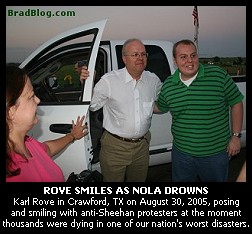 The BRAD BLOG was in Crawford, Texas, in the days before, while, and after Hurricane Katrina made landfall, broadcasting live from on the ground at “Camp Casey”, Cindy Sheehan’s Iraq War protest outside George W. Bush’s “ranch,” where we caught Karl Rove posing for photos with fans on Sept. 1, as New Orleans was drowning.
As Brad described during last Thursday’s Green News Report, when the bulletin from the National Weather Service came over the wire while we were on the air, the warning was so unusually vivid and specific, that at first it seemed a hoax, or at least an exaggeration. He wouldn’t read it on air until he had verified that it was for real. Sadly, it was…
URGENT – WEATHER MESSAGE
NATIONAL WEATHER SERVICE NEW ORLEANS LA
1011 AM CDT SUN AUG 28 2005
…DEVASTATING DAMAGE EXPECTED…
.HURRICANE KATRINA…A MOST POWERFUL HURRICANE WITH UNPRECEDENTED STRENGTH…RIVALING THE INTENSITY OF HURRICANE CAMILLE OF 1969.
MOST OF THE AREA WILL BE UNINHABITABLE FOR WEEKS…PERHAPS LONGER. AT LEAST ONE HALF OF WELL CONSTRUCTED HOMES WILL HAVE ROOF AND WALL FAILURE. ALL GABLED ROOFS WILL FAIL…LEAVING THOSE HOMES SEVERELY DAMAGED OR DESTROYED.
THE MAJORITY OF INDUSTRIAL BUILDINGS WILL BECOME NON FUNCTIONAL. PARTIAL TO COMPLETE WALL AND ROOF FAILURE IS EXPECTED. ALL WOOD FRAMED LOW RISING APARTMENT BUILDINGS WILL BE DESTROYED. CONCRETE BLOCK LOW RISE APARTMENTS WILL SUSTAIN MAJOR DAMAGE…INCLUDING SOME WALL AND ROOF FAILURE.
HIGH RISE OFFICE AND APARTMENT BUILDINGS WILL SWAY DANGEROUSLY…A FEW TO THE POINT OF TOTAL COLLAPSE. ALL WINDOWS WILL BLOW OUT.
AIRBORNE DEBRIS WILL BE WIDESPREAD…AND MAY INCLUDE HEAVY ITEMS SUCH AS HOUSEHOLD APPLIANCES AND EVEN LIGHT VEHICLES. SPORT UTILITY VEHICLES AND LIGHT TRUCKS WILL BE MOVED. THE BLOWN DEBRIS WILL CREATE ADDITIONAL DESTRUCTION. PERSONS…PETS…AND LIVESTOCK EXPOSED TO THE WINDS WILL FACE CERTAIN DEATH IF STRUCK.
POWER OUTAGES WILL LAST FOR WEEKS…AS MOST POWER POLES WILL BE DOWN AND TRANSFORMERS DESTROYED. WATER SHORTAGES WILL MAKE HUMAN SUFFERING INCREDIBLE BY MODERN STANDARDS.
THE VAST MAJORITY OF NATIVE TREES WILL BE SNAPPED OR UPROOTED. ONLY THE HEARTIEST WILL REMAIN STANDING…BUT BE TOTALLY DEFOLIATED. FEW CROPS WILL REMAIN. LIVESTOCK LEFT EXPOSED TO THE WINDS WILL BE KILLED.
AN INLAND HURRICANE WIND WARNING IS ISSUED WHEN SUSTAINED WINDS NEAR HURRICANE FORCE…OR FREQUENT GUSTS AT OR ABOVE HURRICANE FORCE…ARE CERTAIN WITHIN THE NEXT 12 TO 24 HOURS.
ONCE TROPICAL STORM AND HURRICANE FORCE WINDS ONSET…DO NOT VENTURE OUTSIDE!
A young mom from Metairie (next to New Orleans), stopped by the table where we broadcasting late on that long summer night in Central Texas, where the weather had finally begun to cool, thanks to the very winds which would devastate the Gulf. She was still dazed from her long drive and the terrifying foreknowledge of the city’s vulnerability. She knew it might be days before getting word from her mother, a hospital nurse, who had stayed behind at her post to protect critical care patients.
“I didn’t know where else to go. So I came to see Cindy… to be around the people,” she told us, her voice trailing off, as her two little boys played in the prairie grass nearby.
Contrary to the Bush Administration’s excuse for the federal government’s epic failure in responding to the disaster — claiming “no one could have predicted” how devastating a direct hit would be — scientists had indeed predicted exactly that, years earlier…
A major hurricane could swamp New Orleans under 20 feet of water, killing thousands. Human activities along the Mississippi River have dramatically increased the risk, and now only massive reengineering of southeastern Louisiana can save the city…
But the hurricane itself hadn’t devastated New Orleans. In the 12 hours or so after the storm had moved on, we falsely believed we had dodged a bullet.
And then the levees failed. It was the one factor the scientists missed in their calculations: the man-made tipping point. The storm hadn’t breached the levees. The levees simply began to fail.
Hurricane Katrina’s destruction would be followed within weeks by two more named hurricanes, Wilma and Rita, pushing 2005 into the top spot as the year with the highest number of named hurricanes. NASA data would ultimately show 2005 as the warmest year on record.
As we take a moment to reflect on this anniversary, and ponder the good, the bad, and the unfinished business, we would do well to take heed of what we hadn’t by the Summer of 2005: warnings from scientists today.
Science was right about the long-term consequences of human activities altering the processes of the Mississippi Delta — that dredging, development, and levees were killing the marshes and wetlands that once buffered New Orleans from hurricane storm surge.
Now the scientific community is warning us again — and has been for some time — that rising global temperatures due to the rapid release of heat-trapping greenhouse gases from human activities are altering our climate.
Among many negative consequences, they predict this rapid warming will lead to more extreme and intense weather events, and 2010 — already the hottest January-July on record to date — has more than delivered. So far, 2010 is in second place for the most number of countries that have set extreme heat records, and it’s only August.
Scientists have been right in specific predictions of many of the extreme weather events of this year of extremes: the record heat wave and forest fires in Russia; record flooding in Pakistan, China, Nashville, the UK; record-breaking snowstorms and heat waves across the United States and Europe; the loss of sea ice in a warming Arctic…
As we’ve seen in the aftermath of Katrina in New Orleans, and as we’re seeing now, this year, around the world and in our own backyard, these extreme weather events also hold a warning: to prepare our emergency response, recovery and infrastructure for these impacts.
The question now is: is anyone listening?
Desi Doyen is the Co-host & Managing Editor of The BRAD BLOG’s Green News Report.




















For those familiar with the utterly corrupt nature of “disaster capitalism” the “appalling lack of progress in the rebuilding of New Orleans and the Gulf Coast” does not come as any more of a surprise than the appalling lack of progress in the rebuilding of Iraq, especially since much was carried out by the same companies.
As the high winds departed, KBR rushed in, securing a $12 million, no-bid contract to repair the naval station in Gulfport, Mississippi, which, in what Jeremy Scahill described as a “sick irony,” just happened to be the location that the long-vacationing Dick Cheney, the former Haliburton CEO turned vice president chose to kick off his tour of the devastation.
KBR, Scahill noted, traveled “throughout the region assessing damage to…the pumps in New Orleans and the infrastructure of the city….They [set up the] same kinds of camps that we [saw] in Guantanamo and Iraq…to service the rebuilding of the Gulf…”
According to Pratap Chatterjee, Halliburton secured no-bid contracts in the Gulf region through the commander of the Army Corps of Engineers, Carl Strock, who was the same man who provided the no-bid Halliburton Iraq contracts, and then demoted Bunny Greenhouse for blowing the whistle.
Naomi Klein contended that, by the time Katrina struck, “reconstruction” had become a standing, multi-billion dollar industry. Halliburton, Bechtel and Flour all secured pre-signed, no-bid contracts.
Klein reported on a September 15, 2005 meeting in which members of the radical-right, which included a Republican study group and the Heritage Foundation, mapped out a strategy for turning the Katrina disaster into an opportunity to “experiment” in the application of neo-liberal policies. This included a suspension of the Davis-Beacon prevailing wage laws, the conversion of the Gulf region into a “flat-tax free enterprise zone,” an opening up of the Artic Wildlife Refuge to oil exploration, coupled with subsidies for the oil industry, all of which, according to Klein. entailed a massive transfer of public wealth to private hands paid for by radical cuts in such things as the Medicare prescription drug benefit, thereby re-victimizing the very people the relief funds were intended for.
One of the first things the radical privatizers inside the Bush/Cheney cabal did was to fire all of New Orleans’ public school teachers and to then redirect public aid monies into for-profit, private charter schools.
Although, per Bill Quigley, a law professor at New Orleans’s Loyola University, “public housing in New Orleans” entailed “some of the most structurally sound property…in the entire city,” in June 2006 Scott Keller, Deputy Chief of Staff for the Department of Housing and Urban Development, announced that more than 5,000 public housing units for the poor were to be demolished.
Per Quigley, this was part of “a national policy to destroy public housing and replace it with this euphemism of ‘mixed-income housing,’ which…means they take conventional public housing, destroy it and then allow about 10% of the people who used to live there to come back, but it is a great bonanza for developers, for real estate people, for banks….”
Quigley lamented that New Orleans had “become a laboratory†for privatization; that none of the public institutions that were destroyed by Katrina were rebuilt. He warned that while it may not come as fast elsewhere, those who are advancing it intend to impose privatization on the rest of the country.
Quigley’s allegations were confirmed when Greg Palast visited New Orleans nearly a year after the disaster.
Displaced residents were not only prevented from returning to devastated areas but from returning to a perfectly good public housing, “gorgeous, two-and three story townhouses,†untouched by the floodwaters—housing that had been had been boarded up with metal plates.
Patricia Thomas, an African American resident whom Palast assisted in breaking into her own home, complained, bitterly, “Katrina didn’t do this. Man did this. Katrina didn’t come in my house and put these gates up on my windows….Katrina didn’t have me walking out here looking for somewhere I could stay….This was man-made.â€
Comedian Marc Maron summed up the disastrous aftermath of Katrina as “Strip mining the poor people of New Orleans to get at the valuable real estate underneath.”
That was back in 2006. He couldn’t have been more prescient.
DES~! I LOVE Marc Maron! Used to hang with (read: worship) him at the Improv years ago in NYC, when he was a YOUNG, cynical, prescient comic.
Always so smart.
He plays UCB all the time, you know. Has his own podcast: ‘WTF’. I’ll give you a shout next time I’m going down to catch his act (read: stalk him with my decades long professional crush.)
What have we learned? Look at the Gulf now. There is no longer any pretense that our government works to protect us.
Everyone from the Coast Guard, the EPA, NOAA and the administration of the US federal government take their orders from BP. We are nakedly a corporatocracy and everyone just yawns. Move along, nothing to see here, eat your fresh Gulf shrimp, no oil here anymore…
It wasn’t just the alternative press that reported the open desire of Republicans to cleanse New Orleans of its black and poor people. I clearly remember a Wall Street Journal article that laid it out for everyone to see. Unfortunately, I can’t seem to find it (isn’t that always the way?), but I did find a WSJ Washington Wire report reprinted by Raw Story (Congressman Hurricane finally cleaned out public housing in New Orleans) that gives the flavor of what was being said at the time.
Why is everyone so shy about what they know really happened this time five years ago in New Orleans? Days after Katrina, FEMA was cutting the communication lines in Jefferson Parish. That is why communications were fragmented after the storm. It was FEMA either sabotaging land lines or other Federal agencies jamming radio communications.
Who said FEMA was cutting the communication lines after Katrina? Jefferson Parish president Aaron Broussard on Meet the Press, that’s who.
Also, Katrina had passed New Orleans when the levees mysteriously collapsed. Residents said the air was calm, and they though they had made it, when suddenly they heard explosions, THEN the water started to enter the city.
You might also be interested to know that Katrina hit New Orleans with Category 1-2 winds, NOT Category 3 or 4 winds. And the Category 2 gusts that hit New Orleans were on the LOWER end of Category 2 winds. There is no way that the levees breached several hours after Katrina hit New Orleans with Category 1-2 winds.
FEMA lied about the bridges being down after Katrina hit. As we all know now, they weren’t! Many of us know this because the NOPD were shooting anyone in the back who were trying to escape via those bridges. The most famous incident being the Danziger Bridge Massacre.
Did you watch the Frontline episode on the NOPD shootings after Katrina hit? Well, as usual the media asks ZERO questions. We now know that the police lied about responding to gun fire at the Danziger Bridge. Now, it doesn’t take a high IQ to know that the next question that should follow is: Then if you weren’t responding to gun fire on the Danziger Bridge, who told you to shot civilians in the back who were crossing the bridge? But Frontline (or even Brad Blog) restrain themselves from asking such obvious questions.
You see, the reason the NOPD were shooting people on the bridges was because the FEMA buses hadn’t arrived yet. Those FEMA buses would take desperate residents of New Orleans not to safe areas within Louisiana, but to Utah, Texas, Virginia, Colorado. Anywhere but Louisiana, where the odds of getting back to New Orleans would be assured, assuming one wanted to return.
Those poor black and white folk were placed on cattle buses, while the media watched and knew what was happening, leaving abandoned properties that had been for decades coveted by real estate developers.
“The Big Uneasy”–In New Doc, Harry Shearer Makes the Case that Katrina Was an Unnatural Disaster
My New Orleans. Though I’ve lived and work now for many years, New Orleans is my home. Some of my family is still reeling from the storm. Much of the city is still a wasteland, peppered here and there by homes. Drive thru the outlying areas, away from the Quarter and it’s a little bit lonesome. It’s difficult to live there. But do I wanna go back? Oh yeah. shw