
Guest Blogged from Sacramento by Emily Levy of VelvetRevolution.us (with assistance from Michelle Gabriel, photos by Bill Lackemacher of Sacramento for Democracy) from the public hearing on 7/30/07, called by California Secretary of State to receive comments on her landmark “Top-to-Bottom review” of the state’s electronic voting systems. No internet access was available in the hearing room, so I wasn’t able to live blog as I’d hoped. I did, however, take copious notes, which are posted in full below this brief summary.
ED NOTE: The video of the hearing, which was not easily available as it streamed live today, is now posted here and here. But I recommend Emily’s detailed description below for a great deal of value-added content and perspective! And it’s faster! – BF
Note: Story very slightly updated with some corrections in the spelling of names, plus one substantive correction regarding Jim Soper’s testimony (the very last one in the entire article).
 SACRAMENTO – California Secretary of State Debra Bowen made opening remarks, followed by an overview of the Top-To-Bottom Review by the chief investigator, Matthew Bishop, University of California Davis (UCD) Professor of Computer Science.
Following that, each of the three vendors whose machines went through the Top-To-Bottom Review were given 30 minutes to respond to the report. Diebold went first and only took about five of the 30 minutes, followed by Hart Intercivic and Sequoia.
I’m absolutely thrilled to report that Sequoia knows just how to solve the problems found in the Top-To-Bottom Review: California should just by newer systems from them!
After lunch was the public comment period, the longest part of the hearing. I’ve paraphrased and sometimes quoted the comments of just about every person who testified (including my own testimony). There were maybe 25 or 30 county election officials present, many of whom spoke. Freddie Oakley of Yolo County, an election integrity hero, spoke in favor of the Top-To-Bottom Review and said we bought these systems to accommodate voters with special needs and disabilities and “we have let them down in the most appalling way†by certifying systems with such obvious defects and continuing to use them despite those defects.
I believe every other elections official spoke critically of the Top-To-Bottom Review, most criticizing Bowen for not including county elections officials in the review, not reviewing policies and procedures as part of the Top-To-Bottom Review, and conducting the review in a laboratory setting rather than a real election setting. (I, in contrast, think our elections in recent years have been nothing but one giant beta test!)
It will take some scrolling to find my notes on the remarks of the many election integrity advocates who spoke. Most spoke late in the day, probably because they signed up later, after the pre-hearing press conference they held outside the Secretary of State’s office building. But it’s worth the scrolling, because many important things were said. Many of the EI advocates encouraged Secretary Bowen to decertify not just the three election systems tested, but all electronic voting systems. Many advocated for hand-counted paper ballots. Testimony was frequently backed up with credentials, experience, statistics and technical information. The depth and breadth of expertise in the election integrity movement continues to amaze me. (Note: I’ve posted my own comments in full because I had them available. If others who spoke would like their testimony posted in full, I invite them to paste them into the “comments†section of this blog item.)

Several people with disabilities and advocates for people with disabilities spoke. Some, notably Jennifer Kidder, spoke about the importance of election integrity. Kidder said, “The purpose of any equal opportunity legislation is to get marginalized voices heard,†and went on to note that this purpose is defeated if, after voting privately and independently, the vote of a disabled voter is changed by an electronic voting system.
Most of the people with disabilities and their advocates, however, cautioned against going “back†to paper ballots, saying that would be a move in the wrong direction in terms of the accessibility of voting systems. In general, they were supportive of the types of mitigations recommended by the accessibility team of the Top-To-Bottom Review, despite the findings that none of the systems tested actually met the federal accessibility standards as required by law.
Secretary of State Debra Bowen’s office is accepting public comments by email until Wednesday, August 1 at VotingSystems@sos.ca.gov On Friday, August 3, Bowen will announce what actions she will take in light of the Top-To-Bottom Review. We can only hope that she remembers why she was elected, and will take bold action to protect California’s elections.
Detailed notes on the hearing appear below. Where I have paraphrased a speaker, I have done so in the first person, sometimes making my own [occasionally snarky] comments inside square brackets. I hope this isn’t confusing…
Secretary of State (SOS) Debra Bowen is making introductory comments. One system [ES&S InkaVote] not included in review because they were so late submitting materials. She’ll be dealing with that in the coming days. One regret about this project is time. Moving California’s primary to February is a good thing for voters who want a voice in the presidential race, but compacted the time for the Top-To-Bottom Review. Friday [Aug 3] is the legal deadline for her to make certain (unspecified) decisions. Refers to voting equipment “known to have unresolved flaws.†Waiting until 2010 was not an option.
Review is but one piece of the puzzle. Reviewers were not asked to do forensic analysis of past election, or look for malicious code, the classic needle-in-the-haystack problem. Time constraints didn’t allow for this.
Some of the vulnerabilities found may already be protected by already-adopted mitigations. Some are new and may be able to be mitigated as well. Security strongest when built in, which is why review looked at systems as they were certified, without mitigations. First determine whether system is secure, then determine if it can be made secure. If you have a leaky roof you can mitigate the problem with a tarp or buckets, but if you call a roofer out to take a look they’re going to look at structural integrity of entire roof absent buckets and tarps. Then you’ll have to decide if you want to pay to repair the roof, get a whole new roof, or whether you want to move.
We have to determine whether underlying problems can be corrected within constraints of certification process, whether they can be mitigated, or whether some are so serious that systems should not be used.
Top-To-Bottom Review is a means to an end: “We want to be able to have secure, accurate, reliable and accessible elections and we want to be able to verify them. We want to be able to have confidence in the results of the electoral process.â€
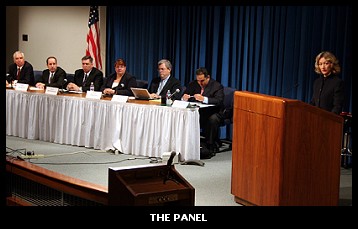
Members of the Panel included:
Lowell Finley, Assistant Secretary of State
Judith Carlson, Elections Division Counsel
Bruce McDannold (don’t know his current title)
Chris Reynolds, Dep. Secretary of State for HAVA activities
One other person on panel whose name I didn’t catch.
Matthew Bishop, UCD Professor of Computer Science will be presenting the report. Announced that Prof. David Wagner would have been presenting on source code, but isn’t going to because that report has not yet been made public.
Matthew Bishop
Presenting results from accessibility and red team reports only, not source code reports which Bowen is reviewing to make sure they don’t expose information that needs to be kept secure. There were two red teams, “Team Bob†and “Team UCSB.†Members names listed at Secretary of State website, “Top-To-Bottom Review”.
Accessibility study: Reviewed all three types of voting systems. Goal was to identify whether systems were sufficiently accessible for voters with a range of disabilities and language access needs. They were also to look at possibilities for both short- and long-term mitigations. They did live subject testing with 45 test voters with a variety of disabilities and language needs. Although some of the systems could be used by some voters with a variety of disabilities, none were fully accessible for all voters with disabilities.
They looked at physical access, especially for voters in wheelchairs and voters with manual dexterity disabilities. Printers had negative impact on privacy and accessibility. Blind voters cannot directly verify the VVPATs [“Voter Verified Paper Audit Trails’]. One system’s VVPAT blocked physical access to the machine. A simple short-wave receiver could be used to listen in on audio ballot on one of the systems! There’s much more. (See full report) Conclusion: The three tested voting systems all substantially non-compliant with HAVA and VVSG guidelines. Discussion of mitigations (see report)
“Red Team” [Hack] Study: Background about what a red team study is: People have said it’s like handing someone the keys to your car and inviting them to steal it. Not a good analogy. Better question is how can a thief steal a car if they steal the keys, or even without the keys? Specific goal of red team was to identify and document specific types of vulnerabilities. Attacks that could come from a voter, poll worker, election official, vendor, etc. Did not evaluate policies and procedures. Didn’t have the time, and each of California’s 58 counties have their own. Also even the best policies and procedures in the world are worthless if not carried out effectively.
With a couple of the attacks they did, it requires significant expertise to devise it but very little to carry it out.
The common belief that secrecy is protection is not accurate. It is in fact a very porous layer of security.
All systems used in elections in California have to be certified. Independent Testing Authorities [federal ITAs] do testing of systems to make sure they comply. Quality of standards is inadequate. Questions raised about the testing of the ITAs, in particular Ciber. There are issues in certification.
Concerns with this study: Time. We had five weeks, not enough to do a complete review, but we were extremely thorough with what we did. Also lack of info provided by vendors. One ballot box wasn’t delivered until July 18. This means that results of this study should be seen as a lower bound, what we could find under these conditions. With more time and more complete info, we may have been able to find more. “All team members felt that they would have found more.â€
What kind of threats? Attacker modifies firmware. Inject firmware, then deliberate mis-recording of voter’s vote.
Time: 10:39a. Recorded description of firmware attack.
Election management systems run on non-secure platform (Windows.)Results:
Sequoia: Breached physical security, overrode firmware. Vendor has proprietary operating system, which one might think would make it more secure, but we found the opposite. Testers were able to detect when system was in test mode and when in election mode. Able to access election management system and inject malicious software, could forge update cartridges and voter cards.Diebold: Server was configured as it would be to a county, vulnerable to well-known exploits, compromised using widely-available software. Not all security related actions were logged. Physical security: bypassed locks, disabled printer but machine could continue to record votes. Default key is very widely known.
Hart InterCivic: A bit trickier because election management system could be installed with a variety of operating systems, so that wasn’t the best use of testers’ time. However, did find that they could get access to undocumented account. Able to override firmware and _____________ Tempest attack succeeded: an electronic listening device, standing well away from the Hart E-slate, could hear votes that voter was casting using audio access feature. He keeps saying read the public reports.
Both teams felt security mechanisms inadequate to ensure security and integrity of systems. Vendors should assume that systems used in completely untrusted environments, which would provide another layer of security. This is not an insult to anyone. Policies and procedures must be carried out effectively and should be part of design of the system, seen as an integral part of the use of these systems. For example, what if you depend on tamper-proof tape and an attacker buys some off the Internet? In general, security should be part of the design and implementation of system, not added on after the fact. Incompatibilities can cause extreme security problems. (Other recommendations went by too fast for me to catch.)
(I notice that Bishop is talking as if these systems are going to continue to be used. )
Tests like this must be done before certification by federal and state officials.
Lowell Finley: Asks Bishop to explain firmware. It’s the type of software that runs on these particular machines, the voting units and the scanners, touch screen, Hart E-Slate, Diebold AccuVote OS, etc.
(E-scan is an optical scanner system.) JVC (Judges’ Vote Control?) is the system that prints out access code for each voter.
Bruce McDannold: Asks Bishop to elaborate on potential consequences of overwriting firmware not just for current election but future ones?
Bishop: Programmer could allow system to be completely vulnerable. “A nasty person†could alter the firmware so wrong vote could be recorded, could change how things are counted, could flip election results, etc. Might or might not be detectable on paper trail. If firmware isn’t fixed, corrupted firmware would continue to run on that machine. This is an example of how crucial policies and procedures are.
Chris Reynolds: Asks clarification about attacks being difficult to design, easy to carry out.
Bishop: Carrying it out would require access to one point of election process to carry out attack.
CR: Asks if auditing is considered a layer of security.
Bishop: Yes. Audits should be designed in with the system as part of security mechanism.
McDannold asks about which attacks affect one machine, which affect more. Bishop says he can’t talk about that without going into the part of the findings that isn’t public.
-
Vendor Responses (30 minutes per vendor, then panel can ask clarifying questions)
Diebold, Hart, then Sequoia
Rob Norcross from Diebold Election Systems:
He’s reading Kathy Rogers’ statement, as she couldn’t get here because of storms in the southwest. He starts off talking about their system’s ability to reduce voter errors! They’re thoroughly reviewing report that they received Friday and will sit down with Secretary of State staff later in the week (I think he said after reviewing private portion of report.) Same old, same old about how they should have had a voting official involved in tests, all systems are vulnerable under these conditions, etc. Testing was not on most recent version of system. Diebold has upgraded software, which has been “federally certified but has not yet been certified in California.†“We are pleased to participate in the review. We enjoyed the cordial and professional relationship with your staff and members of the Top-To-Bottom Review team.†He spoke only a few of the 30 minutes allotted! (Can I have the rest of your minutes, Rob? There are a few things I’d like to say.)
Panel questions: How much different might results have been if done on most recent version?
Norcross: “Personally, I’m not sure.†(He got pulled in to read statement at last minute.) Many of the findings are similar to previous investigation of the system reviewed and have since been mitigated. [Trust us.]
Hart Intercivic:
Norm _________
E-slate first used in 2000 election. Now installed in 300+ jurisdictions nationally. In 2003 they noticed that public demanded higher security for e-voting systems. [I missed part of what he said.] “Systems security must be evaluated in terms of probabilities and likelihoods.†Higher security results in increased system costs, operating costs and complexity, “yielding reduced usability.†Talks about finding acceptable and reasonable balance. He’s complaining about the way the red teams did the Top-To-Bottom Review. [You can’t complain that someone breaks up with you, so you have to complain about how they did it, right?] “Electronic systems have typically been held to an absolute standard, which is unreasonable while vulnerabilities of other [methods?] have been ignored.†Hart analyzed security of paper ballot systems and, guess what? Found some vulnerabilities! (Distract poll worker, steal ballots, etc.)
He says, there can be stronger security, but will the increased complexity be understood? “Is ballot data public information? If so, can it be obscured from public view?†He says this is a question they’ve been trying to get answered for years and will probably eventually been resolved in court.
Hart would have preferred to have been given time to train red team on use of the system, including their system called “SERBO†(sp?) System verification is part of that and was apparently not understood by red team. He talks about something that nullifies the attack scenario that was used in the report. Didn’t quite follow it. (Time: 11:28a)
“It’s been a difficult couple of years for voting system vendors.†He complains that they’re being forced to work in a vacuum. “We need to come together and solve [problems] as one.â€
“We have a duty to our customers and the public to protect the integrity of the system.†Who are their customers, again? I forget. Wants public inspection designed by Organization for Internet Safety. (What’s this?)
Vendors can’t pay for reviews as that will taint the outcome. Counties don’t have the money. They think philanthropic organizations should get involved.
Says there are errors and omissions in report that must be addressed before decisions made.
“This report is an important tool but must be used responsibly.â€
Panel has no questions for him.
Sequoia:
Steven Bennett
Sequoia equipment currently used in 21 of California’s 58 counties. Begins by complaining about the environment in which the review was conducted, that it was a “worst case†evaluation, not a real world scenario. “The red team has no corresponding blue team,†“friendly study.†[Honey, you had that. It was called the ITA process!] Testing assumes insiders have unfettered access, which he says isn’t true. Cameras in warehouses, audit logging, laws that make tampering with election equipment felonies. [Nobody in the government would dare break a law, now, would they?] “All that we have proven is that computerized systems, removed from the environment and placed almost literally out in the street…†can be compromised.
Vendors clearly have another opportunity to give feedback to the Secretary of State’s office.
Talked about how much there was a need to try the hacks in a real election environment. [Not that they’ve tested their mitigations that way or anything.]
Yellow-button attack easily prevented in a number of ways, disabling of yellow button, placement of machine for supervision by poll workers, placing physical seal over button to prevent it from being pressed until authorized, etc.
He says California’s parallel testing deals with the issue raised by the red teams of their ability to determine whether systems were in test mode or election mode.
He’s going through the report, item by numbered item, and refuting things, talking about all the mitigations that mean the findings are, as far as Sequoia is concerned, irrelevant. Hard to follow without having the report in front of me. But it’s very detailed, and those who want to should try to listen to or watch his testimony and review it in detail.
He says it’s false that voters don’t check the paper trails. [see MIT/Caltech study showing most voters don’t check paper trail; see Rice University study showing that two-thirds of voters don’t notice electronic vote-flipping when reviewing their vote.]
He says it is impossible for malicious software to get into a system, mitigated by virus and spyware protection.
“Sequoia concludes that none of the threats outlined represent a realistic threat if [security measures available are in place].†[Note: see comment below about Alameda County.] [Oh, now he has a great idea! All these problems should be fixed by…(drum roll, please) buying updated systems from Sequoia! I feel much better now.]
LF: Are you familiar with videotape that was made of first use of Sequoia VVPAT in Nevada in 2004? [response: yes] Are you aware that elections officials in California agreed that a significant number of voters did not look at the VVPAT? [response: not aware of that]
Public testimony will be after lunch. [Doing my best with the spelling of people’s names. Apologies for errors.]
Speakers from the public are given three minutes each, but some people signed up and then ceded their time to other speakers.
Phillip Harlan
Blind computer person, worried about security, preserving our democracy. I know there are going to be some blind groups here who don’t care as much about security as whether I can cast my ballot independently. I’m more concerned about security, including internally. “It’s more important that our votes are counted correctly than whether I cast one on an absentee ballot or machine, or whether I cast one with assistance.â€
Eve Roberson
Former CA election administrator for 15 years. Understands concerns of RoVs today that machines may not be able to be used. However, the reason they may not be used is critical. Machines sold to counties based upon false representation that they could be used for the purpose for which intended, honest elections. The vendors knew or should have known that their machines were never safe from hacking. I believe firmly that the RoV’s have right to return machines to vendors and to get full refund of the purchase price. Non-computerized, affordable machines are available and there’s time to use them by next election. Op-scans could be used to count these paper ballots. “I urge the Secretary of State to ban these corrupted computerized voting machines for use in any election to be held in the state of California.â€
Stuart Schy
Top-To-Bottom Review much needed. Retired electronics engineer/computer consultant with 20+ years working with disabilities community. Involved in Logic & Accuracy testing of voting systems in his county. HAVA does not mandate purchase of e-voting equipment. We need to know how helpful HAVA equipment has been with voters with disabilities.
Steve Weir
President of California Assoc. of Clerks and Elections Officials. Asks county clerks to stand up. Maybe 25-30 of them. Some will be speaking. He supported the idea of Top-To-Bottom Review before primary was moved. Says we lost opportunity to do methodical process. Says they offered to help and were excluded [NOTE: Bowen also excluded herself from the process so that her bias would not effect the outcome]. Says Top-To-Bottom Review “more about headlines than legitimate science…†If source code wasn’t reviewed, we’ve missed an opportunity and created a public policy blunder. People deserve to know if there’s malicious code in our systems in California. Complains about how study was conducted. The public has been deprived of knowing what real world issues are since testing was done in laboratory setting. Previous studies have shown that machines have counted the votes properly. This was not a comprehensive Top-To-Bottom Review. Unhappy that RoVs, who he says represent poll workers, were not included. There’s not one shred of evidence that one voter has had their vote compromised. There’s no smoking gun here. [That’s part of the problem, dude.] He does think there are some good ideas in the report.
Candy Lopez
Contra Costa Co. Assistant Registrar of Voters (RoV). Because Top-To-Bottom Review didn’t take procedures into account, public is left with “the false impression that undetected tampering is possible in an election.â€
Greg Taber
Riverside Co. “Please decertify the Sequoia voting system used by our county.†We cannot rely on election workers’ integrity. He worked on auditing paper receipts from 2006 election. “I was shocked†at the discrepancies we found. (Missing cartridges, etc.) 21% of precincts had serious problems, only 6% were complete. This situation has not resulted in any disciplinary action. (“You’re doing a heckuva job, Brownie,†Greg Taber quotes.)
Kathy Darling
Elected County Clerk and RoV in Shasta Co. No election officials included in review process. Could have helped particularly in accessibility report, because they know about how they help with some of the things that were found to be problems. Mentions that machinery her county received in 2003 was noted in the review as apparently new and not in use by existing systems. This goes to show the lack of context in which some of these tests were performed.
Alan Dechert
Open Voting Consortium. You’ve got the patient on the table and it’s cut open. You can’t just stitch it back up. “The patient on the table is democracy herself.†“The public has a right to all the information about how the voting system works.†“Should we continue with a voting system that protects trade secret [methods?]†Or should we move to a completely public system? “We are done with secrets. We need a solution.â€
Brent Turner
Open Voting Consortium. Submitted a statement by Jim March saying that this situation needs to be brought into the realm of criminal justice/consumer fraud. Brent says get rid of propriety systems, have hearings on open source, paper ballot systems. Discusses Open Voting Consortium and Open Voting Solutions. “There is no way to tend to the fixes.†“Now that we’ve confirmed the vulnerabilities we must seek solutions.†Says hand counting is part of open source systems.
Emily Levy
Secretary Bowen,
Thank you for the strength and courage that has brought you to this moment.
I fear that, even after months of testing, there’s still an elephant in the room that has not been tackled. Even if you and your staff could plug every hole in physical and software security, and the voting systems were made fully compliant with the accessibility requirements of HAVA, it would still not be safe to use these systems. Why not? Because even if they were absolutely protected from hacking, the systems and therefore our elections could still be rigged. There is no way to provide an absolute safeguard against electronic voting systems being delivered to the counties and presented to the voters already compromised. For this reason alone, these systems and others like them must never again be used in our elections.
The irresponsibility and lack of ethics of the vendors has been amply shown:
They have misrepresented their products.
They have installed uncertified software.
They have cut corners in developing the security of their systems.
Clearly they are not guided by ethics or commitment to the public good. Clearly they have other priorities.
Is it so unbelievable, then, that they might rig an election?
We shouldn’t be thinking of how we can make these systems work, we should be thinking of how we can make our elections work.
We have a crisis in voter confidence that can only be solved by creating a true basis for voter confidence. Only transparency and public involvement can save our democracy now.
Perhaps more than any other human being in this country, you, Secretary Bowen, are in a position to take bold, decisive action that will reverberate around this nation and turn it in its tracks. The next step is to decertify these machines, to send these vendors packing and tell them not to come back. Not with another promise, not with another model, and not with another roll of toilet paper.
The people of California, the people of the United States, the people of the world are counting on you.
Emily Levy
VelvetRevolution.us
Mark Keenberg
Talks about discrepancy between software in escrow and software in use. [I’m still shaking from speaking truth to power, so can’t quite hear him.]
Darrell Forslin
RoV of Trinity Co., using op-scan and Diebold TSx. They’re on their 3rd variety of touch-screens. Pleased to see reviews being done, wishes they’d also reviewed procedures because that’s where he needs help. Testers said that with more time they think they’d have found more vulnerabilities, and he’s concerned that they’re going to mitigate what they found and it won’t be enough. Agrees that policies and procedures should be considered a part of the system. Should look at these and see if they mitigate the vulnerabilities that were found.
Another election official (missed his name)
If Bowen decertifies machines and the elections are a mess it will be her fault.
Conny McCormack
[not sure if the following is the same person or the next speaker]
RoV/Recorder/Co. Clerk in L.A. County, before that San Diego, before that Dallas. Notes that report done in absence of mitigation strategies. No assessment of likelihood of voter going into polling place with common office tool or what poll workers might do. No comparison with paper ballot systems, ease of ballot box stuffing, ease of “attempted fraud.†“Handling paper is really difficult in the electoral process.†We need to move forward. HR 811 and S. 1487 would mandate paper trails and manual auditing that California already doing. Says David Jefferson called her to ask about manual auditing process in L.A. Their November 2006 audit involved hand-counting half a million to one million votes (I don’t think she means that many ballots, but counting each vote on each ballot as one vote.) Cost was two hundred something thousand.
Deborah Seiler
New RoV in San Diego Co. [and former Diebold sales rep!] San Diego Co. has successfully run its elections using Diebold systems. [Finally some news!] “San Diego voters have expressed confidence in their voting system.†There are nine voting systems in use in state and only three were tested. What if the vulnerabilities in the other six systems are greater than the vulnerabilities of those tested? She’s concerned that Bowen’s going to decertify the systems that were tested and leave the other systems in use, it seems. [I agree that wouldn’t make sense.] “It’s important to note that no malicious code was found during the review.†[I believe they didn’t look for it either, but no need to mention that.] Refrain from taking precipitous action until all systems reviewed and security measures are made a part of that review. Institute parallel monitoring. Send Secretary of State staff to county offices to work together. And a few other recommendations.
Dennis Floyd
San Diego Co., volunteer poll worker. Hand counting would take three and a half to four hours, poll workers can’t do that after already working a long day.
Dan Kysor
(missed his affiliation)
“The right to a private, independent and verifiable method of voting must not be sacrificed in the attempt to resolve the outstanding issues with respect to …DRE machines.†The Top-To-Bottom Review fails to consider the legal rights of voters with disabilities. Recommend temporary certification of all systems. No one’s working on accessibility of VVPATs to blind and visually impaired voters. A timeline benchmark approach is the prudent way forward.
Julie Bustamonte
Lassen Co. Clerk/Recorder/RoV. We take our jobs very seriously. No matter how hard the job gets, we always get the job done. [This really is commendable. Absolutely.] “Please don’t throw the baby out with the bathwater.â€
Dave McDonald
Chief Info for Alameda Co. for over 20 years, now RoV. This is too important to rush. Talks about the security of the vote counting room. (If you picture the opening credits of “Get Smart,†you’ll get the idea.)
Julie Rudderwald
Clerk of San Luis Obispo Co., restating stuff said before.
Terry Hansen
Clerk/Recorder/RoV of Yuba Co. adding her voice to the consensus (so far) of the county clerks/recorders/RoVs who have already spoken. “Credibility and trust does not come from chaos.â€
Kelsey Ramage
Horrified with what’s happening with our voting systems. Credibility is shot. Companies are compromised. Machines are compromised.
Gail Work
Election Integrity Committee of San Mateo County Dem. Central Committee. Mentions Ohio, Sarasota. Cozy relationships of vendors and county officials, voting machine sleepovers with pollworkers/breaking chain of custody, election certified in San Diego before votes actually counted. Need audits with 99% scientific certainty. Attention to chain of custody. “Voters deserve complete assurance that every vote is counted as cast.†Talks about how hugely expensive these systems are and how they are draining local coffers. “This democracy belongs to the citizens and the voters of California. It is not for sale.â€
Ann Barnett
Another RoV, missed which county. We do have a bit of a Catch 22. We should respond to the reports but the detail we need hasn’t been released, and rightfully so. No risk assessment has been done. Brings political posturing and emotional responses without practical value.
Ana Acton
(Missed which county) Center for Independent Living. Don’t rescind certification. Accessibility is not perfect but is greater than we had with previous systems. Decertification would be a step backward. She recommends that all types of systems that come to California go through accessibility testing and says that AutoMark hasn’t.
Judy Alter
Colorful description of what a mess things actually were in polling place she observed. Presents a pile of petitions.
Gail Pellerin
RoV, Santa Cruz Co. We’re all in same boat together. We conduct ourselves as nonpartisan caretakers of our democracy. Talks about what public can observe. We are passionate about the elections process and precious gift of voting. Want everyone to vote. Feels frustrated when people don’t vote because they think their vote won’t count. She’s confident in Sequoia system used in Santa Cruz Co and says “I can guarantee that every eligible vote is counted accurately”. [Oh, really?] Talks about recent grand jury investigation of Santa Cruz Co. voting system and concluded that system is fair, accurate and secure.
Freddie Oakley
Elected Clerk/Recorder of Yolo Co. representing voters in her county who appreciate Top-To-Bottom Review. She believes it truly has support of her voters for the Top-To-Bottom Review. Compares the last few months to “an annual physical after you’re 50.†They let you know what’s wrong and help you lead a better life (quit smoking, get exercise, etc.). Now we know what’s wrong, to some extent, and can make a plan to fix ourselves. I was skeptical about these systems anyway. And I’m truly shocked at the accessibility report. Legs on booth aren’t far enough apart to meet minimum standards for ADA. We bought these systems to accommodate voters with special needs and disabilities and “we have let them down in the most appalling way†by certifying system with such obvious defects and continuing to use them despite those defects. Thanks Bowen and also the other clerks.
Clark Boots [Beautz?]
Placer Co. (director of info or something) Encourage Secretary of State on mitigation policies and procedures before making any decisions.
Phillip ____
Election Services Coordinator, Santa Clara Co. We all need to smile. This is an opportunity to show off what we do and strengthen the numerous safeguards we already employ.
Next up is the Placer County group, which signed up for and ceded to each other a total of 45 minutes
[couldn’t hear names of some of the speakers] Security of our voting systems much be considered in the context of policies and procedures.
_____, Asst. Registrar/Recorder, Placer Co., Diebold county. “We are sworn to protect and defend the Constitution of the State of California and the Constitution of the United States.†We take that seriously.
Jim McCauley
[Placer registrar, I think]
Nobody’s ever come to Placer Co. to look at my procedures. “Should you trust me? No. I’m an insider. I need to earn your trust.†I’ve never been a fan of touchscreen voting, not because it doesn’t work, not because it doesn’t count properly.†It’s expensive. But I wanted my disabled voters to be able to vote. So I had focus groups of disabled voters in my office. System of choice we’ve heard of, AutoMARK, I found it had a lot of problems and it was the worst-rated system of my disabled community. They chose a touch-screen system.
[end of Placer Co. group]
Judy Bertelsen
I’m a registered voter in Alameda Co. Thanks Bowen for Top-To-Bottom Review and for the audit working group report. Importance of serious and well-designed audits, should be as good as those used by banks and casinos. It makes no sense for RoVs to audit their own activity/performance. Need serious, professional standards. Talks about “risk-based approach.â€
Neil Kelly
RoV Orange Co. Hart InterCivic. Applauds Secretary of State for her efforts. In Orange Co. we have had some of the closest races in California recently, one election 13 votes apart, one 3 votes apart. We really have gone into a hand count scenario. We found the count “on the paper ballots†to be 100% accurate. [A judge ruled the county did not need to recount the DRE “paper trails”, only the paper ballots, in a recent election contest decided by 3 votes.]
Michelle Gabriel
Concerned Citizen of Oakland, Alameda Co. We’ve heard over and over about how mitigations were weren’t part of report. We’ve heard about tamper-proof seals and how poll workers are trained to look at them and take action if they’re tampered with. Two poll workers testified that training didn’t teach them to check the seals. The gentleman from Sequoia stated that of course people look at VVPATs. Notes studies showing that’s not true. “These mitigations don’t make me feel secure.†If a seal is tampered with and you take the machine out of service, will you count the votes already on it or not? I want you to think about denial of service attacks, not just changing the votes but annihilating the votes. ES&S source code taken out of escrow didn’t match what was in use.
Sharon Graham [Brown?]
Sacramento. One technology not discussed here today is hand counted paper ballots. Reads part of the petition presented by Dr. Judy Alter. Open system, hand-counted paper ballots, counted at precinct level.
Diana Madoshia
Concerned citizen. Every time the vendors come and talk about software versions, it’s always a new version no one has seen. That makes me skeptical about whether my interests are being served. To me it comes down to money. I’m glad for the Top-To-Bottom Review. I have a lot of confidence in my Placer Co. registrar. People of color have been told that there were no problems with our votes being counted, yet it has become documented that there were problems. I’m asking you to take seriously the red teams’ concerns and to implement a lot of security mitigations. We need standardization all over state. “We are all in this together.†The vendor referred to his customers. We are his customers. We are the voters of California.
Kim Alexander
California Voter Foundation, CalVoter.org. This review benefits not only California voters but voters nationwide. Florida and Ohio and NJ are doing similar studies. I’m particularly concerned about Diebold TSx has remotely accessible Windows account that can be accessed without a password. Also firmware for boot loader in Sequoia system can be overridden. These are serious risks that need attention. Security cannot be dependent on procedures. Local procedures vary widely, it’s difficult to oversee all of them. We know poll workers can’t keep an eye on everything. Bowen will need to look at both short- and long-term solutions. Short-term risk mitigation and long-term overhaul. Report at her website about new study for strengthening California’s manual count process. (Somebody post a link to that please.)
John Tuteur
Napa Co. Assessor/Recorder/RoV. We bought touch-screen machines after 17,000 voters chose them unanimously. There has never been a question about their reliability. [Time to start askin’!] California’s 1% manual tally have proven results accurate. Top-To-Bottom Review no relevance, waste of money. Refers to Kevin Shelley’s “decertification fiasco.â€
Jennifer Kidder
Enthusiastic support of Bowen in taking bold strong action. Speaking as a disabled person who needs assistance and accommodations different from others in order to give me an equal opportunity for success. The exercise of voting is for the purpose of having our voices heard, not for the experience of the exercise of voting itself. The purpose of the secret ballot is to combat intimidation/coercion that could result in a vote being stolen. If the vote can be changed after it’s voted, the exercising the right to vote is useless. “The purpose of any equal opportunity legislation is to get marginalized voices heard.†I do not trust any secret software, privately owned, to accurately or honestly express the voice, true intention of disabled voters, including myself. I want the assistance to come from a human being I can communicate with and do trust, not a private corporation whose motive is profit, not my interest. Advocating for hand counted paper ballots, where all can vote and witness the counting of the vote. Public elections cannot be under the control of private companies.
Richard Tamm
Many thanks to Debra Bowen. Alameda Co. Any kind of code could be hidden in these machines and it would be practically impossible to find it. Exit polls are extremely accurate. Some European countries with Hand Counted Paper Ballots use exit polls to declare winner before ballots completely counted because they are so accurate. It’s been said there are no smoking guns. The exit polls are smoking guns. In 2004 the exit polls in all the swing states showed Kerry winning, then all switched over to Bush outside the bell curve of possibility. I don’t trust voting machines because I can’t check how my vote was recorded or tabulated. I am most concerned about secret malicious internal code, not the hacking.
Jim Soper
Software consultant and programmer, election integrity advocate. “One American, one vote, counted as cast.†That’s the motto of my website, CountedAsCast.com. California state law says these machines must be safe from fraud and manipulation. Slot machines are still more secure. Addresses issue of red team having asked for the source code. For Sequoia they didn’t need it because they could do everything without it. For Diebold they had it because it’s on the internet. They had no access to the source code for Windows or Microsoft databases and they were still able to succeed in attacks. This scares me the most. They didn’t need source code for that. They opened machines, keeping security tapes in place. When parallel testing was used, the machines were selected for that before the election. This is not a random or accurate test. Must be random selection of the machines on election day. Lists problems ranging from Monterey Co. registrar now in jail to hundreds of missing memory cards in Chicago, to machine sleepovers. Registrars say they want a real world test. But in Alameda County the Board of Supervisors approved a red team test and the Registrar stopped it. He thanks Debra Bowen very much for doing what she was elected to do.
John Lagoria
Disability Rights ____ Center in L.A., a law firm. We need secure, accurate, reliable and accessible systems, our primary concern is possible disenfranchisement of voters. Much needs to be done to increase access. Let’s not throw out the baby with the bath water. Don’t turn back in time and deny fundamental rights to people with disabilities who want to participate in our democracy.
Brandon Tartaglia
Protection and Advocacy (working with people with disabilities) We agree that short-term strategies could mitigate accessibility problems. We don’t believe in decertification without acceptable and ready replacement as it would disenfranchise voters with disabilities. For long term, actively seek out and develop new voting systems.
Preston Reese
This is the most important hearing that’s been held in California in ten years. Whatever computer you use, it’s going to be vulnerable even to the army of teenage boys. Given that, imagine what a company with the power of Diebold could do.
Jerry Berkman
Wellstone Democratic Renewal Club’s Voting Rights Task Force (VRTF)—submitted prepared testimony and spoke ad lib. At last week’s U.S. Senate hearing on Feinstein’s S.1487, [a rep of some computer agency] testified that upgrades take 54 months. Are we to wait that long? Doug Jones of the University of Iowa has a patent on a an assistive device. This should be looked into. Also VotePAD and EqualiVote. The Alameda County RFP [Request for Proposals] included a question to Sequoia about what kind of security check it did on its employees, and the response was basically it’s none of your business. In Riverside election results posted online, there were four precincts with zero registered voters and one vote for governor. These machines are not accurate. …We need to decertify the DREs. Mitigations are not enough. In February ’08 primary election, allow one DRE per polling place for minimal HAVA compliance.
Carrie Virgil
RoV San Bernadino Co. Elections officials are dedicated and ethical individuals. My co. has only 700,000 registered voters. We were first county in California to implement paper audit trails. Voters are confident with the system. Free access is not permitted to any voting system components. Our goal is to continue to conduct successful elections.
Riverside County group:
Barbara Dunmore
RoV of Riverside Co. Riverside Co. was first county in nation to deploy touchscreen voting county-wide. There have been no errors or defects in any election. [Election Integrity Advocates in the county suggest otherwise] No attacks reported in Riverside Co. or elsewhere. Our voting system performed with 100% accurately. Voter-requested recount has never changed results of an elections. Voters can choose paper. [No mention that county officials then re-create their votes by punching them into the touchscreen machines, as previously reported on BRAD BLOG.] It is ironic that election integrity advocates that so aggressively pursued paper trails now want to abandon this technology.
Wayne Beckham
Problems with methodology of Top-To-Bottom Review, no looking at policies and procedures. Calls it a no-win scenario for the systems. There’s never been a documented case of electoral fraud anywhere in California.
Dan Ashby
Election Defense Alliance, California Election Protection Network. Emphasis today has been on hacking from the outside. Greater danger is inside hacker, uncertified software patches, etc. Voting systems are about two years behind current security requirements. ES&S and Diebold software have common ancestry that includes people convicted of serious crimes. It’s been said that systems 100% accurate. How would we know? When has there ever been a thorough hand-counted audit? One percent audit is not statistically significant. Ballots must be hand-counted in precinct on election night, before they leave the purview of the citizen counters. He reads some quotes from Tom Courbat of Riverside Co., but too fast for me to type. The gist is that they shouldn’t deal with the problems by adding more layers of requirements that counties will have to follow.
Brett Garrett
Voter from San Mateo Co. Voting process must be transparent and simple enough that ordinary people can understand how it works. How can we know that systems are working with 100% accuracy. How can anyone make a statement like that; you lose credibility by saying that. We need paper ballots for full transparency. Not machine-generated paper trails, which are frequently ignored by voters and there’s no assurance that what’s on it is the same as what is counted. Vendors claim newer versions of their systems deal with the problems. This could be an endless cycle, with counties just having to keep buying newer systems from them. Mentions Busby/Bilbray election in San Diego. I do not trust the voting machines and I am not alone in that.
Ann West
San Bruno (San Mateo Co., I believe) Talked about revolving door of elections officials and vendors creating a conflict of interest.
Michael Keenan
Software engineer and concerned citizen. Wants paper ballots. I know how well computers can be manipulated. Paper ballots would solve problems, save money and restore voter confidence.
Joseph Holder
Election Industry is an even greater risk than the military industrial complex Eisenhower warned us about. This review has shown how fearful vendors are of scrutiny. While I welcome this review, it’s not a Top-To-Bottom Review. A Top-To-Bottom Review would include unannounced forensic review, review of audit logs, etc. Shame on election officials who have obstructed citizen oversight. We must know that we are governed by the will of the majority, not the will of hackers or programmers. I ask Secretary of State to decertify all electronic systems. Defend the interests of the voters, not the industry.
Professor Bishop answered a few questions while I was typing other stuff.
Teresa Mafuzzi
California Foundation for Independent Living Centers, Exec. Director. We are extremely concerned with access to democracy. We helped provide individuals to help test the systems here. We’re pleased with the testing that occurred and not surprised by what was found in the accessibility report. About 20% of Californians identify as having some sort of disability or functional limitations. Only about 30% of people with disabilities vote, which we think is largely due to problems with accessibility of systems and polling places. Decertifying the voting systems as they are now is actually going backwards in terms of access for people with disabilities. Paper is not accessible to a full range of people with disabilities and is absolutely inaccessible to a large number of people with disabilities. Where we want to go is where you’re headed with disability report, improving existing systems.
Now there’s an added opportunity for people to speak about LA County’s InkaVote Plus system.
Brent Turner
None of the systems are better or worse than the others. Talks about San Francisco having stayed with ES&S. Didn’t quite get it. At this point we have to stipulate that these machines are broken and democracy is in jeopardy.
Jim Soper
L.A. has the most complex voting cluster I’ve seen, four different systems including InkaVote. There were 18 Dell computers running GEMS II, not needed and uncertified, connected to the central Micro Tally Ssystem network. This was in June of 06. No system should be used without going through this Top-To-Bottom Review. Nobody has checked InkaVote. Please check it.
NOTE FROM BRAD: If you’ve made it this far, you’ll know what a spectacular job Emily did in reporting from the hearing. None the less, I wanted to add my thanks for a fantastic job, Em!


















It should be noted that Deborah Seiler, San Diego’s registrar of voters, who addressed the panel in that capacity, is a former Diebold sales representative. (Don’t ask me how she was hired to be registrar (!!), just remember this is the same county that sent Duke Cunningham to congress all those years…)
Emily,
I offer my heart-felt appreciation for your work and echo Brad’s appreciation as well.
Your comments at the hearing were also first rate, and probably the best comment of the hearing.
I am a bit pissed off at some of these wood-for-brains election officials and EVM companies for allowing the election condition to degrade so much, and am even more pissed off that they do not get it.
But I can keep enough energy within me to keep going in the movement when I consider what would be happening if Debra had not been elected and if we did not have a movement at all.
Not just Deborah Seiler, but all outspoken defenders of non transparancy should have their backgrounds thoroughly scrutinized.
Here’s the short list I found while reading Emily’s fine summary:
Backgrounds to check up on:
Barbara Dunmore
John Tudor
Deborah Seiler
Conny McCormack
Carrie Virgil
Jeremiah Aikin has quite a bit to say about Barbara Dunmore’s attitude regarding open election integrity:
http://www.exit.com/RiversideVoteTest/
McCormack’s Bio shows some good things, however, I see zero technical background:
http://www.lavote.net/GENERAL/McCormack_Bio.cfm
No technical background could leave here susceptible to smoke and mirror promises of vendors.
Those 2 are the only ones a quick GIS brought anything up on….
Emily, thank you for your excellent reporting of this event. Let’s all hope that California does the right thing, by disallowing any machine that can cheat…
and that’s all of them.
It should be called ‘almost the’ “top to bottom review” because they never had time to go deeper into the software to look at the various trappings built in IMO.
Better than a sharp stick in the eye I guess
I didn’t make it. I got sick. Real sick. And I live in Sacramento. The local channels didn’t spend much air time on this at all. The fires that “suddenly broke out” out here in California, took center stage. I noticed that the Audio is really low on the webcast. I decided to use a tool http://sdp.ppona.com/ to download the whole thing then “normalize the sound” then re-render it so I can hear it.
I got like freakin 200 watts on this box and can’t hear the audio!!!
Anyway sorry I didn’t make it, I think it’s part because I am so freaking pissed off that I had anxiety attack or something. Didn’t know if I wanted to sign up to speak, or just bring a camera and document it. I ended up not making it.
I need a vitamin B1 shot or something….
“Dennis Floyd
San Diego Co., volunteer poll worker. Hand counting would take three and a half to four hours, poll workers can’t do that after already working a long day. ”
Dennis Floyd is not a poll worker but Assistant County Counsel for the San Diego County Attorney’s office.
Good job on this Emily, and glad to see so many of my CA friends were out in force to protect the vote.
Your efforts, and those of SOS Bowen and her staff, are having ripple effects as far as over here in Pennsylvania.
Keep up the good work!
Marybeth Kuznik
http://www.VotePA.us
#7 (Bruce)
Dennis Floyd I believe I identified himself by the job title you mentioned in addition to saying he was a poll worker. I couldn’t quite hear him to I didn’t type that part. Thanks for the clarification!
Thank you, Emily, for this report!
Excellent coverage Emily! Sorry I couldn’t stay for the whole hearing. I tried to watch it live on the California Channel. It was brutally slow. They definitely needed more bandwidth. I’ll try to go back and watch the video today.
I’m glad you and Brad were able to use the pictures.
Cheers,
Bill
Emily,
Since you missed my statement, here is what I am submitting:
E-VOTING TOP TO BOTTOM REVIEW COMMENTS
Below I have listed a number of issues which should be included in the Secretary of State Election Division monitoring policies covering Electronic Voting machines.
1. Incident Report Forms and RoV Record Keeping:
A. Forms to be filled out by every voter who has experienced a problem
(re.: incident) while voting
B. Forms to be made available at every polling (voting) site in California
C. 20 to 50 forms at each site
D. Forms to be sequentially numbered and accounted for by each county RoV
E. One copy goes to the voter, one copy to the RoV, and one copy to the SoS
F. A detailed posting of every incident report must be posted on the Internet 36
hours after the close of the election
G. Each county RoV office must maintain and report a detailed record of all
incidents and reports filled out and submit their records to the SoS after each
election.
2. Election Day “Tech Inspections†of all Electronic Voting Equipment
A. Tech Inspection based on the NASCAR Race Day tech inspection model
B. Prior to opening of the polling sites, on election day, copies must be made
(“burntâ€) of all harddrives, memories, and any and all CD’s, and other
removeable storage devices( memory cards, flash cards, memory sticks, etc)
inserted into any electronic voting equipment, prior to, during and after the
election. This includes a copy of the election ballot software used to prepare
all the equipment for the election, This includes, but is not limited to all
equipment used at county central tabulating headquarters and each and every
polling site, in each county. This also includes, and is not limited to
all DRE’s, PBR (polling place ballot recorders) and any and all
electronic equipment used to read, store, and record ballots and votes, used
at every polling site and includes all software, codes, and programs used to
conduct, run, and carry out all election functions electronically.
C. The same procedure must be repeated after the close of the voting, and at the
close of the tabulating done at the central tabulating location.
D. All digital copies are to be reviewed, inspected, and analyzed by certified and
SoS approved software experts, and compared to all software copies held in
escrow.
E. All the inspections and digital/electronic copying is to be conducted by SoS
approved and certified Computer Sciences technology specialists
F. All personnel costs of the specialists are to be born by each county
G. Certified specialists must be on location at all times prior to the start of voting
all through the completion of the Central Tabulation process
3. Polling Site Electronic Voting Equipment
A. If it is financially and logistically impossible to comply with a NASCAR Race Day
Tech Inspection model on polling site electronic voting equipment, then
no such types of equipment can be used at the polling sites.
B. All voting must be done by hand marked paper ballots.
C. All ballots must be hand counted
D. At each polling site, upon completion of vote tabulation, the totals for that
particular polling site are to be posted outside the polling site, visible to
the public. All the individual polling site totals are to be posted on the Internet
within 24 hours after the close of voting.
E. HAVA exempts a jurisdiction from using an electronic overvote and under-
vote notification device if that jurisdiction uses a paper ballot voting system.
See HAVA Title III, Subtitle A, Section 301, 42 USC 15481, (a) , (1), (B)
4. Disqualification Standards and Conditions
Based on the NASCAR Race Day Tech Inspection Model
A. If the State certified and appointed tech inspectors are prevented in any way
from inspecting, analyzing, and reviewing any part of the software, firmware,
and hardware covered in Section 2.
B. If there is any difference from the software held in escrow and the software
in use.
C. Any violations of State Election Codes
D. Other
5. Seizure of Malfunctioning Touchscreen DRE’s
A. SoS mandates that any Touchscreen DRE be immediately removed from
use/service during the election when that specific touchscreen has been
reported to polling site workers as having changed the voter’s vote selection
B. A full and detailed statement and incident form is to be completed by the
voter and the polling site captain, including the serial number of the
touchscreen.
C. The polling site captain is to personally contact the SoS, and report the
touchscreen incident immediately upon notification by the voter.
D. The voter is to be instructed by the polling site captain to call the SoS
touchscreen problem specific hotline and report the incident as well
E. SoS is to set up a special, dedicated phone line for this specific problem only
F. The problem touchscreen is to be shipped within 24 hours directly to the SoS
in Sacramento.
G. The problem touchscreen cannot be touched by county IT personnel at any
time.
H. The problem touchscreen is to be treated as evidence in a felony vote
tampering investigation.
I. SOS is to launch a felony vote tampering investigation of each and every
instance of touchscreen vote switching
J. The same standards and conditions apply when a DRE switches (changes)
a voter’s vote selection
Emily,
Here is the second part of my response on the Hearing:
DEBUNKING the RoVs’ IT SECURITY CLAIMS:
At the Monday, July 30 Secretary of State hearing on the SoS E-Voting Top to Bottom
Review, there was much testimony and claims made by various IT “chiefs†from numerous Registrar of Voters departments from throughout California. These IT “experts†made repeated and strenuous statements that their electronic voting equipment could not possibly be hacked and altered due to the fact that they employed and utilized anti virus and anti spyware programs. Furthering support of their security procedures, they stated that they frequently updated their Microsoft, and anti-virus and anti-spyware programs, which, in their minds guaranteed that they have made it impossible to hack into their equipment and cause potential damage to the integrity of the elections. Assured of their own impregnable security measures, these IT gurus were convinced of their ingenious defense tools. And they tried to convince the SoS and the public that they actually knew what they are doing.
However, there are major flaws, inaccuracies, and deceptions inherent in their claims of security knowledge and measures. To begin with, these IT “chiefs†all stated that their Electronic Voting Equipment is NOT connected to the internet, so it cannot be hacked into. If this is true, how do they receive and install their Microsoft, anti-virus, and anti spyware updates? It is impossible to update these programs without being connected to the internet. In order to receive the correct updates, the program’s home site must first read your computer to find out what you need to receive. Second, the updates are
sent into your computer through the internet. If what they say is true, that they do update these programs, then their e-voting equipment is at times connected to the internet. Do they have firewalls on their equipment? When their equipment is connected to the internet, does the e-voting software “call†home? One would merely look at the firewall’s logs to see that, if they use a firewall. And do these IT “expertsâ€,
so obsessed as they are with security, even bother to find out who their e-voting equipment is contacting when connected to the internet while updating their security
programs? And, how do they update their software on the DRE’s and PBR and other polling site equipment? Do they connect these to the internet as well?
Further demonstrating their complete and total lack of knowledge of how anti-virus and anti-spyware programs work, these IT “experts†proudly proclaimed that these programs would prevent any intrusions and virus and malware insertions into their equipment.
Well, these security programs use a data base of known and identified malware programs for the detection and prevention applications. If a program is not in their known data base, these programs will not detect it. As any program which would be used to alter and/or manipulate the vote tabulation and count records of an e-voting
machine would be very precisely use specific, it would be a program not ever used on any other computer other than an e-voting computer. Consequently, any vote altering program would not be exposed into the electronic environment from which the anti-virus and antispyware programs use as a data bank. Therefore, the anti-spyware and anti-virus programs are next to useless in preventing a use specific vote altering program.
As further evidence of their complete and total lack of understanding the security involved in e-voting equipment, these IT “experts†never once mentioned any security procedures insuring that each and every removeable memory data storage device (CD’s, flash cards, smart cards, flash drives, etc) are clean of any possible malicious vote altering programs. This is the way that this malware is introduced into the system.
They do no due diligence analysis of the data on these memory devices and they have no interest or concern about inherent built in vote altering programs imbedded within the program’s software.
All the RoV personnel who spoke never once acknowledged or gave any indication of awareness of the voluminous incidents of e-voting problems which have happened in America since 2000. They are either oblivious of this or they are incredibly ignorant. Either way, this is an intolerable position to take on their part.
After listening to the various IT “experts†pontificate on their extraordinary security measures, and realizing how glaringly wrong, misleading and deceptive their claims were, one comes to only one conclusion. That is, these RoV IT “experts†knew what they were saying was incorrect, or they are completely and totally ignorant of what real security is involving e-voting equipment. Their pompous, arrogant, elitist attitudes cannot and will not compensate for their utter and complete ignorance of implementing truly effective security and defense measures necessary to protect the sanctity of the vote in America.
Here is a copy of my comments at the hearing yesterday. First though is the statement made by the Napa County RoV:
Video time stamp:
05:15:00:
I’m John Tuteur, the Napa County Assessor Recorder County Clerk and Registrar of Voters.
05:17:25
The top to bottom review has no relevance to the real
world conduct of elections within the framework I have just discussed
and has wasted almost one million dollars of scarce federal funds.
This top to bottom review deserves the same admonition that I gave
to former Secretary Kevin Shelley after his decertification fiasco.
Secretary Bowen, you should know better than to erode the public’s
confidence in California’s fair and accurate elections process
for crass political purposes. [He turns to face Secretary Bowen]
Shame on you.
His contact information is:
Napa County
John Tuteur, Registrar of Voters
900 Coombs Street, #256
Napa, CA 94559
Phone: 707-253-4321
Email: elections@co.napa.ca.us
My comment:
CALIFORNIA SECRETARY OF STATE
HEARING
SACRAMENTO, CA
July 30, 2007
President Eisenhower warned us of the dangers of the military-industrial complex. After four years of activism and research I can say the election industry presents an even greater danger to our republic, for it puts at risk the very foundation of our form of government: the right of the people to choose who shall govern them.
Today our elections have become captured by vendors that care more about their bottom line than about the accuracy or security of our elections, and too many local election officials that care more about expediency and convenience, and their self-interest, than their duty to the voter.
This review has shown just how fearful the election industry is of scrutiny, and how incestuous the relationship is between vendors and election officials. The orchestrated campaign by both the vendors and local election officials attacking the Secretary’s review is not just revealing, but outrageous. Those election officials who have participated in those attacks should be ashamed.
During the last four years we have repeatedly seen deliberate efforts by election officials to obstruct public oversight of our elections. That must end.
While I welcome this review, it is not a top-to-bottom review. A top-to-bottom review would include unannounced forensic inspections of actual deployed systems. This would determine what firmware and software are actually installed, what lines are actually connected, and what communication links and drivers are activated. It would include a review of recent election event and audit logs.
I am very disturbed that LA County’s voting system was not examined. That county alone can determine the outcome of any statewide race or proposition.
After what I have experienced and observed over the last several years involving election officials and vendors, I do not trust the election industry. It is as self-serving as the military-industrial complex.
Electronic voting is inherently vulnerable. No amount of procedures, seals, or locks can provide the degree of confidence that we as citizens demand. We must know that we are being governed by the will of the majority, not the will of some hacker, fanatic, or incompetent programmer.
Procedures are no better than implemented.
Given the fact that every examination of every electronic voting system by an independent team has shown its unfitness for its intended purpose, I ask the Secretary to de-certify all electronic forms of voting. The Attorney General can then investigate possible legal actions based upon fraudulent business practices by the vendors.
Local election officials must stop defending the interests of the industry, and defend the interests of the voters instead. They must stop hiding the process if they are to restore our trust.
I want to thank Secretary Bowen for starting to review these voting systems. I would warn her that there are people within the Elections Division that have and will subvert her efforts.
Secretary Bowen was elected on the platform of restoring the voters’ trust in the electoral system. Any election official who does not adopt that same principle should resign or be fired.
I am adding a PS: John Tuteur should be the first in line for resigning. It is RoV’s with his attitude that have perpetuated this mess. He has abdicated his oath of office and should be ashamed. Check out VotersUnite.org’s website and see the 27 page list of Sequoia failures from around the country. That is what has eroded the public’s confidence. That and RoV’s that keep lying and stating that all is well.
OMG, Emily! This is brilliant!! Your statement literally brought tears to my eyes. You stated perfectly and eloquently what so many of us feel and know to be true.
Thank you for all the time, energy and love you bring to the election integrity movement, and a gazillion THANKS for the painstaking note-taking and transcribing of the event!!
Emily,
Thanks for taking the notes. As for Conny McCormack,
she was in Dallas and left after a scandal, and then in
San Diego, and now L.A.
Dennis Floyd, who followed Deborah Seiler, said he was
here today as a poll worker. Sounded suspicious. Using
Google, I see a letter of his in Black Box Voting.
He signed it:
Dennis Floyd, Senior Deputy
Office of County Counsel
San Diego, CA
E-Mail: dennis.floyd@sdcounty.ca.gov
In Michelle Gabriel’s remarks, she noted that two poll
workers in Alameda County weren’t told how to check
the seals, etc. One of them was David Wagner,
head of the top to bottom review.
The link to the study of strengthening the manual tally,
mentioned by Kim Alexander, is:
http://www.sos.ca.gov/elections...swg_report.pdf
In my remarks, the statement that it takes 54 months for a
major update was from the Elections Technology Assoc.,
which is Diebold, ES&S, Hart, etc. Actually they said 48 months,
54 months is for a new product. I also botched the 0 registered
voters in a precinct and 1 vote for Gov. I said there were 4 such
in Riverside; actually there are about a dozen.
Thank you emily! Here is my testimony in a version with a few clarifying details, such as numbers, that I left out because of time.
REPORT ON ES&S INKAVOTE PLUS PRECINCT BALLOT COUNTER
AND the ADA UNIT,
Los Angeles County, Nov, 2006 General Election
Judy Alter
I focus on the ES&S InkaVote Plus Precinct Ballots Counters and the audio device for visually impaired and limited-English voters. About 90 citizen observers in Los Angeles County last Nov. visited almost 300 poll sites selected to include a wide variety of voting populations. Each observer had a list of 13 possible precincts to visit during the day and only reported on observed problems. In all the reports, one third of concerned these ES&S machines, (99 out of 282). I studied 81 of these. Almost half (38, 48%) concern mechanical or software problems with these scanners and audio devices. (Only one observer stated that the machines worked all day.)
Mechanical problems occurred in about two thirds of the scanners at these 38 poll sites: they did not work at all—did not turn on, or jammed becoming inoperative. (One poll worker managed to clear the jam but the machine remained inoperative for 7-8 hours that day). Two scanners worked intermittently after being fixed. (One poll worker tightened a loose cable and got the scanner to turn on.) When election officials brought replacement scanners, two worked and two did not. At poll sites with multiple precincts, if one of the scanners did not work, poll workers let all voters from other precincts scan their ballots into the working one (and sorted the ballots into their respective precincts at the end of the day.) At one site poll workers could not replace the error-message paper roll and stopped using the scanner. At two sites (observers saw that) poll workers stacked completed ballots on the floor next to the inoperative scanners instead of placing the ballots into the slot of the large black ballot box underneath the Inkavote Plus scanners.
Almost 40% of these scanners also had software problems. In one the internal clock was off one hour. Several scanners rejected ballots with no over-vote on them. At one poll site a poll worker set aside 50-60 ballots for that reason and did not put them into the ballots box. At two poll sites, poll workers chose to override the error messages when this continued to happen. Two scanners did not print out a zero tape (and one poll worker did not want that information made public;) three scanners at first rejected a ballot but accepted it the second time; five rejected a ballot but did not print an error message. (This list of scanner problems probably represents the problems on the reports I have not yet read.)
Problems with 7 ADA audio assist devices ranged from poll workers not able to set them up (to work,) to replacement devices set up by county officials that would not work after 5 tests. One visually impaired voter spent a half hour voting on one, but at the end the machine did not print out that voter’s ballot. (She voted again with assistance on a regular ballot and left frustrated at the loss of time and the malfunc¬tioning machine.) Five voters wanting to use this ADA machine for language assistance, voted with the help of their children on regular ballots instead of taking 30 minutes.
Registrar Conny McCormack told the poll workers (who staff the 5,024 poll sites) that these InkaVote Plus scanners were not tabulating votes. My team of 21 snap tally witnesses found that, at the end of the day, the poll inspectors printed out a tally tape for the LA Times and Edison exit poll reporters instead of hand counting the selected results for the snap tallies as we witnessed them doing in June. (These snap tally witnesses verified that the software in these scanners tabulates the ballots as they are scanned in, even if, during the Nov. 2006 they were not officially tabulating.) Finally, in each scanner is a modem that observers cannot know if it is on or not. Current Election Code bans wireless capacity in DREs but not scanners. We strongly recommend that you reconsider the use of these scanners based on this information and a complete report I will submit.
Finally, I am presenting these 316 petitions for hand counted paper ballots signed by almost 1900 citizens requesting that the legislature stop allowing the use of secret vote counting on computerized and privatized machines. Please return to publicly counted paper ballots, counted at the precincts and tabulated on adding machines without any software. The mathematical process of adding numbers is not proprietary. Without ballots counted in public we do not have democratic elections.