
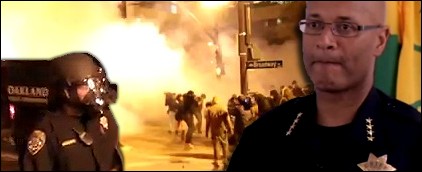
Guest blogged by Ernest A. Canning, with Brad Friedman
In the wake of a violent, night-time confrontation with Occupy Oakland demonstrators last week by the Oakland Police Department (OPD) and some 15 other law enforcement agencies, questions have arisen about the legality of the tactics used by the agency during mass arrests which led to serious injuries, including the fractured skull of a two-tour Iraq vet.
Oakland’s Interim Police Chief Howard Jordan has maintained that the use of chemical agents and other so-called “less than lethal” weapons were required in order to defend law enforcement officials from demonstrators.
However, a forensic analysis by The BRAD BLOG of video taken immediately prior to and during last week’s raid and confrontation with Occupy Oakland demonstrators, creates doubt about the legality of the OPD decision to declare the demonstration to be an “unlawful assembly,” and, in particular, raises serious questions about the veracity of the Interim Oakland Police Chief’s claim that police “had to deploy gas in order to stop the crowd and people from pelting us with bottles and rocks.”
Moreover, evidence in several of the videos suggests that the multi-agency task force may have violated both CA Penal Code Section 407 and an OPD Training Bulletin [PDF] that had been adopted pursuant to a federal consent decree signed by the Oakland PD after another confrontation with protesters some years ago.
That federal consent decree was the product of litigation initiated after a brutal assault on a 2003 anti-war protest at the Port of Oakland, during which, according to civil rights attorney James B. Chanin, OPD not only deployed so-called “less than lethal firearms,” but ran over demonstrators with motorcycles, and shot and arrested longshoreman who were not even a part of the demonstration.
Chanin reports that, during a deposition in the 2003 case, he “discovered” that the OPD had “infiltrated a subsequent demonstration, and even a planned route the demonstrators would take.” Video posted at the end of this article shows plain-clothed, under-cover cops mingling with demonstrators at Occupy Oakland, revealing that OPD used similar infiltration techniques during recent demonstrations as well. Audio included in the video captures Interim Chief Jordan bragging about the ease of infiltration.
Yet another video, also posted below, suggests that two-tour Iraq vet Scott Olsen’s brain injury was likely caused by a member of the San Francisco Sheriff’s Emergency Service Unit (ESU), but, despite reports from activists on the Internet, the identity of that officer is still an open question…
Jordan: ‘We had to deploy gas’
 During his press conference following the October 25th raids, Interim Chief Jordan defended his agency’s use of chemical weapons at the demonstrations which had come to a confrontation point at the intersection of 14th and Broadway [emphasis added]:
During his presser, Jordan discussed two separate actions in which gas was employed — a pre-dawn raid on the Occupy Oakland encampment and the action later in the evening at 14th & Broadway where demonstrators had gathered in protest. In fact, witnesses have explained to The BRAD BLOG that there were at least four different volleys of chemical agents at the evening protest.
During the presser, Jordan also initially claimed that “no rubber bullets” were used during the evening action, explaining, “we don’t have rubber bullets in our inventory.” But his explanation of the situation changed as he was pressed by reporters…
INTERIM CHIEF JORDAN: This morning those were OPD officers only that were clearing the plaza, the outside agencies were not brought in until later on–
REPORTER: But what about in the evening…people are showing us wounds and rubber bullets…Can you say for sure that none of the 16 agencies were using–
INTERIM CHIEF JORDAN: I don’t know that. We have to assess that.
Videos depict unprovoked police assault
The following video by Abby Martin of MediaRoots.org, recorded during the evening police action, prior to the first use of chemical agents, provides key evidence which appears to contradict a number of claims made by Interim Chief Jordan concerning the deployment of gas as a purely defensive maneuver “necessary to protect our officers”…
Martin denies her video, as seen above, was altered or edited to filter out protester provocation prior to the police action. A number of other witnesses we’ve interviewed corroborate her assessment. Her video appears to demonstrate that officials intended to use chemical agents before there was even a hint of provocation from the crowd gathered at 14th and Broadway.
At the outset of her video, members of the SF Emergency Service Unit are seen standing behind a portable metal barricade facing demonstrators on the opposite side of the barricade. There are two rows of ESU deputies, the second of which can be seen holding what appear to be weapons used to fire 37 mm tear gas canisters. These weapons look very much like the ARWEN 37 (aka the “Anti Riot Weapon ENfield”), which its manufacturer describes as “the Father of all Less Lethal Systems.” The ARWEN 37 sports a “5-round rotary drum magazine.” Its range is said to be up to 100 meters.
In the video posted at right, the Canadian manufacturer of the ARWEN 37 states that officers are trained not to aim for the head, where the force of a tear gas canister could prove fatal.
Note the comment from CST Mel Tourigny of the Ontario Provincial Police in that video [emphasis added] that “the ARWEN is used in situations where the police are dealing with individuals who are combative“, but compare that to the conduct of the crowd in Oakland, as depicted in the Abby Martin video. No “combative” protesters are seen in her video, even as police announce their intentions to the crowd to deploy chemical agents.
Note also that officers are trained to aim for the legs or torso, as there have been cases where the ARWEN has seriously injured, even killed people with strikes to the head. (The OPD Training Bulletin states that “Direct Fired Specialty Impact Less-Lethal Munitions (SIM)…shall not [be fired] at a person’s head.” During his press conference, Interim Chief Jordan said that OPD “asked our mutual aid partners to honor our rules of force.”)
Returning to the Abby Martin video, initially the SF ESU deputies are seen standing silently, facing a number of people quietly milling about the intersection on the other side of the barricade. The deputies in the front row are bearing shields and batons. They do not brandish the batons, except on two occasions when a disabled woman places her hand on the barricade for balance. SF ESU team member, Scott Bergstresser, twice slams his baton onto the metal barricade, shouting: “Don’t touch the barricade!”
We then see demonstrators marching up the street, holding signs and shouting: “Who’s street? Our street!” No sign of violence, rocks or bottles is apparent in the video.
At approximately 2:35 into the video, we see deputies donning gas masks, as Martin narrates the action on scene, while also attempting to communicate with the SF ESU Deputies.
“They’ve got their tear gas masks on, ready to…gas the peaceful protesters,” she is heard saying. “Please do not tear gas us, please!,” she implores. “Wow! They are definitely planning to tear gas us right now.”
As the first warning from officials is heard — “if you refuse to move, chemical agents will be deployed” — the camera pans the line of SF ESU deputies. They stand in the same formation as seen previously. They do not move. They do not flinch. There is no evidence from their actions that so much as a single object has been hurled in their direction.
Still no sign of violence, as the following announcement is made over a loudspeaker [emphasis added]:
Throughout the announcement, and as it is repeated, the Abby Martin video contains close up shots of the SF ESU deputies displaying no emotion; standing in the formation. No rocks or bottles can be seen in the air or on the ground. Neither is there audio evidence of glass breaking.
After the announcement (appx. 4 minutes into the video), gas masks are seen on all front row law enforcement personnel. Still no rocks; no bottles seen in the video.
Martin herself is heard contemporaneously narrating the video again, just after the announcement about the intention to use “chemical agents”. She says: “So, just completely peaceful assembly and they’re basically telling us they’re gonna chemically spray us, tear gas us.”
At 4:40 into the video, as the camera has moved approximately 30 feet from the barricade, the police line is still visible. There is no evidence of rocks, bottles or any other objects in the air. The police line is still in place.
At 4:53 into the video, we see former Marine and Iraq War vet, Scott Olsen, standing next to a sailor holding a Veterans for Peace flag and a copy of the U.S. Constitution. They’re standing perfectly still, within ten feet or so of the police barricade.
When the order to disperse is repeated “in the name of the People of the state of California,” demonstrators respond: “We are the people!”
Martin: ‘Protesters threw things…AFTER they were gassed’
 At 5:09, the Abby Martin video depicts protesters, many holding hands, with their backs to the police, still chanting, “We are the people!” A police line is visible, but still, no rocks or bottles.
At 5:14 into the video, after an edit point, the camera is further from the barricade. The crowd is still in place as we then see projectiles suddenly flying over their heads from the direction of the officers and into the crowd. The first explosions are heard. During his press conference, Interim Chief Jordan attributed the sound to the weapons used to fire the 37 mm tear gas canisters. This is followed by explosions of the canisters themselves and gas seen rising from the crowd which then begins to disperse amid the chemicals.
Martin informed The BRAD BLOG that she had been within a few feet of the police and the barricade until it became clear that the police were about to gas the crowd. Her video, as seen above, confirms that account. As law enforcement officers began to deploy their weapons, she began backing farther away from the police barricade and to her left to get out of the line of fire. The camera was briefly off, then turned on again.
As she backed away, Martin panned the crowd with her camera as projectiles from the police begin to fly.
She denies seeing or hearing anyone throw anything at the police before the protesters were initially assaulted with gas. In response to our initial questions via Twitter, Martin claimed she “didn’t edit out any protester provocation,” adding “From my vantage there was none that warranted Oakland PD’s response.”
We pressed for more details, which Martin offered via email…
A number of other witnesses present at the confrontation have confirmed that account to us as well.
Footage aired on MSNBC’s The Last Word with Lawrence O’Donnell on the evening following the assault, corroborates Martin’s account of a demonstrator hurling an already smoking gas canister back towards the police line. But, again, no evidence is seen of demonstrators “pelting” the officials “with bottles and rocks” prior to their deployment of tear gas, as claimed by Interim Chief Jordan immediately following the incident.
Other videos corroborate Martin’s account
The final video posted at the end of this article includes several different camera angles from several different videographers. It begins with the former Marine Scott Olsen seen again in a camouflage jacket and hat, prior to his critical brain injury, standing next to the sailor holding the Veterans for Peace flag. The amplified warnings from law enforcement heard in Martin’s video are also heard in this video, as the crowd chants “we are the people!” in response.
At approximately the 0:42 second mark, there is a good shot of the SF ESU deputies, gas masks now on, manning the same metal barricade. No rocks; no bottles; no reaction from the police to indicate they are being “pelted”.
At 0:45 Olsen and the sailor are facing the SF ESU deputies, as tear gas smoke begins to rise from the street. Most of the other demonstrators are now further back. From the right side of the video; behind and to Olsen’s left, a streak of white gas hurling through the air towards the police line is seen, indicating that one of the demonstrators hurled a canister back at the police moments after the canister first began to disperse its content. That’s the first actual shot of any projectile moving towards the police line during all the video we’ve so far reviewed covering the moments before and just after the first use of chemical weapons on demonstrators during the evening confrontation.
At the 1:11 mark there is a bright array of sparks, at the approximate location where Olsen was standing, but it is impossible to say if this is the moment when the former Marine was struck in the head.
At approximately 1:35 of the video, we see, from a different angle, a group of demonstrators coming to the aid of Olsen. None of them are throwing anything at the officers. In fact, they’re all focused on Olsen when, at 1:41 to 1:42, an officer lobs an explosive canister, presumably tear gas, at Olsen’s would-be rescuers. It explodes in their midst, right next to the injured Olsen, forcing the responders to momentarily scatter.
Protester Clair Scott said that she was the first to reach Olsen; that she, and the others who later arrived to aid Olsen, had called out to the police for medical assistance; that they, instead, were struck with the explosive tear gas canister. She had been within a few feet of Olsen, but only saw him after he was on the ground. She said “there was nothing to provoke the police when they started tear gassing their citizens.”
The OPD Training Bulletin acknowledges that even when “some members of a crowd engage in violence…other members…are not.” It cautions officers to “minimize the risk that force…may be directed at innocent persons.”
The officers appear to have ignored that warning from their own Training Bulletin.
Glenn Beck jumps to conclusions
During the above-linked episode of MSNBC’s The Last Word, and some 24 hours after the event, O’Donnell conducted a live satellite interview with Tasha Casini, a college student and Occupy Oakland demonstrator. O’Donnell played a clip of Interim Chief Jordan’s press conference, and then asked her if she saw “people throwing bottles and rocks before they used those tactics.” There is a delay in the feed, and then Casini response: “Yep. People were doing that.”
While O’Donnell did mention the word “before,” it is not entirely clear that Casini was precise in her response. What is clear is that Casini is the only protester we’ve been able to find who has given such an account to date. Her response is inconsistent with the video evidence available so far, as well as the account provided via email by Abby Martin.
However, as other witnesses have reported, there were some four different volleys of gas used on the crowd throughout the evening.
The BRAD BLOG has attempted to reach Casini in order to clarify her details, and to confirm that, in fact, she heard O’Donnell’s question clearly during the satellite interview. To date, we have not heard back from her, but will update this story if we do.
Another account of bottles being thrown at police officials comes from James West of Mother Jones, who says he witnessed “two men throw bottles at the police”, even as the bulk of demonstrators were peaceful and chastised the “small, visible, determined group of agitators” who had hurled projectiles.
In a conversation with West today, however, he clarified that, in fact, he had not been on the scene prior to the first use of chemical agents by the police. He had arrived at 14th and Broadway only after police had already used gas on the crowd the first time, and says that he heard of no reports of similar provocations prior to that first use by law enforcement. A number of other witnesses who were at the scene during the initial deployment also confirmed they witnessed no such provocation from demonstrators at that point, in contradiction to the Interim Police Chief Jordan’s claims. In fact, several characterized those claims as “absurd.”
Nonetheless, former Fox “News” host Glenn Beck saw no need to pin the matter down or to determine whether there was evidence that would conflict with Jordan’s so-far-unsupported “rock and bottle throwing” allegations. Instead, Beck seized upon Casini’s remark as seen on MSNBC, in an apparent effort to score political points against the demonstrators.
“Wow,” he said on his radio program, “They sure sound innocent, right? The police should never respond to physical assaults from an angry mob. Ridiculous! Horrible! What is this Bizzaro World?”
Did OPD violate state law & training bulletin by declaring ‘unlawful assembly’?
CA Penal Code Section 407 states:
The mere fact that a crowd is noisy (this one was) does not mean that it is “boisterous” or “tumultuous.” A crowd can be declared an “unlawful assembly” only if the crowd is assembled “for the purpose of committing a criminal act” or there is a “clear and present danger of imminent violence,” according to the training bulletin.
The OPD Training Bulletin, according to Rachel Lederman, a San Francisco attorney affiliated with the National Lawyers Guild, was adopted as part of the settlement of the 2003 case as a guide “on how the police can act without violating people’s constitutional rights.”
It states:
The bulletin also states that the “mere failure to obtain a permit…is not a sufficient basis to declare an unlawful assembly.”
One can understand why, in light of the stated legal requirements, Interim Chief Jordan would tell the media that gas was deployed only because his officers were being pelted “with bottles and rocks.” The video evidence, Abby Martin’s statements to The BRAD BLOG, and the eye-witness accounts of several others, however, directly contradict that claim.
The only conduct indicative of imminent violence prior to the first use of chemicals by the Oakland PD’s task force, as seen in the videos published to date and as detailed by eye-witnesses, were the actions of law enforcement personnel donning gas masks and announcing their clear intention to deploy chemical agents.
If the order to disperse was unlawful, then the ensuing use of gas was likewise unlawful as well.
Thus, it comes as no surprise that, according to Lederman, the National Lawyers Guild is now contemplating further legal action against the City of Oakland.
Moreover, chemical agents are supposed to be a technique of last resort for officers. While Jordan and many in the media continue referring to application of “non-lethal force” in their coverage, the manufacturer of the ARWEN 37 does not describe its weapon as “non-lethal.” It refers to it as “less lethal.”
The federal consent decree-mandated OPD Training Bulletin states that because chemical agents “can produce serious injuries or even deaths,” chemicals can be used for crowd control “only if other techniques, such as encirclement and multiple simultaneous arrest…have failed or will not accomplish the policing goal as determined by the Incident Commander.”
The Abby Martin video, and the others, suggest that no other crowd control method was employed at 14th and Broadway. A bevy of heavily armored officers, with helmets and shields, stayed behind a protective barricade as they fired “less-lethal” weapons and potentially lethal gas into a defenseless crowd of apparently peaceful demonstrators.
Unresolved questions pertaining to Scott Olsen’s injury and who caused it
As depicted by the last video posted below, there is a great deal of circumstantial evidence, including the nature of his injury, to suggest that Scott Olsen was struck by a tear gas projectile fired by an ARWEN-like weapon, as opposed to a hand-lobbed canister. There is no known definitive footage, however, at this time, pin-pointing the precise cause of his injury.
Nonetheless, it is clear that if he was shot, it would have been at very close range, raising questions of an intent to inflict serious injury, especially given the explicit admonitions of both the manufacturer and the OPD Training Bulletin against aiming such a weapon at someone’s head.
Although a number of bloggers have identified SF ESU’s Scott Bergstresser as the responsible deputy sheriff, one would hope that fellow supporters of Occupy Wall Street would recognize that the principle of “Equal Justice Under Law” includes the rights to both a presumption of innocence as well as due process. In that light, The BRAD BLOG takes exception to those who saw fit to publish Deputy Bergstresser’s home address on the Internet — an irresponsible action that could endanger not only Deputy Bergstresser but his family.
Video documenting police infiltration of Occupy Oakland follows. [Hat tip to BRAD BLOG reader and Occupy LA demonstrator Jeannie Dean for the link]…
Video showing Scott Olsen’s injury is inconclusive as to who caused it…
UPDATE: This morning, the sailor who can be seen in the videos bravely holding the Veterans for Peace Flag and a copy of the U.S. Constitution immediately in front of the heavily armored contingent of SF ESU Deputy Sheriffs appeared on Democracy Now!. His name is Joshua Shephard.
The interview produced the following colloquy:
AMY GOODMAN: What was taking place?
JOSHUA SHEPHERD: Yes, just the tremendous use of force, the escalation of force, from Oakland PD and the assisting agencies. It was traumatic.
Additionally, BRAD BLOG commenter Bill Larson furnished two excellent explanations of the legal issues that arise from our factual presentation in comment #3 & comment #5, below.
UPDATE: The Port of Oakland issued a formal statement that “maritime operations are effectively shut down” in response to today’s General Strike, called in response to the violence at last week’s demonstration.
UPDATE 11/7/11: Exclusive: Oakland Police Walk Back Claim That Tear Gas Was ‘Necessary to Protect Officers’ From Occupy Oakland Demonstrators
Ernest A. Canning has been an active member of the California state bar since 1977. Mr. Canning has received both undergraduate and graduate degrees in political science as well as a juris doctor. He is also a Vietnam vet (4th Infantry, Central Highlands 1968).















@Enest A. Canning,
This article shines a light on the real facts of the unprovoked attack on innocent OCCUPY OAKLAND demonstrators. Thanks Ernest.
I have a question though.
If “The federal consent decree-mandated OPD Training Manual states that because chemical agents “can produce serious injuries or even deaths,” chemicals can be used for crowd control “only if other techniques, such as encirclement and multiple simultaneous arrest…have failed or will not accomplish the policing goal as determined by the Incident Commander.” was followed.; then why was tear gas used in the early morning attack on the OCCUPY OAKLAND camp by OPD, when the demonstrators were asleep?
You should have put more emphasis on that being unlawful also. That begs an investigation and lawsuits against the city and OPD.
Best,
Ralph
I forgot to add…OCCUPY EVERYWHERE!
The Sergeant declared a non-violent assembly unlawful.
Under California law, An unlawful assembly occurs when two or more people assemble together (to commit a crime/ [or] to do a lawful act in a violent manner). When two or more people assemble to do a lawful act in a violent manner, the assembly is not unlawful unless violence actually occurs or there is a clear and present danger that violence will occur immediately.
So it was an unlawful order for the crowd to disperse. Thus the resulting use of chemical weapons, rubber bullets, and flashbang grenades was assault and excessive force, and it is the police who were there are guilty of rioting….
They should also throw in charges for…
Unreasonable force
Excessive force: In making arrests, maintaining order, and defending life, law enforcement officers are allowed to use whatever force is “reasonably” necessary. The breadth and scope of the use of force is vast—from just the physical presence of the officer…to the use of deadly force. Violations of federal law occur when it can be shown that the force used was willfully “unreasonable” or “excessive.”
Failure to keep the public from harm….
The public counts on its law enforcement officials to protect local communities. If it’s shown that an official willfully failed to keep an individual from harm, that official could be in violation of the color of law statute.
Title 18, U.S.C., Section 241 Conspiracy Against Rights
This statute makes it unlawful for two or more persons to conspire to injure, oppress, threaten, or intimidate any person of any state, territory or district in the free exercise or enjoyment of any right or privilege secured to him/her by the Constitution or the laws of the United States, (or because of his/her having exercised the same).
Punishment varies from a fine or imprisonment of up to ten years, or both; and if death results, or if such acts include kidnapping or an attempt to kidnap, aggravated sexual abuse or an attempt to commit aggravated sexual abuse, or an attempt to kill, shall be fined under this title or imprisoned for any term of years, or for life, or may be sentenced to death.
Title 18, U.S.C., Section 242 Deprivation of Rights Under Color of Law
This statute makes it a crime for any person acting under color of law, statute, ordinance, regulation, or custom to willfully deprive or cause to be deprived from any person those rights, privileges, or immunities secured or protected by the Constitution and laws of the U.S.
Acts under “color of any law” include acts not only done by federal, state, or local officials within the bounds or limits of their lawful authority, but also acts done without and beyond the bounds of their lawful authority; provided that, in order for unlawful acts of any official to be done under “color of any law,” the unlawful acts must be done while such official is purporting or pretending to act in the performance of his/her official duties. This definition includes, in addition to law enforcement officials, individuals such as Mayors, Council persons, Judges, Nursing Home Proprietors, Security Guards, etc., persons who are bound by laws, statutes ordinances, or customs.
Punishment varies from a fine or imprisonment of up to one year, or both, and if bodily injury results or if such acts include the use, attempted use, or threatened use of a dangerous weapon, explosives, or fire shall be fined or imprisoned up to ten years or both, and if death results, or if such acts include kidnapping or an attempt to kidnap, aggravated sexual abuse or an attempt to commit aggravated sexual abuse, or an attempt to kill, shall be fined under this title, or imprisoned for any term of years or for life, or both, or may be sentenced to death.
References
http://www.justia.com/criminal/...2600/2686.html
http://www.fbi.gov/about-us/inv...s/color_of_law
http://www.fbi.gov/about-us/inv...tes#section241
http://www.fbi.gov/about-us/inv...tes#section242
Ralph: I appreciate your thoughtful and perfectly valid question.
However, this article, already quite lengthy, focused specifically on the evening events at 14th & Broadway.
We have not reviewed relevant footage or analyzed extensive witness accounts of the early morning roust of the encampment.
As you can see, Brad and I spent a great deal of time garnering the evidence so that we could present it in a way that readers can reach an appropriate conclusion about the evening confrontation at 14th & Broadway.
I don’t think it appropriate for me to express an opinion on the earlier event as I lack sufficient information for doing so.
I should also note that any person can present a case to the Grand Jury in their community and the grand jury can issue an indictment without the District Attorney pressing charges.
I think this situation would qualify and you can bypass the blue wall that tends to protect police officers…
FYI the sailor, referred to in your article, is Joshua Sheppard. He stated in an interview with Amy Goodman on DemocracyNow! that it was “peaceful…it descended into chaos quickly…with the escalation of force, the tremendous use of force by the OPD and assisting agencies”.
You can’t have a more credible eyewitness than this brave sailor.
http://www.democracynow.org/
Hey Ralph, You beat me to it! Yes, lets ask the 2 veterans standing between the protestors and police if there was anything throw at the police before the police chose to use excessive force as their first step in dispersing a LEGAL assembly of the people.
And thanks Brad and Ernest for debunking the ever prevalent propaganda. I hope you can track down the gal on O’Donnell’s show for clarification, and he will be forth coming with the clarification. But wouldn’t it be nice if he did that himself?
Re Bill Larsen @3 & 5:
Thanks so much for the excellent points and authorities. I’ve added a link to both comments in the update.
Ralph @6 & Ancient @7. Greatly appreciate the link to the heroic Josh Shepherd’s appearance on Democracy Now.
As you might suspect, Brad and I have been quite busy tracking down the details as to precisely what took place. Had we known of his name or the DN appearance, we would have included it when we first published this piece.
I’ve now included it in an update.
Within the the agonizing time it takes to DISPROVE FALSE MEDIA LINE and the time it takes to prove THE TRUTH; I pray for grace for all that stand between.
Excellent piece, well done.
Props to Ralph @ 6 for his hat tip to the squid. Being a retired squid myself, that one kinda put a lump in my throat seeing his picture…
What do you expect from Oinkland?
Brad, I can sum up the relevance of whether or not the protesters “provoked” the police with one simple excerpt from the policy manual.
Page 16
Section F
2 … Direct Fired SIM may never be used indiscriminately against a crowd or group of persons even if some members of the crowd or group are violent or disruptive.
a. Direct Fired SIM may be used against a specific individual who is engaging in conduct
that poses an immediate threat of loss of life or serious bodily injury to himself or herself,
officers, or the general public or who is engaging in substantial destruction of property
which creates an imminent risk to the lives or safety of other persons. In such
instances, Direct Fired SIM shall be used only when other means of arrest are unsafe and
when the individual can be targeted without endangering other crowd members or
bystanders.”
In other words, even if there were a few random people who lobbed bottles of water, small rocks or paint at the riot-gear-protected police officers, they are not allowed to retaliate against the crowd by the means they employed.
Period.
Also, the Oakland Police Officers’ Association wrote an obnoxious letter to the general public and posted it on their website.
I posted a reply on mine.
An Open Letter To The Oakland Police Officers’ Association.
> Ontario Province Police
Their name is “Ontario Provincial Police.†They are colloquially called “the O-P-P.â€
Good story. One criticism for Ms. Martin, however. Given the anti-OWS spin and propaganda, we must make every effort to ensure our documentation is pristine. She has two gaps (including five minutes at a critical time) in her recording. While there may be perfectly innocent reasons for this, the value of her video is significantly diminished (not entirely, of course) because of this. Such gaps are easy targets for those seeking to ignore everything else that is recorded, so I’m very sorry to learn about those gaps.
To all who continue to document OWS and the responses, I urge you to make every effort to avoid such things in the future. I would go further and suggest that perhaps mini-seminars be held at various encampments for those interested. Emphasize a few key points over and over: The camera must not go off or be turned off, sound must remain on (very important if the camera gets knocked around), and no gaps or “edit points” (a subtle term appearing above that flashes neon warning signs to those burned on the ACORN/O’Keefe nonsense). Remember, we must uphold the highest standards we can.
LMK @14. Let’s be fair.
Ms. Martin’s is the only unedited video that runs at length. The others appear to be compilations of videos shot by multiple cameras.
Also, while it is easy for you or I to sit back and say she could have done this or that, it is altogether different when someone is both trying to document a volatile situation and is caught in the midst of a frightening situation, face-to-face with heavily armed law enforcement personnel in riot gear who have just threatened to gas her.
It is quite understandable that she shut the camera down briefly while moving out of the way. Also, I’m having difficulty understanding where you come up with the “five minutes” to explain the edit point. And, the video is running again, sans violence, briefly before the first explosion.
That said, I think your suggestions for mini-seminars an excellent one. I think it important that OWS make it a point to have dozens of cameras, strategically placed at all large demonstrations so that they can begin filming the moment there is a prospect for confrontation.
It would also be quite helpful that OWS conduct seminars on peaceful, non-violent civil disobedience. No matter what level of force is applied by law enforcement, those participating in OWS can never retaliate. To do so is to surrender the movement’s moral superiority.
Hamranhansenhansen @13.
Thanks. I’ve corrected the body of the text accordingly.
Parts of my neighborhood were trashed last night by some of the people marching. I know I’m supposed to continue supporting and encouraging these people (I marched with them at one point), but I’m actually feeling bummed about all the damage and the work ahead to remove graffiti, repair windows, and repaint. More small businesses are going to be spurred to leave downtown Oakland. It reminds me of the days when people would come in and trash Jack London Square every weekend. Eventually businesses just give up and take their jobs with them.
A linguistic quibble, which I post because the wrong word makes me stop and stare and thus interrupts the flow of the narrative: Beware words that look and sound similar but mean entirely different things. Disburse (same root as bursar) means pay. Disperse means scatter. Disbursing might happen in the future if demonstrators are successful in suing the police, but dispersing is what was happening during the demonstration. Your keeping the distinctions straight will let the rest of us keep our minds on the substance of your excellent post.
Thanks, CK! Noted and corrected above!
Not a quibble, CambridgeKnitter. The correct word is “disperse.” Not sure where we included the typo, “disburse,” so if you can give me a hint, I’ll correct it.
Thanks.
Re #15: You’re right about my mistake on a missing five minutes, I misread. Still concerned about “edit points”, though. To follow up on the subject of training OWS occupiers to document these events, I would add (1) raw (uncut and without interruption) video is best and (2) work on a “buddy system”. If one reporter or person with a camera is confronted or harassed, have a second person there to record it.
The nonviolence part cannot be emphasized enough. I am also critical of closing the port right now. That is the sort of action that should be saved for later, if necessary. I am concerned that some bad influence, provocateurs and COINTEL are at work in the Oakland OWS.
LMK –
In regard your concern about “edit points” in various OWS videos, you are absolutely right to keep an eye out for such things (and it’s one of the reasons we noted it in our story above). However, the event in question went on for hours on end, until dawn’s early light. It is likely impossible for any citizen videographer to keep the camera rolling ad nauseum, lest they run out of “tape” or battery before something noteworthy occurs.
Best such folks can do in such an event, where there is no specified end point, is roll as much as they can, when they can, at stuff they believe likely noteworthy, and hope to capture the stuff that is. Many of these folks, btw, are simply recording on their cell phone video when something occurs. And as battery charging is a precious commodity in the Occupy situations (and “hard drive” space on cell phones at any time is similarly finite), it’s unreasonable to ask them to keep rolling at all times.
Just a thought, FWIW. They can only do what they can do. And I’m ever grateful they have been able to do as much as they have with so very little to work with, frankly!
lmk @21:
I respectfully disagree.
OWS is a mass withdrawal of consent to the status quo. The goal is not to simply persuade the powerful to “reform” the existing system. The goal is a radical transformation from a system that is democratic in name only; a system entailing impunity for the criminal oligarchs at the top and in which money rules, to a genuine egalitarian democracy where the only valid standard for “leadership” is a commitment to the 99%.
We are at the early stages of a second American revolution — hopefully a peaceful, non-violent revolution, but a revolution nonetheless.
Transformation from our autocratic, corporate security state to genuine egalitarian democracy will not be accomplished by simply camping out in public parks or marching or holding signs.
General strikes are an extraordinarily effective means of non-violent, civil disobedience. So are boycotts. (Recall the Montgomery bus boycott). So too is a fundamental change in how we elect, as well as whom we elect, for OWS will not become the democracy it seeks until it occupies the legislative and executive branches of government.
The problem is that the general strike must be tied to a specific demand, e.g. the resignation or termination of the interim Chief of Police or the mayor.
@katie b
I am very sympathetic to your concerns as I think the OWS should be too. Unfortunately, I think it is not so much the peaceful aasembly that causes the biggest problems but the riot by cops. The reason they were initially peacefully assembly in the streets was their encampment was removed I an early am raided with tear gas (pre-dawn is when thugish unprofessional coos like to do it because thats when people are most sleepy, guaranteed to create confusion, difficulty in comlplying for those that want to avoid arrest, and mayhem, where as a day light action of mass arrest, one person at a time would cause far less disturbance) but even a bunch of people milling in the streets is disruptive but not nearly as offputting as a cop riot. That mayhem is what is on the news and leads customers to avoid the are.
Consider NY’s OWS. For most of the businesses there it is a wash, some hurt some, most neutral or better due to crowds. The OWS has organized people to fix a bathroom sink that one business claimed was broken by a protester etc…but business goes on and OWS is actively working to minimize harm and work with local businesses. Beside some of the initial bad ass corralling and pepper spraying incidents by NYPD, it seems Bloomberg has asked the police to avoid all out vioent assaults. Even when the police cleared the bridge, they did not do by teat gas and flash bang grenades, but by arrestting people one at a time.
Also for another comparison, see how the long term occupying of the WI Capitol in response to Gov Walkers union busting bill. There the police acted with professionalism, with emphasis on safety of both the protesters and the citizens in the area. Again, the businesses in the are we’re impacted, but overall it was neutral, with one pizza business making out like bandits (they donated much also).
So I think NY OWS and WI are just two examples how the protestors and cops can act in a way that lets the protesters make their political points (not become a reality TV show on protesters via thuggish cops) with a minimum impact on the area and businesses. No doubt there will be some collateral damage even with most peaceful aasemblies, but I would argue the vast majority of the bad impacts are in reactio to unprofessional overly aggressive police force and a few bad apples reacting to that in a violent or property damaging way.
I heard some of the Oakland OWS were cleaning up glass at a Wells Fargo branch and removing graffitti. I would suggest for concerned citizens like you and businesses in the area, should first insist to the mayor that the mayhem initiated by the cops is the biggest problem, biggest impact and without that, things for the business community and local residents would be much much better. Also I encourage you and local businesses to bring the issues you raised directly to the protesters in cooperative spirit, and see if they would be willing to engage in clean up efforts and in othe ways support and assist the every day ordinary businesses the area. While general strikes may be effective,(I’ll leave that to another discussion) I’m assuming most of the protesters would rather not have their downtown turn into a ghost town with roving bands of cops chasing the most hardened protestors but would rahter have big numbers of ordinary citizens massing in huge peaceful assemblies, ala WI…. If the protester can make their political points AND still maintain the health of their local economy. You yourself could likely lead or at least forward a productive relationship with the protestersand also
I would suggest you may want to demand to the city govt that your local cops emulate approaches of more peaceful interactions with mass occupying type protests in other cities. Here in my home town, there is a occupy protest that has caused almost no distaste or aversions to downtown MPLS by general population because there has been no violent cop crack down. The cops have removed tents (without tear gas) and been somewhat obnoxious, but they have let protesters assemble, and have on occasion, when protesters took to the street and marched, say to the local FED reserve building, they did not corral them or mace or tear gas them, instead they provided effective, professional traffic control, ensuring the least amount of traffic disruption and the safety of the protestors. And the MPLS police at not the epitome of a professional force, they can be overly aggressive and thuggish, much more than St. Paul and some other cities I have lived in, but even MPLS police seem to able to avoid nasty unnecessary riots by cops.
Also, be aware that just in the last few years, because of way more video shot by crowds, that police routinely infiltrate the crowds and provoke violence. This may seem like an outlandish claim, but even the Canadian police who often get credit for being more professioanal than many of our city cops, were caught infiltrating a Toronto protest and inciting violence, jumping on cars etc, (they were identified by their matching, police issued boots and some other exterior clothing things and secret gestures they seem to adopt so they can knwomeach other, so the reguakr cops know who toavoid ebating and arresting etc) The article above shows evidence that Oakland PD is also doing this Palin clothes infiltration, although I don’t know if there is any evidence they were inciting violenc. But becuase of this infiltration you can’t even assume that the destruction of property and graffiti was even a few violent radical types.
Again a simple demand form the business community that the police not be infiltrating the crowd in plain clothes and that police be expressly told that any plain clothes cop found to be inciting violence and any giving that cop that order will be prosecuted to the full extent of the law. They will Lilly deny any such activity, so they publicly should have no resistance to such forceful promised enforcement against police acts they will claim never happen.
For the few roughnecks In the crowds that amy be choosing violence, or property destruction, again I would suggest local residence and businesses work with main groups of protestors that seem as concerned about this as you are. In WI they cleaned up mess left behind, as they do in NY, I’m sure same arrangement can be made with OAkland OWS.
Great points, Karen. To tie in with what Brad said about recording events, while I wasn’t aware of the time scales in question (yes, battery power becomes an issue, eventually), I think OWS should work to coordinate recordings at every Occupy event. During slow times (“the wait”) maybe only a few record. When things ramp up, more people should record. This system should include coordination of recordings, to make it easier to “hand off” recording duties during “the wait” without missing anything.
Based on what Karen said, recording could also help ID the police and provocateurs. Train citizens to recognize and record the telltale signs, like footwear and hand gestures. Remember also how the rightwing nuts claimed no slurs were used in DC because no one had a recording? I guarantee that at some point in OWS a critical fact regarding OWS will be in dispute, and recordings will help the OWS side.
To change subjects slightly, EC, it appears we agree and disagree about the strike. My point about saving strikes for later is because they should be used as levers when previous demands are not met. If I read you correctly, you seem to say the same thing: strikes are good for enforcing demands. Since I was not aware of any well-publicized demands by OWS in Oakland over the last few days, the strike seemed premature. Maybe I missed a demand that was made a few days earlier.
I also do not believe strikes that appear retaliatory (“police misbehaved, so we’re shutting down the port”) are as effective as something more along the lines of “we told Oakland to back off, they refused, so that’s why we’re on strike.” Strikes are like trump cards that can also be used against the strikers (from a PR perspective). For those reasons, strikes should be used carefully and only for clear purposes. And also keep in mind that the PTB count on provoking reactions to smear the image of OWS. That is even more reason to resist reacting to events, and instead focus on a “demand, short wait, strike” model.
My question (really since 9/11) where the HELL are the lawyerts!!
Good question, Sophia. I’ve been hoping someone would answer, yet find nothing when I check back. I’d love to get involved, though I’ve seen nothing about any sort of coordination efforts among attorneys. On my own, I can’t come up with anything beyond contacting the ACLU or the National Lawyers Guild.