

As we noted was likely to happen just after posting last night’s update on the Fukushima Daiichi nuclear disaster, the “calm” over the last day or two that we reported was somewhat broken shortly thereafter. Japan’s Prime Minister Naoto Kan took to the air for a rare press conference to discuss the situation at the crippled nuclear plant, and to mark the two weeks which have passed since an unprecedented, three-prong earthquake/tsunami/nuclear disaster rocked the country.
Kan described the situation at Fukushima as “very grave and serious”, adding, “we are not in a position where we can be optimistic. We must treat every development with the utmost care.”
He did not, however, offer much in the way of new information. In the meantime, other government officials have now recommended (but not ordered) that those living between 20 and 30 kilometers from the plant voluntarily leave the area. They stress that the new recommendations are due to the difficulty in supplying food and other resources to the area, not because of an increase in radiation levels.
Last week, those living within 20 kilometers of the plant were forced to evacuate from that “exclusion zone”, and those within 20 to 30km of the plant were instructed to stay indoors to avoid radioactive fallout. The U.S. government has recommended a larger exclusion zone of 80 kilometers (50 miles) around the plant, though Japan has not felt it necessary to widen their own mandatory exclusion zone.
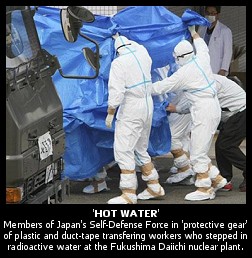 The most noteworthy hard news development since our report yesterday is the speculation — and yes, we’ll still call it speculation until there is hard confirmation — that the containment vessel at Unit 3 has ruptured in some fashion, and that a meltdown may be occurring in the core of the reactor. Those details seem to be largely speculative still at this hour, based on the investigation into what caused the water at the reactor building to be as radioactive as it was to lead to “beta burns” on the feet and ankles of three workers yesterday who stepped in water while trying to restore electricity to the unit. Two of them were hospitalized. (See dispiriting photo at top of this article.)
Whether the extraordinarily high levels of radiation in the water is coming from a crack in the steel containment vessel housing the reactor core there, or from water leaking out of the spent fuel pool at Unit 3 — or even from something else — doesn’t seem to be conclusively known at this point. But the radiation in the water was reportedly 10,000 times the “normal” limit, with some reports pegging the radiation at 100,000 times higher.
That’s not the only disturbing news, however, as we now have more scientists ringing in on the data we discussed in detail yesterday from Austrian researchers suggesting that some 50% of the radioactive cesium-137 that spewed from Chernobyl in 1986 has already been emitted to surrounding areas in Japan from one or more of the crippled reactors at Fukushima…
Before more troubling information on that disturbing thought, Voice of America’s Steve Herman reports in his latest article, that there are signs that the zirconium tubes, in which the uranium and/or plutonium fuel pellets are stored in the reactors, may be degrading — another signal of possible core meltdown [emphasis added]:
Scientists say chloride in the salt could also break open the zirconium alloy layer of protection around the fuel rods which prevents volatile radioactive elements from escaping.
Tokyo Electric Power confirms that zirconium 95 in sea water several hundred meters from the Fukushima plant has been detected since Wednesday when testing began there for additional radioactive elements.
A spokesman for the Japanese prime minister’s office tells VOA there is no clear evidence that any fuel rod covering has been breached.
Later, Herman, VOA’s NorthEast Asia Bureau Chief and a very reliable source of news reporting from both the Fukushima prefecture and Tokyo over these past two weeks, tweeted that a source from the Nuclear Information and Resource Service (NIRS), has said the workers hospitalized after burns from coming into contact with radioactive water “also seem to have ‘internal exposure'”.
 Incredibly (see photo at right) their seems to be a lack of footwear provided to protect workers while working in the water at the damaged nuclear plant. Japan Probe blasts TEPCO for that today, writing: “It is unclear why the two workers weren’t equipped with footwear that could protect them from 15 centimeters of water. Judging from the photos from the power plant, it would seem that a lot of workers are just wearing normal shoes as part of their radiation suits. There also seems to be some folks with plastic bags duct-taped over their shoes.”
While we’ve been unable to find further confirmation of NIRS’ “internal exposure” assessment of the two hospitalized workers, in their 10:00am, 3/25/11 update on Fukushima this morning, NIRS, the 30-year old anti-nuclear advocacy organization, wrote:
This has led to new open speculation among government and utility officials that the core of Unit 3 has been breached and primary containment has failed (most observers have suggested this for several days). The Japanese Prime Minister has called the situation “very grave and serious.” Radiation can be expected to be released from at least Unit-3 for some time. Steam is continuing to be released from multiple reactors at the site-steam releases at this point are certainly radioactive.
Meanwhile, Kyodo News service is reporting today that “Tap water in 16 municipalities across six prefectures has been found to contain a level of radioactive iodine higher than the maximum recommended for infants,” though they added that “in some of the municipalities where the standard was exceeded, radioactive iodine later returned to a safe level.”
New Scientific Analysis: Fukushima Accident is ‘Level 7’

We have gone out of our way to be exceedingly careful in our coverage of this disaster over the past two weeks, focusing usually on information confirmed directly by “official” sources, such as the Japanese government itself or from the plant’s owner/operator Tokyo Electric Power Co. (TEPCO).
Other “non-official” sources have been painting a far more dire portrait of the situation at Fukushima than we’ve often felt comfortable relaying as “hard news” here during the last 14 days of nearly round-the-clock coverage. We’ve striven to be balanced in that coverage, and have, in fact, been quite conservative in the details we’ve passed along to date. The situation is disturbing enough as it is, just based on “official” news frankly, such that we haven’t felt it necessary to share some of the more alarmist or sensationalist speculation about events on the ground.
While we have offered some speculation over the past two weeks, as balance to the “official” line and usually coming from scholarly sources, we always try to note it as such (for example, with the information from NIRS above.)
Last night, we reported the new assertions of Dr. Edwin Lyman, a Senior Scientist at the Union of Concerned Scientists’ (UCS) Global Security Program. Lyman is described by UCS as “an expert on nuclear plant design and the environmental and health effects of radiation.”
Commenting to reporters yesterday on new data from researchers at Austria’s Central Institute for Meteorology and Geodynamics in Vienna suggesting levels of radioactive fallout — particularly cesium-137 — from Fukushima may be nearing Chernobyl levels, Lyman said he believed “the estimates…appear to be roughly consistent with” additional data he’d examined from the U.S. Department of Energy from March 22nd.
“That does appear to be consistent, at least in order of magnitude terms with the idea that roughly 50 percent of the cesium that was released at Chernobyl has already been released from the plant,” he explained during a conference call with reporters yesterday.
The Austrian data was gathered from a global network of air samplers set up to verify the Comprehensive Nuclear Test Ban Treaty around the world.
In his comments, Lyman also noted that he believed the “danger that the workers are facing” at the power plant itself “are greater than TEPCO suggests” and suggested, as have others recently, that it’s possible the area around the plant could become uninhabitable for decades.
Today we have more scientists offering information based on the Austrian data and separate, but supporting information. According to a statement released this morning [PDF] by Greenpeace Germany (obviously, an anti-nuclear advocacy organization), based on a new assessment of the Austrian data and data published by the French government’s radiation protection agency (Institut de Radioprotection et de Sûreté Nucléaire or IRSN), the Fukushima accident needs to be reclassified to levels meeting, and perhaps exceeding, the International Nuclear Events Scale (INES) rating of the Chernobyl disaster.
The INES ratings are from 1 to 7. The Fukushima accident was recently raised to level 5, an “accident with wider consequences”, on par with the Three Mile Island disaster. Chernobyl was rated as 7, a “major incident”.
According to Greenpeace Germany’s statement, based on their analysis from Dr. Helmut Hirsch:
In contrast to the Chernobyl accident which involved one nuclear reactor, Fukushima has suffered major failures at four.
…
Dr Hirsch concludes, “Taking all the releases from the Fukushima-daiichi reactors together this [is] obviously an INES 7 with the possibility that it is three INES 7’s, taking each reactor separately which results in a release of 100,000 Tbq each.”
“From the very beginning this accident looked potentially devastating in terms of radiation release. It is far from over, and today we have further evidence of a very real risk of reactor core meltdown with potentially catastrophic effects. The nuclear industry and the IAEA have claimed since Chernobyl that such an event would not take place in a western reactor. Their dangerous complacency over decades has now led us to an utter catastrophe for the people of Japan, and the accident is not over,” said Heinz Smital nuclear expert of Greenpeace Germany.
Hirsch and Greenpeace are also [critical] of the INES scale as the basis on which nuclear accidents are assessed by national governments and the IAEA [International Atomic Energy Agency]. The INES scale was intended to be applied in the case of one accident at one site. At Fukushima, the accidents have been at multiple nuclear reactors, suffering two critical failures – reactor cooling and spent fuel storage. The INES scale was never designed for such an eventuality because the nuclear industry and the IAEA considered such things not possible. In an example of their distorted logic INES classifies each event at the Fukushima power plant separately. Yet the releases of high levels of radioactivity do not discriminate in terms of who they affect once they are released.
The release goes on to charge that, due to the population density in Japan, versus the less populated areas of Belarus where much of the Chernobyl radioactivity fell, “The implications for collective dose of radiation to the population and human health are enormous.” They add that they will be sending their analysis to the International Atomic Energy Agency (IAEA) in Vienna for study.
In fact, a number of scientists over the past two weeks have been critical of the idea that the Fukushima incident could be anywhere near as damaging as Chernobyl. Their conclusions tend to be based on the differing design of the reactor in the former Soviet Union which did not have as many layers of containment structures — so-called “Depth of Defense” — that Japanese, and other western plants, have. Also, the burning of graphite rods used at Chernobyl (but not in Japan’s plants) led to uncontrollable fire and an explosion sending radioactive fallout much higher into the sky for wider disbursement than is believed possible at Fukushima.
Obviously, Greenpeace has an “agenda”, so their analysis should be taken with that in mind. But as we continue to hear more and more independent scientists and scientific bodies comparing the situation at Fukushima — which shows no real signs of ending anytime soon, despite slow progress reportedly being made each day to bring the disaster under control — it becomes more and more difficult to avoid some of the worst-case scenarios and analyses now emerging, as based on actual, real-time data gathered from the ongoing crisis.
Earlier today I appeared on the Randi Rhodes Show with guest host Nicole Sandler to discuss the latest Fukushima developments, and the political ‘fallout’ here in the U.S. That interview is now posted here.
For breaking Fukushima-related news (and more), as it happens, 24/7, please follow us via Twitter: @TheBradBlog.






















The Chernobyl documentary.
Why are they still trying to recover these reactors rather than just sealing them in as done at Chernobyl? Has there been any study as to the altitude that the releases have reached and how much has gotten into the jet stream? Also, why are there no reportings on the amount or the fact that radiation has been detected in Alaska? Just today they finally noted that radiation had been detected in Hawaii…. To me it is logical if it reached California and Colorado, it has to have been detected in Hawaii. Based on early predictions, Alaska would also have radiation detected.
On a final note, is there any way to confirm the accuracy of the amounts detected that have reached the US?
Finally, I feel sorry for the people of Japan. They are suffering the most…. Thank you to the workers who have been trying so valiantly to save the plant, their countrymen and the world.
Bear Woman asked:
I don’t think they’re trying to “recover” them, as much as stabilize them. They’ve already said that the plant will have to be permanently shut down, most likely, and there have been reports that workers are training to use the cement trucks currently rigged to pump water into Unit 4, to pump cement with it, as a last ditch effort to “kill” that unit.
So I suspect that may be on the drawing board for all of the Units, as necessary. But to do even that much is extremely hazardous, and much safer to accomplish if the units are stable — or closer to it than they are now.
I haven’t seen an official “study”, but have seen reports (can’t recall where off hand) that the explosions to date hurled radiation several hundred meters into the air, as opposed to several thousands meters, as at Chernobyl where, as you note, the radiation was able to get into the jet stream that way, and contaminate a much wider area. Or, so say the reports I’ve seen, in any case.
Can’t tell you, but can make a guess or two. A) It may not have reached Alaska, but rather, stayed more to the South. The reports I’ve seen of radiation reaching the U.S. were in Southern California (lucky me!). Luck of the wind. And/or B) Have seen reports that suggest some of the EPA monitors may either not be working, or that there may not be enough of them, because they are only now deploying more of them.
There are also monitors around the globe for Nuclear Test Ban Treaty monitoring, but I’d have to go check to see exactly where all of those monitors are placed.
Not that I know of. You’ll just have to “trust” your government, I suspect. Though independent scientists are also plowing through all of that data, so if there are real concerns here in the U.S., I suspect they will get out to the public one way or another.
The fact that this is occuring so close to the 32nd anniversary of the Three Mile Island crisis is an ill omen. TMI and Chernobyl should have been wake-up calls to the potential dangers of nuclear power.
My heart goes out to the people of Japan who are struggling with the aftermath of an earthquake, tsunami, and now a nuclear crisis.
Anchorage is closer to Tokyo(3,462 miles) than either Honolulu (3,859 miles) or Los Angeles(5,487 miles) are.
The Aleutian Islands are even closer than Anchorage.
The plume hit Alaska before it hit Hawaii or the mainland US.
Thank you, Brad, for trying to tell it like it is while being responsible about pure speculation. I have been extremely disappointed and bothered by the poor quality and lack of in-depth reporting both on Japan (which is partly understandable) but also about the conditions of the domestic nuclear industry.
Some of the happy talk being passed off by news also is in fact pure speculation.
IN terms of alternative sources of info, I found a link to a seller of geiger counters who said he was putting up a network here:
http://www.allvoices.com/s/event-8482842/aHR0cDovL3d3dy5yYWRpYXRpb25uZXR3b3JrLmNvbS8=
I don’t have any way of evaluating that site other than to say that it’s one source of info. be sure to read the notes and follow the comments by the owner to use this site responsibly.
The EPA’s site for radiation monitoring is here:
http://www.epa.gov/radiation/
This disaster is a cautionary tale for governments that lose the trust of their citizens by either not leveling with them, or losing citizens’ confidence over time by getting in bed with a regulated industry, or both. When the govt really needed/s to be taken seriously…..we see here that it’s now not the go-to trusted source of accurate info. Not a good place for a government to be at all in a disaster.
In terms of whether the Fukushima plants were going to be abandoned as of a few days ago, I was puzzled by a piece in the WSJ which says TEPCO is seeking $25Bn for “repairs to damaged plants”.
http://online.wsj.com/article/SB10001424052748703921204576217632245381732.html
If that’s what it costs to stabilize and decommission these plants, we should all sit up and take note, because this article also suggests that the government of Japan (e.g, the taxpayers) will most likely be taking the hit.
It’s impossible for me as a layperson with no sense of costs involved to tell from the article whether some attempt to repair the plants was actually being contemplated. Maybe one of your engineer readers will have insight on this.
Japan has over 50 reactors. How many times can a government in an earthquake prone area of the world take the hit for a damaged reactor? Somebody better be considering such a scenario.
The US has over 100. Everybody focuses the most attention on the West coast, but it’s eye opening to look at the density of reactor sites on the East coast. Realizing that most of these plants are located on bodies of water in a region with a “hurricane season” ever year, and that the East coast has become far more densely populated since the plants were built decades ago, there’s lots to consider here as we go forward. For example, the issue of radiation contamination of Tokyo’s water reminds me that we have to consider not only where the population lives, but where its major roadways and airports are, where its open reservoirs for water supplies are located, and so forth. People don’t have to be near a plant to be powerfully affected by an accident at that plant.
BTW, my favorite euphemism (NOT) was heard on NPR, where radiation had not “contaminated” an area, but had “found its way” to that area.
Thought, I was kidding before? Enjoy the following climate change is man made presentation.
http://www.youtube.com/watch?v=b1yIfOYQWxA
Celebrate Earth Hour a day before Green News.
I remind again, if your local, city, state, or federal have budget deficits and they are cutting services, or raising taxes, You’ll need to bring a copy of the “Comprehensive Annual Financial Report” to the table and slap it down.
Today is the last day of 2011 Tsunami Awareness Week March 21-26
http://www.oes.ca.gov/WebPage/OESWebsite.nsf/Content/503BF86CBCEE8CD4882576EE00575B85?OpenDocument
For those looking for hard data rather than spin, I noted the following attempt to acquire more Japan radiation level info for the public, mentioned in a press release from Beyond Nuclear:
link to the release via commondreams.org:
http://www.commondreams.org/newswire/2011/03/25-4
It is interesting that the same U.S. government which recommended an 80 kilometer (50 mile) “exclusion zone” to Japan operates at home under “emergency-response plans that call for evacuating residents only within a 10-mile radius of such a disaster here.”
Yeah Brad, I’m cynical too about the safety claims from the radiation emissions, especially as it is compared to “natural” radiation that one receives over the course of a year.
It’s like me saying a 20 foot tsunami isn’t dangerous because there are waves that “naturally” wash ashore EVERY day, and the water in the tsunami is FAR LESS than the total water that hits the beaches in a year. But there are plenty of videos on youtube that will attest to the destructive force of the tsunami.
How long before the youtube videos of the cancer damage caused by this “tsunami of radiation” released on the world?
The war news out of Libya conveniently knocked events in Japan out of prime time.
“Some greens have wildly exaggerated the dangers of radioactive pollution.”
– George Monbiot in his article explaining his conversion to pro-nuke
http://www.guardian.co.uk/commentisfree/2011/mar/21/pro-nuclear-japan-fukushima
If he will stand behind these words, then he should will willing to act as the watch guard and keep terrorists from stealing the debris.
As I’m reading (and relying on) Brad’s indispensable coverage of Fukushima, specifically the conflicting reports from the assorted agencies responsible for radiation testing, I am reminded of what I (was mortified) learned in Lower Manhattan in 2001 re: EPA “testing”…
In 2001, I worked closely with the Carpenter’s Union, Local 608. When the EPA test results on the air quality were released claiming the air was perfectly safe to breathe, the Union President’s OSHA rep informed me that their people on scene were shocked to see that the EPA had taken their test samples from WAY outside the affected areas in order to produce the desired “clean” result. They had *no* interest in testing the fatal “hot zones” the Carpenters’ OSHA people had discovered when doing their own, independent testing. (Damn dirty Unions!)
This made me weep for my Carpenters, who were employing so many overly enthusiastic, young, spirited, patriotic men and women who wanted to be there and help with the recovery; knowing full well what kind of long term health effects they might experience.
…reluctant, citizen Generals.
When I saw the moving photo Brad posted last week of the Japanese TEPCO official breaking down in tears, I see the same tub of pain.
Thought this was worth mentioning as we all try to mete out the official results / testing coming at us (and not) from all over. Not only do I completely mistrust the U.S. agencies / corpo-media to level with us about the levels – but the mortifying precedent they have set for LYING about serious public health concerns…
…has me instinctively dismissing them, now. With impunity.
Poster hanif at PressTV makes a valid point.
Re: youtube videos of the cancer damage caused by this “tsunami of radiation,” go to to the 1:24:40 mark in the Chernobyl documentary to see the effect of that disaster.
Jeannie Dean, since you bring this up, here’s from the article about Larry Silverstein.
One more striking, horrific similarity:
NO REGULATION BOOTS.
We couldn’t get them, either. (That uber-tool Guiluiani kept telling the world we didn’t need anything. We did.)
Fires from 200tons of burning debris scorched through the thick souls of rubber boots in less than a week. Couldn’t use the steel reinforced, because a steel beam coming down on would sever a foot.
The regulation boots we DID receive were donated by the private sector (Catapillar’s CEO) but had some trouble finding their way to the site after THE RED CROSS re-routed them for storage in one of their massive warehouses…
…in PARAMUS, NJ.
The photo Brad posted of the Japanese heroes in sneakers and baggies and duct tape. Is. So. Very. Disturbing.
Yes, Ghost – I’ve seen that disturbing quote from Silverstein. One of many. (Btw, thanks for your handle, your thoughts, your posts, and for uphill battle for justice on behalf of all the Ghosts of 911 that you and the Truth Movement are waging. And hello, “Winning!”)
does any1 have news of whats going on in wisconsin with the recall petions?
i keep hearing they have ovr half the signatures needed…but i would love to hear specifics…like if they are using voters lists from last election to contact peops and are they actually finding those peops?
Correction / addition to my above post: it was 200,000 tons of burning debris. Not 200. Big diff.
And something just came back to me. A direct (albeit paraphrased) quote from Charlie, Local 608’s OSHA rep re: the EPA testing…
“The testing procedures were so bad a 7th grader taking biology could see they were full of shit…”
(From late October / early November 2001.)
“Worse Than Chernobyl”
That’s the truth of this.
The scale of severity will be raised.
Welcome to 8.
Jeannie Dean, I am assuming that “pull it” is the Larry Silverstein quote you are referring to.
karenfromillinois (#17) ~
While Wisconsin has all but disappeared from our single-tracked, one-trick-pony express national media feed, I just found a ton of links on Twitter using “Wisconsin Recall” in the search field.
You, being you, would probably have seen most of the related posts by now, but here’s a WAPO article that goes into the Dems projections of the recall / where it stands as of yesterday – but does not address the important details you’re smartly inquiring about:
http://www.washingtonpost.com/blogs/the-fix/post/wisconsin-dems-well-win-back-the-senate/2011/03/24/ABZ0dPQB_blog.html
I suspect you probably have the latest scoop – in fact, I sort of count on you for it. Thanks for bringing it to our attention…will keep my ear to the Twitter feed.
{Ed Note: Comment deleted. Serious and offensive criminal allegation levied against a private individual without evidence or reference to support it. Worse, the unlinked reference to the supposed claim is said, misleadingly, to be from a news site, but if the reference cited actually exists there, it’s as a user comment, not as a news item. So I’ve deleted the comment. Please do not do that. Thanks. – BF}
Ghost – Brand new spot from the BuildingWhat? campaign:
http://rememberbuilding7.org/
anyone want to help start a new subdivision outside of a 100 mile radius of a nuke?
http://en.wikipedia.org/wiki/Earthship
Understood Brad. It is also understood that someone fitting the profile of the person described by poster would be extremely well protected, along the lines of another Larry — Lawrence King.
The poster provides additional information with avenues for verification. Is there any way that can be shared?
Jeannie, the gentleman in the spot who lost a son speaks movingly in the documentary.
Dr. Shyam Sunder of NIST – the most unconvincing liar ever.
Unless news stories vastly misrepresent the public response to the government pronouncements on this nuclear disaster, the Japanese government seems to slow on the uptake that nobody trusts either TEPCO or them ALREADY. By the time they got around to “suggesting” people leave a wider radius around Fukushima, the people for the most part were long gone, so people are hardly taking their cue from the government.
An LA times story mentions the lack of timely and detailed info on the conditions, once again.
ENOUGH ALREADY — the world should demand that they GET THE INFO AND GET IT NOW. Also, do they get to grade their own homework, deciding what rating to give the accident? I thought I read that the only rating that counts is the self-assessment of seriousness. That’s a little self serving.
Maybe it’s a cultural thing, or an accurate reflection of the rumors aobut how the regulatory body operates in Japan, but the government’s “admonitions” to TEPCO to be more forthcoming are along the lines of what you’d expect from somebody in a handmaiden relationship to the power company, rather than the Japanese government’s regulatory body demanding answers to pointed, specific questions with quite specific deadlines for information and fines if it is not provided. Yes, I know that the regulators in Japan are said to be “captive,” but SNAP OUT OF IT, GUYS. It’s crunch time.
What is not focused upon but should be is the extraordinary amount of leeway this company seems to be given to just handle it like a corporate internal incident. Or am I missing something? Way way too deferential.
http://www.latimes.com/news/nationworld/nation/la-fg-japan-quake-nuclear-20110327,0,4288592.story
I note particularly this quote:
Chief Cabinet Secretary Yukio Edano chastised the company, known as TEPCO, saying that it needed to share information more quickly and, unless it does so, “the government will not be able to give appropriate instructions and [the company] will make workers, and eventually the public, distrustful,” according to Kyodo News.
YA THINK? I’d say that horse is already long out of the barn, Mr. Secretary.
Continuing:
TEPCO officials apologized for the lapse but also noted that workers had ignored alarms that had alerted them to high levels of radiation in the work area.
When it comes to holding anyone’s feet to the fire, all I’m hearing is about workers with radiation burns on their feet.
We really must bite the bullet and ask this hard question: What is the chance that in the end, this event will have international safety implications? I think we have to face that possibility NOW, not be dragged kicking and screaming into “it can’t happen here, but wait, oh guess what, now it is…oh sh*t”. If we don’t, then if and when it should turn into some sort of an international contamination incident, everybody will be caught feeling the (radioactive) breeze on their butts with their pants around their ankles.
What the F is going on, and if you don’t know, then you better get in there yourself and find out. It is criminal that these crews are working with incorrect protective clothing (which might be hard to come by if it has to be discarded due to contamination either daily or periodically after use).
Where in the prospectus does it say that oh, BTW, in order for this investment in nuke plants to work out, if there’s an accident, we might have to ask some people to give up their lives or their health to save our investment? Should we operate ANY nuke plant without this service already buttoned up and contracted out? “Community safety depends upon some as-yet unidentified people who will risk their lives to save our butts. We hope they volunteer.”)???
The fukushima disaster has helped espose the comical unpreparadness of the japanese ‘authorities’
as well as the dangers of nuke power, and that it cant be controlled or contained
http://my.firedoglake.com/lobster/2011/03/26/fukushima-heralds-the-end-of-capitalism/
…there was no regulatory apparatus strong enough to move TEPCO.
That is the central problem with capitalism. Efficiency concentrates power in the hands of a few. In other words, efficiency concentrates risk, and the risks are borne by all. Without rules — without government regulation, and lots of it — the wolves will eat everything and everyone.
Another incriminating report from Kyodo News:
TEPCO’s Fukushima office acknowledged Saturday that it had known earlier that the radiation in the underground level of the turbine building of one of the reactors was extremely high, but had not made the information available to pertinent parties.
Labor? Not my problem, says management.
Facts? Nothing to worry about, either. They’re Master of the Universe, doncha know. Look how rich they are! Markets don’t lie!
——————–
Capitalism is essentially a system for putting the lives of the many into the hands of a few. And far too often, those few don’t give a damn about anyone but themselves.
@brian: I’d switch the word ‘comical’ with ‘criminal’. The radical ineptness and lack of preparation&foresight on the parts of TEPCO and the Japanese Government is breathtaking, but we’ve seen this so many times, I’m surprised we’re even shocked. Katrina, the BP spill, Exxon-Valdez. I am just wondering: when DOES the self-preservation instinct kick in? When do ENOUGH people die that we as a race of individuals depending on each other collectively take a decision in our own favor, let alone an ACTION! When are there enough extinct species, poisoned waterways, overused farmlands, destroyed mountaintops, eco-systems, and social structures before we say: ENOUGH!? (I hear that word ringing in my ears since 2008, and now that the Strawman has shown is stuffing, I realize-it was US who said it, tho HE parroted it, and we must say it again and again and again!) When will ENOUGH children, men, women, polar bears, bees, birds, plants, forests, and oceans die for us to put a stop to this MADNESS? Why in the name of all that is sacred and holy are we (collectively) content to watch this happen without joining as one to scream: ENOUGH!!!??? I’m damned if I know! But what is happening in Japan is simply the end of the beginning of our nuclear nightmare. We must bring it all to an end, make the adjustments we need to make, and quit living like oil, gas, nuclear energy are necessary to maintain this idiotically frenzied lifestyle we all seem to care so much about.
Me, I just wanna read a book, eat an apple, write, and be at peace. Is that so much to ask?
ENOUGH!!!
OK-went to Opednew.org to calm down a bit, and found a well written & reasoned article tthat essentially says what I did: here ya go:
http://www.opednews.com/articles/Is-You-Itching-for-Rescue-by-j-dial-110326-655.html
Sorry all-that wonky nonwrapping thing happened again-opednews.org
I, and surely other readers, understand that Greenpeace has an agenda in possibly exaggerating claims.
Does TEPCO and other nuclear industry bodies have an agenda in understating the seriousness? I would say they, by several multiples more than Greenpeace, have a compelling interest to not being truthful.
It isn’t yellow journalism to say that. Use their stock price and holdings as evidence of their interest. However, it needs to be said. If Fukushima becomes a bigger failure the Western world will take notice of it again (its effectively out of the media right now) and it would be better if Brad Blog might contribute to a narrative which explains corporate interests and how those interests interconnect with corporate controlled media, interlocking directorships with other industrial energy firms, etc. They are all working to cover this up.
While we all understand caution, journalistic integrity can be compromised in trying to remain ‘credible’ when credibility is defined by a den of thieves and liars.
What’s with all the Building 7 comments? It’s been almost 10 years and you people still don’t know what happened? Please do your homework before posting easily refutable nonsense. The notion that Building 7 was not damaged and only had small fires is totally false, and there is PLENTY of video and such showing that. Larry Silverstein is a real estate thug, but he was not “in on 9/11”. Please do your homework before wasting comment space.
http://www.debunking911.com/pull.htm
http://www.debunking911.com/WTC7.htm
http://www.debunking911.com/WTC72.htm
And what about NYFD? All the people below are still alive and you can verify their statements easily. Are you saying they are lying? NYFD was in on a plot to kill their own people? Really? Have you people no shame?
“Early on, there was concern that 7 World Trade Center might have been both impacted by the collapsing tower and had several fires in it and there was a concern that it might collapse. So we instructed that a collapse area — (Q. A collapse zone?) — Yeah — be set up and maintained so that when the expected collapse of 7 happened, we wouldn’t have people working in it. There was considerable discussion with Con Ed regarding the substation in that building and the feeders and the oil coolants and so on. And their concern was of the type of fire we might have when it collapsed.” – Chief Cruthers
“Then we found out, I guess around 3:00 [o’clock], that they thought 7 was going to collapse. So, of course, [we’ve] got guys all in this pile over here and the main concern was get everybody out, and I guess it took us over an hour and a half, two hours to get everybody out of there. (Q. Initially when you were there, you had said you heard a few Maydays?) Oh, yes. We had Maydays like crazy…. The heat must have been tremendous. There was so much [expletive] fire there. This whole pile was burning like crazy. Just the heat and the smoke from all the other buildings on fire, you [couldn’t] see anything. So it took us a while and we ended up backing everybody out, and [that’s] when 7 collapsed…. Basically, we fell back for 7 to collapse, and then we waited a while and it got a lot more organized, I would guess.” – Lieutenant William Ryan
Here is more evidence they pulled the teams out waiting for a normal collapse from fire…
“The most important operational decision to be made that afternoon was the collapse (Of the WTC towers) had damaged 7 World Trade Center, which is about a 50 story building, at Vesey between West Broadway and Washington Street. It had very heavy fire on many floors and I ordered the evacuation of an area sufficient around to protect our members, so we had to give up some rescue operations that were going on at the time and back the people away far enough so that if 7 World Trade did collapse, we [wouldn’t] lose any more people. We continued to operate on what we could from that distance and approximately an hour and a half after that order was [given], at 5:30 in the afternoon, World Trade Center collapsed completely” – Daniel Nigro, Chief of Department
“They told us to get out of there because they were worried about 7 World Trade Center, which is right behind it, coming down. We were up on the upper floors of the Verizon building looking at it. You could just see the whole bottom corner of the building was gone. We could look right out over to where the Trade Centers were because we were that high up. Looking over the smaller buildings. I just remember it was tremendous, tremendous fires going on. Finally they pulled us out. They said all right, get out of that building because that 7, they were really worried about. They pulled us out of there and then they regrouped everybody on Vesey Street, between the water and West Street. They put everybody back in there. Finally it did come down. From there – this is much later on in the day, because every day we were so worried about that building we didn’t really want to get people close. They were trying to limit the amount of people that were in there. Finally it did come down.” – Richard Banaciski
“Firehouse: Did that chief give an assignment to go to building 7?
Boyle: He gave out an assignment. I didn’t know exactly what it was, but he told the chief that we were heading down to the site.
Firehouse: How many companies?
Boyle: There were four engines and at least three trucks. So we’re heading east on Vesey, we couldn’t see much past Broadway. We couldn’t see Church Street. We couldn’t see what was down there. It was really smoky and dusty.”
“A little north of Vesey I said, we’ll go down, let’s see what’s going on. A couple of the other officers and I were going to see what was going on. We were told to go to Greenwich and Vesey and see what’s going on. So we go there and on the north and east side of 7 it didn’t look like there was any damage at all, but then you looked on the south side of 7 there had to be a hole 20 stories tall in the building, with fire on several floors. Debris was falling down on the building and it didn’t look good.
But they had a hoseline operating. Like I said, it was hitting the sidewalk across the street, but eventually they pulled back too. Then we received an order from Fellini, we’re going to make a move on 7. That was the first time really my stomach tightened up because the building didn’t look good. I was figuring probably the standpipe systems were shot. There was no hydrant pressure. I wasn’t really keen on the idea. Then this other officer I’m standing next to said, that building doesn’t look straight. So I’m standing there. I’m looking at the building. It didn’t look right, but, well, we’ll go in, we’ll see.
So we gathered up rollups and most of us had masks at that time. We headed toward 7. And just around we were about a hundred yards away and Butch Brandies came running up. He said forget it, nobody’s going into 7, there’s creaking, there are noises coming out of there, so we just stopped. And probably about 10 minutes after that, Visconti, he was on West Street, and I guess he had another report of further damage either in some basements and things like that, so Visconti said nobody goes into 7, so that was the final thing and that was abandoned.
Firehouse: When you looked at the south side, how close were you to the base of that side?
Boyle: I was standing right next to the building, probably right next to it.
Firehouse: When you had fire on the 20 floors, was it in one window or many?
Boyle: There was a huge gaping hole and it was scattered throughout there. It was a huge hole. I would say it was probably about a third of it, right in the middle of it. And so after Visconti came down and said nobody goes in 7, we said all right, we’ll head back to the command post. We lost touch with him. I never saw him again that day.