
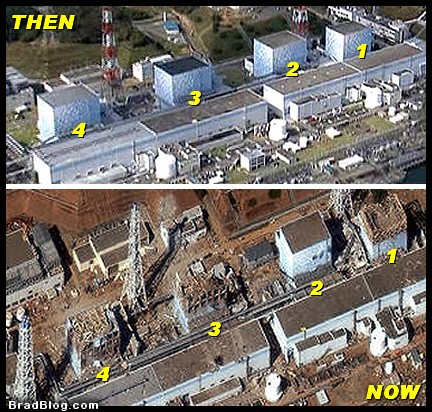
“On March 10 they had a multibillion-dollar asset that generated a lot of electricity,” David Lochbaum, director of nuclear safety at the Massachusetts-based Union of Concerned Scientists told reporters on a conference call today. “On March 11 they had a multibillion-dollar liability that’s going to cost a lot to clean up.”
“They’ve made considerable progress bringing equipment to the plant and restoring power,” he said. “But they’re not out of the woods yet. They are working with razor-thin margins.”
Japanese officials remain appropriately cautious at this hour as well, but positive signs for stabilization at the stricken Fukushima Daiichi nuclear plant continued on Tuesday…
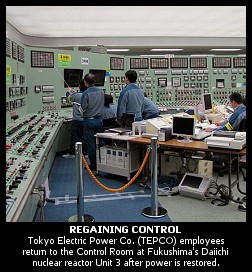 Each of the stricken reactors has now been linked to outside power, even as workers attempt to restore the pumps and cooling systems at each, so they can actually make use of that electricity. Alex Martin at The Japan Times offers this very helpful, straight-forward summary of the latest status of each reactor at the crippled plant as of Tuesday…
Firefighters sprayed a massive amount of water onto the spent nuclear fuel pool at the No. 3 reactor, while restarting similar efforts at the No. 4 reactor, according to Tokyo Electric Power Co.
Although white smoke — possibly steam — billowed continuously from the buildings housing the No. 2 and No. 3 reactors, Tepco said work could proceed as radiation levels didn’t surge at the site.
Defense Minister Toshimi Kitazawa said he believes the smoke rising from the No. 2 reactor was vapor given off by the water that has been sprayed, while the blackish smoke briefly detected Tuesday at the No. 3 reactor was likely rubble that caught fire following a rise in temperature.
Work to restore electricity resumed at 8 a.m. Tuesday.
With power restored to the No. 3 reactor, all of the plant’s six reactors have now been hooked up so that key equipment can be restarted, including ventilation systems to filter radioactive substances from the air and gauges in the control room.
Workers still need to check the condition of each piece of equipment before feeding the power in, the nuclear safety agency said.
Tepco hopes to restore power to key equipment, including data measuring devices, and functions by Wednesday for the No. 1 and 2 reactors and by Thursday for the No. 3 and 4 reactors, Hidehiko Nishiyama, a spokesman for the Nuclear and Industrial Safety Agency, said.
The March 11 quake and ensuing tsunami knocked out power at the plant, causing cooling system failures at the No. 1, 2 and 3 reactors, resulting in their apparent partial core meltdowns.
The pools storing spent nuclear fuel outside the reactors at the No. 2, 3 and 4 units have all lost their cooling functions, requiring coolant water to be pumped in, while hydrogen explosions have blown off the roofs and upper walls of the buildings housing the No. 1, 3 and 4 units.
…
Reactor No. 4 had electricity access restored at 10:35 a.m. Tuesday, and was also undergoing utility checks. Work was also being done to connect electricity between reactors 4 and 3, Tepco said.
As we noted in our last detailed report, the cooling systems are working again now at Units 5 & 6 which were both off-line prior to the March 11 earthquake and tsunami. They had seen rapid rises in temperatures at their spent fuel pools, but now temperatures at those two units have returned to manageable levels since power was restored to them late on Sunday.
In addition to information on the spreading discoveries of radiation being found in food, milk and tap water, Bloomberg reports: “Five kinds of radioactive materials released by damaged fuel rods were detected in the sea, Tokyo Electric said on its website. Levels of Iodine-131, which increases the risk of thyroid cancer, were 127 times higher than normal in a sample of seawater, the company said.”
Meanwhile, in this country, the U.S. Nuclear Regulatory Commission (NRC) — which has been very supportive of the nuclear energy lobby in recent years, rather than serving as strict regulators, according to critics — continues to offer mixed signals about concerns for nuclear power plants here.
Yesterday, NRC’s executive director for operations, Bill Borchardt told commissioners that officials have “a high degree of confidence” that operations at the 104 nuclear reactors in the U.S. are safe, according to AP, even as the commission “was set to approve a 90-day safety review of operations at U.S. facilities to comply with a call last week by President Barack Obama.”
But there were varying views among the members of the NRC as to whether enough was being done in the wake of the Japan disaster:
“Are we less prudent than the Germans?” he asked.
Borchardt replied that officials “asked ourselves the question every single day, ‘Should we take a regulatory action based upon the latest information?’ ” Each time, he said, the answer was no.
“I’m 100 percent confident in the review that we’ve done and we continue to do every single day that we have a sufficient basis to . . . conclude that the U.S. plants continue to operate safely,” he said.
“100 percent confident”? Really? Why does that level of confidence only serve to make us much — much — less confident in their judgment?

More on the Fukushima nuclear crisis earlier today in our 3/22/11 Green News Report for radio. And, of course, we continue to offer quick updates around-the-clock, as warranted, via Twitter.























The nuke reactors are safe on the coastline, and near the plates and fault-lines as long as the coalition of the Illuminati doesn’t fire up that haarp technology in earthquake mode again.
Oh wait, more earthquakes… a bunch of 6’s.
This is the global consciousness awakening, it’s time to put these rotten people in jails, turn off their death machines, and un-do their unconstitutional bs. Perhaps the fear of nuclear fallout and death is exactly what’s needed. If you don’t have a pit in your stomach, it’s because your still watching your tv, where the news comes late, and filtered.
And ol Barack he’s in the southern hemisphere’s jet stream. nice. Pelosi in Italy.
Where’s the god damn epa data in non-scientist format?
Senator seeks to block California reactor license renewals pending seismic study.
It would appear that NRC Commissioner George Apostolakis is what CA Republican State Sen. Sam Blakeslee had in mind when he expressed concern “about this culture of disregard of risk.†He said he would try to block PG & E’s license to run the Diablo Canyon nuclear power plant “unless the utility withdraws its renewal application pending a seismic study of the facility.â€
Blakesee, by the way, holds a doctorate in geophysics. The Diablo Canyon nuclear plant is located inside Blakesee’s district.
“100 percent confident”? Really? Why does that level of confidence only serve to make us much — much — less confident in their judgment?
Probably because they should not be more than 50% confident at most. It is 50 / 50 because it could go either way.
Low intensity radioactivity from that place landed in Iceland…
http://www.scientificamerican.com/article.cfm?id=radioactive-particle-traces
Well they got water into the #4 reactor pool again. Except there is no reactor pool in the #4 reactor building. In fact there isn’t even a #4 reactor anymore. What could have happened to make it disappear? On second thought maybe you shouldn’t answer that one.
We gotta ask Mr. 100% Borchardt how confident he was that the Fukushima facility was operating safely on March 10.
Then we gotta ask the logical follow up questions to reveal how naked he is.
Utter nonsense.
Here’s Amory Lovins with some sense–
http://www.commondreams.org/view/2011/03/19-1
Probably because they should not be more than 50% confident at most. It is 50 / 50 because it could go either way.
What TraLaLaLaLa said.
Your city, state, country have “budget” problems?
Look up “Comprehensive annual financial report” but don’t bpther looking it up on any syndicated media, they profit from it.
http://cafr1.com
Just so everyone, you know, reads things. Borchardt said that he was 100% confident in the review. Not that he was 100% confident that there wouldn’t be any problems in any US power plants ever. And I’m sure the Fukushima Nuclear Power Plant WAS operating safely before the earthquake. There is very little we can do to protect any structure from a magnitude 9 earthquake.
Also, Dredd. That is not how probability works.
What are those large white, cylindrical storage tanks next to a corner of each turbine-generator building? Are these for fuel next to the backup diesel-generator bunkers, or for fresh water storage? Or, were the two fuel tanks (that got washed away) the only fuel tanks for the diesel-generators.