
 [Update 12/22/10: Alaska Supreme Court decides against Joe Miller on all counts. Details here…]
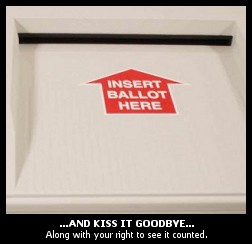
Having paper ballots is one thing. Seeing them actually be counted, unfortunately, continues to be quite another matter.
For those of you who may not understand why it’s not enough to merely have hand-marked paper ballots that are tallied only by oft-failed, easily-manipulated computers — even if those paper ballots could be counted by human beings “in the event there are questions about the results”, as supporters of such systems like to say — need look no further than the extraordinary finding on Monday from New York’s highest court, its Court of Appeals.
And, for that matter, what is likely to happen in Alaska very soon, where Republican Joe Miller continues to wait for a similar decision from that state’s Supreme Court in his fight for a hand-count of all paper ballots in his still-uncertified U.S. Senate race against Republican write-in candidate Lisa Murkowski and Democratic candidate Scott McAdams…
Where Have We Heard This Story Before?
As New York Election Integrity advocate Bo Lipari, of New Yorkers for Verified Voting explains today what happened in New York…
The contest in question is a race where just 451 votes, out of some 84,000 ballots cast, separate the two top candidates and where the results decided by the courts without actually bothering to have humans count the ballots, means that Republicans will gain a majority in the New York state Senate, allowing them “a critical voice in next year’s decennial redistricting and during at least the first two years of Governor-elect Andrew Cuomo’s term,” as Newsday reports.
“It’s okay to trust the machine,” is how Lipari describes the message of NY’s high court ruling, adding “The Court didn’t understand why we need to compare machine reported results with a manual inspection of ballots in the audit, failing to grasp that the way we get to the real result is counting the paper, not avoiding it at all costs.”
It is for this reason — and many others spelled out on these pages over the years — that we’ve argued merely having paper ballots is not enough. They need to actually be counted by human beings, publicly, with all parties and the entire community observing, video cameras rolling, and all done at the polling place immediately after polls close, with results posted then and there before ballots are moved anywhere or by anybody.
That is, as we’ve described it, Democracy’s Gold Standard. Unfortunately, many Election Integrity advocates, even including Lipari over the years, and even in his article today, seem to argue that it’s enough to just have the paper ballots which we can look at, as needed, in post-election “spot checks” to make sure everything is on the up and up, or otherwise for counting by humans in full “if needed”.
News flash: It’s always needed. It’s needed in New York. It was needed in New Hampshire, in Massachusetts, in California, in Arizona, and everywhere else, including today in Alaska, where voters are allowed to use paper ballots to cast their votes, but not allowed to see them counted — at least if we are to have a democracy in which all parties can know that the results of elections have been accurately tabulated and reported.
Not Unique New York
Over the past year, New York became the last state in the union to “upgrade” to fully computerized voting systems. Until this past election cycle, many of the state’s voters had continued to use mechanical lever systems which, supporters of those systems argue, are more reliable, more secure, cheaper to operate, harder to game, and, unlike paper-based op-scan systems, legal for use under New York’s Constitution.
Setting those arguments for lever machines (and the ones against them) aside, under a flawed and seemingly dishonest argument made by federal officials years ago in support of the horrible Help America Vote Act (HAVA) of 2002, New York was strong-armed into purchasing new electronic voting systems. As the state reviewed its options for that several years ago, Lipari and many other EI experts advocated strongly and effectively for the state to move to paper-based optical-scan systems, rather than 100% unverifiable Direct Recording Electronic (DRE, usually touch-screen) voting machines. They were successful in their arguments and, thankfully, New Yorkers are now allowed to vote on paper ballots, rather than being forced to vote on unverifiable DRE systems.
But as proponents of hand-counted paper ballots will argue, computerized systems for tabulating paper ballots virtually ensure that the ballots will rarely, if ever, actually be examined by human beings to determine whether or not the incredibly flawed, easily manipulated computer systems are actually accurate.
The decision by the New York Court of Appeals this week underscores the strength of that argument. Again.
The state is now fighting about when full hand-counts ought to be required, if ever, and how much of a post-election “audit” of ballots is necessary to help determine that. As Newsday reports in their coverage of the NY state senate contest:
[Republican “winner” Jack] Martins’ attorney, Peter Bee, asked the judges to avoid adopting a standard for future elections. He said cases should be determined “with standards of reasonableness and standards of discretion without outlining a perfect, bright-line rule.”
Bees’ sentiment is, of course, a rather convenient one for the Republican “winner” in this case. We suspect Republicans may (correctly) feel differently the next time the issue comes up and they find themselves on the “losing” end of an incredibly close, unofficial, unverified computer tally. Didn’t the GOP argue in Bush v. Gore that rules for elections need to be determined, with “bright-line rule[s]” if you will, before they are carried out?
But the next two grafs from Newsday are simply breathtaking…
“What happens the next time a gubernatorial election is won narrowly by one candidate or the other?” he asked. “Are we going to count millions of paper ballots by hand?”
My goodness! Imagine a narrow state-wide election in which the future of the state hangs in the balance and the losing candidate and his/her supporters think they actually may have won instead of lost. Are we going to allow them to find out for themselves whether they did? Or are we simply going to trust in the state’s oft-failed, easily-manipulated computers made by Dominion (a Canadian firm using e-voting Intellectual Property (IP) owned by Venezuela), and those made by the private e-voting firm, ES&S (a company which has their own long history of failure)?
Apparently the NY Republicans are choosing the latter, “voting” against citizens and in favor of the private companies and their un-overseeable tallies. And the state’s highest court has now has ruled that unverified counts produced by systems made by those companies are more reliable, apparently, than counts done by actual New York citizens. Unfortunately, that same belief continues to be the “law of the land” in most other states as well where it is incredibly difficult and/or expensive for a candidate to see an actual hand-count of ballots cast in their race.
Moreover, Lipari’s own blog item, in using the metaphor of a bag of marbles to detail the absurdity of the court’s decision, even tends to undermine his own argument that post-election “audits” or “spot-checks” are enough to determine if a full hand-count is needed. You can see his argument for yourself, and it’s a good one, but it doesn’t underscore the need for post-election “spot-checks”, it — and the finding of the New York court — underscores the need for paper ballots to be tabulated correctly and transparently in the first place, since it’s a rare case where those ballots will ever be properly examined after the computers have announced a “winner”, no matter whether the computers are accurate or not.
Meanwhile, in Alaska, a similar story…
 That same issue is currently being decided by another high court, this one in Alaska, where Republican candidate Joe Miller has called for a hand-count of paper ballots in the U.S. Senate race in a state where, as we detailed at length not long ago, inexplicable computer tallies, including still-unexplained disparities of hundreds of thousands of votes, have marred election after election over recent years. Though there is a paper ballot for each vote cast in Alaska, yet another candidate is being forced to go to court to try and convince the state they should actually be counted by human beings before a winner is declared.
The AK Supreme Court is set to rule any day now in regard to Miller’s appeal [PDF] in his state election contest [PDF] where he is alleging that the liberal way in which Murkowski’s write-in ballots were tallied was in violation of state law requiring perfectly correct spelling of write-in candidate names. He is also arguing for a complete hand-count of ballots on, essentially, two bases: First, that alleged voting irregularities occurred, requiring a closer review of all ballots. And, secondly, the fact that Murkowski’s write-in ballots were examined by hand (necessarily, since the optical-scanners can’t read hand-writing), giving her tally more accuracy than that afforded everyone else by the Diebold op-scan systems used across the state.
On the matter of the State Division of Election’s liberal interpretation of the election code (AS 15.15.360) which states that at least the last name of a write-in candidate be written “as it appears on the write-in declaration of candidacy” in order to be counted for the candidate, the lower court has offered a rather liberal, even Clintonian, interpretation of the law, declaring that it appears to depend on the definition of “appears”. That, despite the law which also reads “A ballot may not be counted unless marked in compliance with these rules.”
“The use of ‘appears’ allows variations of the write-in candidate’s name to be accepted. ‘Appears’ does not mean ‘exactly,’ ‘precisely,’ or ‘perfectly,’ but rather ‘close to,’ ‘like,’ or ‘resembles.’ … The definition of ‘appears’ in this context does not require perfection or precision, but rather a close, apparent approximation known to the viewer upon first look,” the lower court judge ruled [PDF]. “If exact spellings were intended by the legislature, even with respect to the most difficult names, the legislature could have and would have said so.”
But a “first look” at what? Up until this year, as The BRAD BLOG reported in October, Alaska had never before supplied a list of write-in candidate names to polling places, as Division of Elections director Gail Fenumiai admitted herself in response to our public records request.
Had Republicans supported the lower court’s loose interpretation of election code in 2000, Bush v. Gore would likely never have even been necessary, Al Gore would have been named the winner in very short order, in an election where, had paper ballots been allowed to be counted by humans, it would have determined [PDF] that he won the state and the Presidency along with it. But had “voter intent” been allowed as the standard for counting votes, the way Alaska is now arguing, despite their laws which suggest otherwise, Gore would have easily won long before Bush made a federal case out of it.
Miller has argued that some 8,000 votes tabulated for Murkowski should be discarded on the basis of such spelling errors, and those voters completely disenfranchised in the race along with it. While that sort of mass disenfranchisement is likely appalling to anybody who supports democracy, the (rather reasonable, and arguably appropriate) “voter intent” basis on which Alaska is determining valid votes ought to be encoded into law to avoid such disputes in the future.
The BRAD BLOG had, of course, predicted this mess months ago, in September, when Murkowski first declared her intention to run as a write-in candidate after losing to Miller in the GOP primary, and after the AK Div. of Elections made clear that they were sort of making it all up as they went along.
However, even if Miller’s hopes of tossing all 8,000 votes were agreed to by the courts, he’d still be behind Murkowski by some 2,000 votes in the still-unofficial results where the majority of votes were tallied only by op-scan systems with a dreadful record of failure. The arguments Miller’s team has forwarded to date concerning “voter irregularities” are not particularly well supported, but his Constitutional “equal protection” argument, essentially that votes recorded in favor of Murkowski had more weight than those tallied by the flawed e-voting system, has a great deal of merit — particularly if one is familiar with the failings of these systems.
So, despite available paper ballots which show conclusively who actually won and who actually lost, Miller finds himself in the state’s highest court, at great expense, fighting to actually have them counted by human beings so we can all find out who actually won and who actually lost.
We don’t agree with Miller on much of anything, policy wise. Nor do the knee-jerk, largely substance-less “voter fraud!” arguments advanced by his initial team of hard-Right partisans seem to amount to much more than the usual GOP fear-mongering over largely non-existent “voter fraud”.
But on the right for all ballots to be counted in the same way, and, even more importantly, for all candidates and all voters to know that their election results were tabulated accurately, a public hand-count of ballots should not be so difficult for any candidate to have. If such a count occurred on Election Night, in front of everyone at the polling place, many of these fights (which we’re seeing more and more of each cycle) would be wholly necessary.
“The fact is, this is about the integrity of the election,” Miller was quoted by AP as saying earlier this week. “Making sure we’ve got a clear process that we can apply, not just in this election but in future elections, making sure that the rule of law is upheld.”
“And that really is the goal here,” he continued. “Once that’s done, obviously, we’re going to sit back and respect whatever the numbers are. But that hasn’t happened yet.”
Whether Miller is saying those words — all of the right ones as far as any serious Election Integrity advocate would likely agree — for his own personal long-shot benefit, or whether he actually means them is of little matter. He is spot on. And it shouldn’t be as difficult for him, a Republican, or for Johnson, the machine-reported Democratic “loser” in New York, or for their supporters, or for candidates and their supporters anywhere else, to know that an election has been decided fairly and accurately.
The majority of voters in the United State are now able to cast their vote on a hand-marked paper ballot, thanks in no small part to democracy advocates like Lipari in New York and others all across the country. So now that we’ve got paper ballots, how about we now actually bother to count them?
CORRECTION: New York’s high court is actually called the Court of Appeals, as opposed to Supreme Court, as per this map. References in the article above have been modified to correctly reflect the naming in NY’s court structure.
I hope this (the NY ruling) can and will be appealed. It almost seems as if the court regards paper ballots as merely decorative, at least when they stand in the way of getting Republicans into office; perhaps they regard democracy similarly.
AIoT – Following the NY Supremes’ decision, the Democratic candidate conceded the race. There will be no appeal (to what would need to be a federal court), as made apparent by the concession and by the lack of Constitutional issues raised during the contest, as I understand it.
On the other hand, Joe Miller has raised Constitutional issues in his case, which he actually filed, initially, in federal court (which remanded it, for the time being, back to the state to deal first with the issues of state law). Depending on the findings of the AK Supremes, Miller could well appeal to federal courts, if he is so inclined.
Brad, great article. Having been intimately involved in the Alaska election (including the write-in counting effort in Juneau), I wholeheartedly agree with this article. The Senate Election process in Alaska was a fiasco, from the beginning, where they disallowed, then allowed the write-in lists to be present at the polling place.
I reviewed thousands of ballots in Juneau as the final reviewer for Miller over the final four of seven days of counting.
I take issue with only one of your positions, that is:
>>the (rather reasonable, and arguably appropriate) “voter intent” basis on which Alaska is determining valid votes ought to be encoded into law to avoid such disputes in the future.
On a practical level, the law needs to provide an objective standard by which an party can (reasonably) review the facts of a situation and come to the same conclusion. In the case of Gail Fenumiai, Director of the Division of Elections, being the sole person (with no documented standard) to determine what was a vote for Lisa and what wasn’t, then it was simply (and essentially) if the person wrote Lisa (or some variation thereof) and there was an M and a K in the last name, the was good enough !
the bottom line is you CANNOT determine voter intent ! All you can do is apply an objective standard to the ballot. for example, if the oval wasn’t filled in but the person wrote Lisa Murkowski, how can you reasonably say that there was no intent to vote for Lisa ?
Plus, there were significant “protest” votes, so how do you factor this in ? such as
Murcowsh*t (without the *)
Murkowski with a sad face
Fu** Lisa (not with the *’s)
And here are ballots Gail accepted:
Muskisk
Murcosaga
Murski
it’s really not that hard to spell Murkowski
Please have a look at my website (in my profile), plus review this (long and detailed) write-up of the proceedings.
Plus, although I suppose an anti-Miller person could gripe that this is sour grapes, what is the point of having a primary if the winner is not going to be – the winner ?
I wish I had faith in a legal appeal to a higher court but where might it end up, SCOTUS? As I recall from 2000 they see little virtue in counting ballots and don’t hesitate to substitute their ability to appoint for an actual vote count.
As to the NY precedent, the replacement of lever machines with hackable computers, followed by the ruling that ballot counting is extraneous, resonates like a one-two punch at the vital connection between my ballot and the end result.
Once counting paper ballots is illegal, we won’t even have to bother wondering if scanner ounted elections are rigged or inaccurate. A major link to detection wlll have been removed, increasing the deterrence factor.
It would be interesting to know the history of the AK law stipulating name spelling has to be accurate for the vote to count.
It sounds like the kind of law that majority parties would want in place to discourage independent candidacies screwing up a two-horse race.
Nobody else in the voting process is expected to be able to spell properly, or demonstrate that they colored the oval by a name they can read.
Is this essentially a write-in literacy test?
Agreed that the rules need to be clear in advance and should not change when the ball is on its way down the field.
I will go out on a limb and say that many of the misspellings are likely for Murkowski; however, a liberal but noncodified decision making process like that gets murkier 1) when two people with similar names are running and the race is close and 2) when the spelling could conceivably be a vote for the candidate but awfully close to e.g. a celebrity name, as well.
@ctwatcher comment 5
er, make that DECREASING the deterrence factor.
Bill in Baltimore:
Thanks much for your additional insight. Particularly helpful from someone who was working up there on Miller’s behalf.
As to where you take issue with one of my points…
Allow me to both agree and disagree, in part, with you here.
I think my language where you quoted me is, in fact, a bit misleading as to what I was trying to get at. I’m not suggesting that the *specific* basis on which the state is currently determining “voter intent” is good or should be encoded into law. But rather, the notion of “voter intent” being the determining factor in accepting/rejecting ballots needs to be encoded into law.
You are right that no one person — Fenumiai in this case — should be the sole arbiter of voter intent. But voter intent is, in fact, discernible in almost every case, as we saw up in Minnesota, for example, when out of some 3 million ballots cast, a broad swath of multi-partisan observers and judges agreed upon the voter intent unanimously in all but about a dozen or so ballots (as memory serves).
They had a very smart, transparent and multi-partisan process to both determine voter intent as well as to adjudicate disputes about that all along the way (at the local counting level, the county level, the state level and finally the judicial level). They showed the nation how it can and should be done in cases where ballots must be centrally counted by hand and all but the most absurdly partisan was able to come to consensus on just about every single ballot, leading to results which were accepted by all (serious) parties.
So yes, I believe voter intent can absolutely be determined, but the way in which that will be done needs to be encoded into law before the election, not on an ad hoc basis as the AK DoE seems to have done.
You can’t. Such a vote should absolutely be counted for her, and where the DoE has said otherwise, they are simply wrong. The GOP argued similarly in both FL 2000 and in the case of a write-candidate for Mayor of San Diego in 2004 (where they tossed out ballots where the name was correctly written, but the oval wasn’t filled in — the write-in mayoral candidate would have won, rather than the Republican who did, under the hard Right control of the SD Registrar’s office at the time.)
But that’s what I mean about encoding such rules into law. In the AK case you mention above, the DoE determined they would go by the election code (which requires the oval to be filled in), but then ignored the rest of the statute, or liberally (rather absurdly, frankly) interpreted the word “appears” as I note in the article.
In any case, I may review the phrasing I used on the passage you object to and possibly tweak it to be a bit more clear as to what I was getting at. So I thank you for pointing that out.
Perhaps not for you, but you are well educated and very literate. Neither of those two things is, or should be, a prerequisite for someone to exercise their franchise.
Not sure what you mean by that. Are you saying Murkowski should not have been allowed to run as a write-in? If so, then I strongly disagree. She, like any other citizen who meets the legal requirements, may do so. Should the Republican Party hold it against her? I would! 🙂 But that’s a different matter than whether she should be allowed to run or not.
Thanks again for the thoughts, Bill, and I’ll look forward to checking out the links you shared.
Brad in #7:
“So yes, I believe voter intent can absolutely be determined, but the way in which that will be done needs to be encoded into law before the election, not on an ad hoc basis as the AK DoE seems to have done.
if the oval wasn’t filled in but the person wrote Lisa Murkowski, how can you reasonably say that there was no intent to vote for Lisa ?
You can’t. Such a vote should absolutely be counted for her, and where the DoE has said otherwise, they are simply wrong.”
First, I agree with your position that these are legal votes. It doesn’t matter if the oval is marked, as long as the write-in doesn’t create an overvoted ballot, these ballots should be counted for Murkowski.
But as I read your argument, you make the point that rules should be encoded into the law. This appears to me to be the case in Alaska.
Miller v. Treadwell, ASC, 12/22/2010:
“The Division did not count a number of ballots for Murkowski because the voters had not filled in the ovals next to the write-in line, even though the voters had written in Murkowski’s name. Murkowski argues that these votes should have been counted for her.50 We disagree. Alaska Statute 15.15.360(a)(10) states that “[i]n order to vote for a write-in candidate, the voter must write in the candidate’s name in the space provided and fill in the oval opposite the candidate’s name.†(Emphasis added.) Although AS 15.15.360(a) does not address spelling, marks that validly “fill in the oval†are subject to the requirements of AS 15.15.360(a)(1) and (a)(5), which state:
(1) A voter may mark a ballot only by filling in, making “X†marks, diagonal, horizontal, or vertical marks, solid marks, stars, circles, asterisks, checks, or plus signs that are clearly spaced in the oval opposite the name of the candidate, proposition, or question that the voter desires to designated.
. . . . .
(5) The mark specified in (1) of this subsection shall be counted only if it is substantially inside the oval provided, or touching the oval so as to indicate clearly that the voter intended the particular oval to be designated.
In other words, the statute mandates that the write-in voter mark the oval in some fashion; a blank oval will invalidate the vote. Writing in the name but not marking the oval is not compliant with the statute. Murkowski is not entitled to declaratory judgment that AS 15.15.360 should be interpreted to excuse write-in voters from marking ovals as required by law.51 Accordingly, we affirm the decision of the superior court on this issue.”
It seems to me that the court has contradicted itself. Earlier in the opinion, they state:
“Guided by this polar principle, we declared in Edgmon v. State, Office of the Lieutenant Governor, Division of Elections that “the voter shall not be disenfranchised because of mere mistake, but [the voter’s] intention shall prevail.â€
Even though this is the code (Alaska Statute 15.15.360(a)(10)), it needs to be looked at by the State Legislature. No vote should be disqualified for this reason.
lottakatz in #4:
“I wish I had faith in a legal appeal to a higher court but where might it end up, SCOTUS? As I recall from 2000 they see little virtue in counting ballots”
The blame belongs to Gore, not the court.
Three times, the Florida Supreme Court reminded us that Dec. 12th was the deadline. In fact, they noted that Gore agreed that this was the law of the state. After that date, the dispute becomes a matter for Congress to decide.
Gore had 36 days to file and get a fair recount. He never made such an attempt. Twice, he tried to skirt the law and get partial recounts of the state. If you are trying to get a fair recount, you should have at least try to get all the ballots with the same defects recount (over and undervotes). He didn’t even make that kind of effort.
“and don’t hesitate to substitute their ability to appoint for an actual vote count.”
The USSC did not appoint Bush. There were no judicial electors sent to the Electoral College for Bush, nor is Congress required to accept such electors.
From the article:
“Had Republicans supported the lower court’s loose interpretation of election code in 2000, Bush v. Gore would likely never have even been necessary, Al Gore would have been named the winner in very short order, in an election where, had paper ballots been allowed to be counted by humans, it would have determined [PDF] that he won the state and the Presidency along with it. But had “voter intent” been allowed as the standard for counting votes, the way Alaska is now arguing, despite their laws which suggest otherwise, Gore would have easily won long before Bush made a federal case out of it.”
Brad, I disagree. There is no proof that Gore won, there never will be. Gore had the chance to get a fair recount, he decided not to do so.
“Had Republicans supported the lower court’s
By citing the Consortium study, it is clear to me that you are talking about the order from the Florida Supreme Court. The case was Gore v. Harris, decided 12/8/2000.
“loose interpretation of election code in 2000,”
This is the reason why Gore could NOT win in the Electoral College. “Loose interpretation of election code” would allow the Bush supporters in Congress the political cover to vote against seating Gore as President.
“Bush v. Gore would likely never have even been necessary,”
IF Gore had followed the law, Bush v. Gore would not have been necessary.
“Al Gore would have been named the winner in very short order, in an election where, had paper ballots been allowed to be counted by humans,”
Considering that the order was flawed, who knows who would have won. IF Gore had managed to “win” this partial recount, he still has to face Congress with his judicially appointed electors. I highly doubt that Gore would have gotten enough support he needed to win the Electoral College (partisans will be partisans).
“it would have determined [PDF] that he won the state and the Presidency along with it.”
I find it ironic that you would cite a partial study of the disputed ballots as proof that Gore would have won. As I have proven on this blog before, the Consortium missed close to 5000 disputed ballots.
If you claim that democracy is based on counting all votes, why cite a partial study to make your point?
“But had “voter intent” been allowed as the standard for counting votes, the way Alaska is now arguing, despite their laws which suggest otherwise, Gore would have easily won long before Bush made a federal case out of it.”
You are comparing apples to oranges. In the case of Alaska, the court said:
Miller v. Treadwell, ASC, 12/22/2010:
“We fail to see how having one person examine all overcount, undercount, and write-in ballots and all ballots challenged by either candidate is not a uniform standard.”
In Florida, we had many people recounting ballots, who couldn’t even agree what was a legal vote. As Justice Souter wrote:
His dissent in Bush v. Gore:
“But evidence in the record here suggests that a different order of disparity obtains under rules for determining a voter’s intent that have been applied (and could continue to be applied) to identical types of ballots used in identical brands of machines and exhibiting identical physical characteristics (such as “hanging†or “dimpled†chads). See, e.g., Tr., at 238—242 (Dec. 2—3, 2000) (testimony of Palm Beach County Canvassing Board Chairman Judge Charles Burton describing varying standards applied to imperfectly punched ballots in Palm Beach County during precertification manual recount); id., at 497—500 (similarly describing varying standards applied in Miami-Dade County); Tr. of Hearing 8—10 (Dec. 8, 2000) (soliciting from county canvassing boards proposed protocols for determining voters’ intent but declining to provide a precise, uniform standard). I can conceive of no legitimate state interest served by these differing treatments of the expressions of voters’ fundamental rights. The differences appear wholly arbitrary.”
Until you can cite a “study” or a “recount” that includes all of the spoiled ballots, along with the overseas ballots that were declared valid on Dec. 9th and again on Dec. 11, 2000, you will never be able to prove that Gore really won.
If Gore really thought that he won, maybe he should have filed for a full and fair recount of the ballots.
Mark Da Shark:
In your comment @8, I just want to go on record agreeing with you — since that so rarely occurs — that the court seems to have contradicted itself by declaring “voter intent” as the overriding determinant factor for counting ballots in one place (regarding spelling), but not in the case of a failure to fill in an oval next to the name written in, where they happily toss out what appear to be otherwise valid votes there.
As to your comments @9 and @10, I have no interest in, yet again, relitigating the Bush v. Gore case with you here, and your lengthy legal assertions (which I strongly disagree with) that Gore’s attempts to receive recounts were, in some way, not fair and/or against the law. Your argument, while I believe that you believe it as a Bush supporter (and the SCOTUS just happened to agree with you as well), is wrong.
My mention of Bush v. Gore in the context above is that the GOP argued votes could not be counted by human beings in FL2000 because that somehow would apply a different standard for counting in one county versus another (ridiculous, since each county already has different methods of counting across the state, with each county using differing equipment, and even within counties themselves where ballots are counted one way when cast at the polls, and another way when cast via absentee) and to the point where “voter intent” should be the determinant factor for judging validity of a vote. Voter intent was quite clear on thousands of ballots that were tossed out as “spoiled” in Florida, but the GOP argued that “voter intent” didn’t matter, following the prescribed “rules” did. A convenient argument then, not so convenient now for supporters of Murkowski, in any event.
Brad in #11,
“…..while I believe that you believe it as a Bush supporter…..”
We do seldom agree. Part of the problem is that you take such indefensible positions, and then claim partisanship is the reason why your critics are wrong.
“…..that Gore’s attempts to receive recounts were, in some way, not fair and/or against the law…..”
Again, you have not only taken an indefensible position, but it CONTRADICTS what you said in other places in this blog.
Of course it was unfair to only recount in 4 counties. If you have a box with 179,855 blue and red marbles, how are you going know how many of each color you have if you only grab a handful and count just them?
My argument is that Gore violated the law by trying to get partial recounts of the state. Even though he was not entitled to a recount punchcard ballots under Fla. Stat. 102.166, he managed to get the FSC to go along with his 4 county recount. That order was vacated by a UNANIMOUS decision of the USSC (yes, even the liberals agreed) because it appeared to them to be a rewriting of election code.
The second attempt, where he was REQUIRED to ask for a statewide remedy to a statewide problem, he FAILED to do so. He claimed is was an “error of law” to recount ballots on a statewide basis. The order from the FSC was again, a partial recount of the spoiled ballots.
My point STILL REMAINS, Gore was only entitled to one manual recount. That was under Fla. Stat. 102.168, it must be statewide, with a uniform counting standard, and must be completed by Dec 12. None of this, a dimple chad is a legal vote at this counting table, but is not at a table across the room.
In thread 8270, you complain “…..the results of votes tallied only by computer systems made by Diebold, Inc. — and never checked for validity by human beings — would once again rule the day.”
But when it comes to Florida 2000, you tell us that it is was “legal” to ignore thousands of ballots in the state. In other words, they don’t need to be recounted by human beings.
It doesn’t matter if it was “legal” or not, that is not the issue. It isn’t right. DRE’s are legal in some states, but neither of us support their use.
You talk a good game, but when are you going to walk the walk?
Mark da Shark @ 12:
Seriously? When am I gonna “walk the walk”? Look, Mark, your comment above reveals that you’re largely clueless about these matters and yes, seem to be more interested in hanging your hat on partisanship rather than reality or the rule of law. As you said:
No. That’s why I claim *you* are wrong in this issue. I’m quite certain I’ve long ago demonstrated my non-partisan creds when it comes to dealing with issues of Election Integrity (I’m going to bat for Joe Miller of late, for chrissakes!) Your argument is wrong because it’s wrong. As it is in your comment above.
My position does NOT “CONTRADICT” anything I’ve said in other places on this blog.
You seem to have a problem with the difference between “unfair” and “illegal”. Furthermore, you seem dreadfully unaware of how election law actually works. If you’d like to argue that Gore’s recount request in four FL counties was “unfair”, you’re entitled to your opinion. That was, however, the law at the time, which allowed him to request a recount in any county. As a matter of fact, there was no mechanism, to my knowledge, to request a full state recount. Had he wanted to recount the entire state, he’d have had to request same in each and every FL county.
That is neither “unfair”, “illegal”, or even particularly unusual. In CA, for example, any elector (voter) may ask for a recount of any race, in any county they wish. That contestant then gets to choose which precincts will be recounted. They may choose to recount one precinct, several, or all of them. Up to them. Is that “unfair”? I guess you might argue as much, but I don’t much care about that argument. It’s the law and perfectly legal.
There was no violation of law in his doing so. The law might have been found to be unconsitutional (under either FL or US constitution), but it was not illegal or in “violat[ion] of the law” to do so. So you’re either a very bad lawyer on this point or so blinded by partisanship that you’re willing to charge a former Vice President/Presidential candidate with breaking the law by asking for a recount. That is, of course, laughable.
Apples and oranges. The discussion about FL 2000 was not about whether ballots should or shouldn’t have been hand-counted. I would, of course, have been in favor of counting every vote by hand, transparently, if the chain of custody was known to have been secure. (And, btw, most of the counties that did “recount” in FL, merely did a machine recount, running the same ballots through the same machine again, instead of hand-inspecting them, which is now illegal in the state of FL, btw.) But that’s not the issue you and I were debating.
Our FL2000 debate, in other words, is totally different from the Alaska Senate race where we have known deficincies in the electronic tabulation system, in a state with a history of unreconcilable computer-tallied election results. I would love to see all of those ballots in AK counted by human beings and verified for accuracy (as I would have in FL). That is true in any election. But it is also perfectly “legal” (unfortunately), to allow the machines to tally some or all of the ballots. Joe Miller may succeed in his federal, Constitutional argument that it’s unconstitutional to do so, as I described in my analysis of his suit last night. He may, therefore, receive a remedy from the federal court which could include an order to count all the ballots in the state by the same method, which would have to be by hand, since the machines can’t discern write-in votes. But I have never argued it was illegal to count as they did in either FL2000 or in AK2010.
Of course it matters what is “legal” and what isn’t. You are welcome to offer what you think is or isn’t “right”. But to suggest Al Gore “violated the law” by asking for his recounts, or that Alaska doesn’t have the right to determine the way they count their own ballots is absurd. And legally wrong. Again, your argument (not the argument of folks I disagree with, just yours) seems to be based on your strident partisanship for George W. Bush and your interest in defending him even when the position is indefensible. I am certainly no partisan for Joe Miller, but I thoroghly support his efforts to see every ballot in the state transparently hand counted.
Every day, sir. You?
Brad in #13,
“You seem to have a problem with the difference between “unfair” and “illegal”. Furthermore, you seem dreadfully unaware of how election law actually works. If you’d like to argue that Gore’s recount request in four FL counties was “unfair”, you’re entitled to your opinion. That was, however, the law at the time, which allowed him to request a recount in any county.”
I have explained why you are wrong before. Let me do so again.
The law that you are referring to is Fla. Stat. 102.166. This law deals with MACHINE ERRORS in a specific precinct or county. It is NOT designed to settle a STATEWIDE issue such as 179,855 spoiled ballots in every county of the state.
In 1992, Broward v. Hogan, it was found that over and under voted ballots were VOTER ERROR, thus Gore was not entitled to a recount of the punch card ballots under this code because it is NOT machine error.
The FSC did rewrite the laws (see Palm Beach v. Harris 11/18/2000) as to allow Gore to have a recount under this code, but it was vacated by a 9-0 decision of the USSC (see Bush v. Palm Beach 12/4/2000).
“As a matter of fact, there was no mechanism, to my knowledge, to request a full state recount. Had he wanted to recount the entire state, he’d have had to request same in each and every FL county.”
Come on Brad, please. You never heard of Bush v. Gore??????? That is what you are saying!!!!
Gore filed his complaint (11/27/2000) under this specific code, i.e. Fla. Stat. 102.168. The case was Gore v. Harris.
Judge Sauls found that Gore failed to file a proper challenge because he didn’t ask for a statewide remedy for a statewide problem (see Gore v. Harris 12/3/2000).
On appeal, the FSC agreed that this required a statewide remedy, but then FAILED to order a statewide recount of all 179,855 spoiled ballots (see Gore v. Harris 12/8/2000).
Then Bush appealed the case, and it became Bush v. Gore.
I find it hard to believe that you don’t know about this law, especially when it was this that law used that was used to bring the case to the USSC.
If you don’t even know about Fla. Stat. 102.168, I am sorry, but I have to ask, have you actually read these cases? Do you really understand what they said? Where do you get your information? Clearly it is not from the Florida Code book or from reading the cases.
“Apples and oranges. The discussion about FL 2000 was not about whether ballots should or shouldn’t have been hand-counted. I would, of course, have been in favor of counting every vote by hand, transparently, if the chain of custody was known to have been secure.”
Yet, you defend Gore misuse of the law. It seems to me that you are trying to have it both ways.
“(And, btw, most of the counties that did “recount” in FL, merely did a machine recount, running the same ballots through the same machine again, instead of hand-inspecting them, which is now illegal in the state of FL, btw.) But that’s not the issue you and I were debating.
You do know that the machine recount under Fla. Stat. 102.141(4) did not include about 25% of the ballots?
“Of course it matters what is “legal” and what isn’t. You are welcome to offer what you think is or isn’t “right”. But to suggest Al Gore “violated the law” by asking for his recounts, or that Alaska doesn’t have the right to determine the way they count their own ballots is absurd.”
Clearly, you do not understand my point. It is NOT that he “violated the law” by asking for his recounts. Gore violated the law by using the wrong code in his first attempt at a recount, and violated the law by not asking for a statewide remedy in the second attempt.
“Again, your argument (not the argument of folks I disagree with, just yours) seems to be based on your strident partisanship for George W. Bush and your interest in defending him even when the position is indefensible.”
I see that you went running back to your crutch. Well, at least you are consistent. I find it hard to believe you can make a judgment about my position, when you don’t even know about the laws that governed that election.
Mark da Shark:
I’ll open by quoting the same opening graf I just typed to you in another thread, in response to your other latest All-Bush v. Gore-All-The-Time screed:
You seem to have a great difficulty between distinguishing your (and James Baker III’s) opinions and/or spin of cherry picked laws, and what the laws actually say and/or what Gore argued about them.
That same confusion about your (and Baker’s) opinion of law is akin to your confusion between “violations of law” by Al Gore, and Supreme Court findings that a particular law or court decision was in violation of the Constitution.
There was no “violation of law” in Gore asking for a recount in four counties. You, however (and James Baker III and the Republican SCOTUS) felt that the FL mechanism that allowed/required that, was in violation of the Constitution. That the FL Supreme Court “rewrote” law to require a full statewide count is not the same as Gore’s legal team “violating the law”, by following what was, at the time they filed, the law of the land!
I can’t believe I’m either bothering to go back and forth with you on this. Again. Please move on. If you actually give a damn about actual democracy (versus assuring your preferred 2000 Presidential candidate is somehow cleared in history of having been selected, rather than elected), I’m quite sure there are many ways you could prove your bona fides here. But somehow, I suspect that’s not really your main interest in showing up here at all.
If there isn’t, please take your Bush propaganda and history rewrite elsewhere where someone may actually be interested in it.