
 Those who follow me on Twitter may already know that I’ve been referring there to the New York Times’ shameful coverage of the Richard Blumenthal situation as the paper’s “ACORN Pimp Hoax REDUX.”
Their front page exposé last week suggested that Connecticut’s Attorney General — the leading Democratic candidate for the U.S. Senate — was, perhaps, a serial liar because, the “paper of record” informed readers, he’d exaggerated his service in the military. But then we learned that the Times had failed to share the complete video taped comments from a recent speech. Instead, they chose to quote and share just one selective portion out of context to help make their case.
Not only did the complete video — which Times Executive Editor Bill Keller now admits the paper had seen prior to publication of their story — offer additional comments from Blumenthal in the same speech, which may have mitigated the comments the Times selectively shared with readers, the paper also failed to share with readers that the story had been fed to them originally by the campaign team of one Blumenthal’s Republican rivals for the U.S. Senate seat.
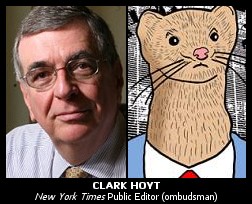
Now that the NYTimes’ Public Editor, Clark Hoyt — supposedly the paper’s “readers’ representative” or ombudsman — has rung in with his “verdict” on the whole mess over the weekend, we can officially announce that the comparison to the Times’ shameful response to the ACORN Pimp Hoax scandal, which we spent the better part of three months detailing earlier this year, is complete…
The Blumenthal brouhaha started with the Times’ scoop by Raymond Hernandez where he’d quoted — and posted a :58 second video excerpt — from a 2008 speech honoring vets and senior citizens in which Blumenthal said “We have learned something very important since the days that I served in Vietnam.”
Blumenthal, however, served state-side during the Vietnam War, rather than “in Vietnam.”
However, at the very beginning of the complete version of the very same speech — in a portion that was neither quoted nor posted by the “paper of record,” but noted by AP in a report responding to the Times — Blumenthal referenced himself “correctly” as [emphasis added] “someone who served in the military, during the Vietnam era.”
Subsequent follow-up coverage of the NYTimes’ reporting by other media outlets found that the Times may have been as guilty as Blumenthal, perhaps even more so, of exaggeration in their story, which could end up dashing the hopes of Democrats to hold onto the seat being vacated this year by the retiring Sen. Chris Dodd.
The Hartford Courant’s Colin McEnroe contacted state reporters who’ve covered Blumenthal for years and found that, nearly to a one, as Media Matters’ Matt Gertz noted “none had stated that they had ever heard Blumenthal say that he served in Vietnam.”
“Every time he talked about his military record, he was quite clear that he had been a military reservist and never came close to suggesting he was in Vietnam,” the Connecticut Mirror’s Mark Pazniokas — who, as McEnroe reports, “may have covered Blumenthal more often than anybody else” — told the Courant.
Just as the NYTimes did when they were first contacted about their inaccurate (and, in that case, repeatedly inaccurate) coverage of the ACORN Pimp Hoax, as The BRAD BLOG exclusively reported earlier this year, the paper offered absurd excuses and rationalizations for the failures in their report when initially questioned by other media.
Greg Sargent of “The Plum Line” blog at the Washington Post aptly observed, in regard to the paper’s initial response to the portions of the speech they didn’t bother to let readers know about:
Even if you don’t believe the longer video is exculpatory in any way, as The Times says, there’s no conceivable reason for leaving out the fuller context and letting readers make the call for themselves. It seems obvious that when dealing with a story this explosive, you would want to err on the side of more context, rather than less.
“More context” which the New York Times also failed to include in Hernandez’ report: the fact that they were tipped off to the story in the first place by the campaign of Linda McMahon, one of Blumenthal’s potential Republican opponents for the U.S. Senate seat.
Public Editor Hoyt’s response in the paper to all of this came over the weekend. At least it didn’t take two months, as with his ultimate response to the Times’ ACORN Pimp Hoax fail. But, as with both his extraordinary emailed responses initially sent to The BRAD BLOG and in the column he finally published in which he somewhat corrected his initial responses to me, and admitted that both he and the Times were “wrong” in at least one aspect of their “pimp” coverage, Hoyt by-and-large played defender of the paper, not of the readers as is his supposed mission.
Yesterday, Media Matters’ Matter Gertz observed that Hoyt’s column on Blumenthal “misses [the] mark” by “ignor[ing] several key pieces of information that have come to light since the original story went to press, and even promotes a key falsehood that the Times’ PR staff has used in defending the piece.”
Moreover — and more to the point of our coverage here — today, Media Matters’ Eric Boehlert finally draws the direct comparison, as we have been doing on Twitter, between Hoyt’s response to the Blumenthal mess, and his shameful response to the ACORN Pimp Hoax disaster. In both cases, of course, the Times ran with a story based on selectively edited portions of video tapes, without bothering to examine, or report on, the complete context of the video. The result: reports that were ultimately more wrong than right, but which ended up having devastating consequences for the targets of the reports — both of whom happen to be Democratic, or Democratic-leaning.
Today Boehlert appropriately asks: “Why is it that when liberals and Democrats raise concerns about Times reporting, Public Editor Hoyt seems to start his analysis from a defend-the-Times perspective?”
The question is spot on, as Hoyt’s troubling pattern continues to emerge. Writes Boehlert:
But despite all those sins of omission — omissions which if included in the original blockbuster would have severely undercut the article’s newsworthiness — Hoyt essentially gives the newsroom his seal of approval.
Sound familiar? Boehlert certainly thinks so, as he then goes on to draw the comparison to Hoyt’s “train wreck performance” in response to the paper’s ACORN coverage as “a pattern emerging of Hoyt giving the all-clear signal for shoddy Times journalism that rankles liberals and Democrats.” He then adds:
Look, I am contacted all the time by folks with a political agenda who have a “tip” for me about someone or something which could potentially embarrass their political opposition in some fashion. Sometimes I’ll cover it, sometimes I won’t. It depends on whether the news is fit to print.
If, however, the “tip” included a video or a statement of some sort, say, from a document or speech, I’d insist upon reviewing the entire document or full context of the statement before I’d even consider running it. Because of that, far more “tips” end up never seeing the light of day — at least on this website — than those which actually run as stories.
If I’d been offered information such as the Blumenthal comment in the video, I’d both have insisted on reviewing the full video — as the Times concedes they did — as well as offer it to readers so they could judge for themselves. That’s if I even ended up running the story, which is doubtful given the full context of Blumenthal’s complete speech.
Had I decided to run it, I’d also have disclosed where the information originally came from.
I’m not the New York Times — in fact, I never even went to “J” School — but these points seem like a no brainer to me. How the New York Times, of all papers, could not see that as the case, much less make excuses for it all after having been called on it, seems to simply defy legitimate explanation.
That Hoyt, as the supposed “independent,” “readers representative” would defend this basic “Journalism 101” failure defies all but the most insidious conclusions, frankly.
Hoyt’s horrendous response to the ACORN brouhaha appropriately earned him devasting criticism from around the blogosphere, editorial cartoon ridicule, and even calls for his firing.
As the ACORN Pimp Hoax scandal was unfolding, I did not join in the calls for Hoyt to be removed, as I had become directly involved in that story and didn’t feel it appropriate to offer such direct opinion.
At this point, however, it’s clear that Hoyt has utterly failed in his supposed mission. He has no place serving as an ombudsman for that paper — or any paper — as he’s proven to be little more than a defender of the New York Times and their editors … at least when it comes to stories that seem to adversely affect those who are not Republicans.
Hoyt should be removed from his role as Public Editor. He has failed. Time and again. But he likely won’t be, given that he has served the paper so very well…and the readers, so very poorly.
I’m glad, Brad, that you used the word “supposed” to describe the mission Hoyt “utterly failed in.”
The real question is whether the corporate interests which control The New York Times hired Hoyt to carry out a “mission” that is both nefarious and contrary to the ostensible role of an ombudsman–hatchet man for the hard-right at a “paper of record” which only pretends to practice journalism?
There has been a coordinated effort behind grabbing total control of the news media going back several decades. For example, the New York Times is a fascist mouthpiece in a tweed coat, and always has been despite its cosmetically liberal style. The vile New York Times has a long history of suppressing information flow, as exhibited by their disgusting and cowardly misrepresentation of murderous USA-sponsored oppression in Latin America over so many decades. I think that Internet threw a wrench into their plans to maintain autocratic control of information flow. Now there is a massive effort to dominate it as well, and paint the concept of net neutrality as government controlling the web.
Re: the NYT:
Fool me once (Judith Miller), shame on you.
Try to fool me 2, 3, 4, 5 +++ times, we are outing you as a shameless servant of Republican corporate interests and never trusting you again.
Re: Blumenthal:
Context is everything and the NYT fell down on the job.
That said, I’m not really crazy about Max Blumenthal. He said, “Now, on a few occasions I have misspoken about my service, and I regret that and I take full responsibility…” (emphasis mine).
On a FEW OCCASIONS ???
OK, once in a misstatement, fine, I’ll let that go.
But a FEW? How many, Dick? How about some CONTEXT?
Fool me once….
Lora, you and I are ordinarily in total agreement, but I can’t agree that The New York Times fell down on the job.
Falling down on the job suggests that the “paper of record” had the mitigating information about Blumenthal but carelessly missed it.
But when you see deceptive pieces–Judith Miller on Iraq WMD, the ACORN pimp hoax, Blumenthal–being repeated time and again, when repeated demands for retractions are met with obtuse ofuscation, you reach the point where you are forced to conclude that the deceptions are not “mistakes.”
If The New York Times were honest, it would start by changing Clark Hoyt’s full job title. It’s not “Public Editor.” Hoyt is the “Deceive the Public Editor.”
Who wins? The NY Times and the rest of the Media. McMahon has bags of money, but Blumenthal is leading, so anything to make the race more equal would generate lots of money for the media.
Two additional issues:
– Why was this on the front page? It should not have been that big a deal if covered properly in context.
– The rest of the National media is falling down in understanding this story. Looking at the Sunday talk shows and other shows, it seems all the pundits research was based on reading the Times story, ignoring any of the later information.
– Where were they on Bush’s Guard service? On Joe Lieberman’s, and Dick Cheney’s complete avoidance of service? How many of these stories made the front page, without mitigating information?
Ernest,
Thank you for pointing out my mistake. My word choice did not accurately reflect my actual thinking on the subject. I am in total agreement!
Correction: The NYT did NOT “fall down on the job.” They deliberately misinformed the public — again!
I like your new job title for Hoyt. Hmmm how about DUPE? Deceive the Unsuspecting Public Editor.
That’s great, Lora! Perhaps we can start referring to him as Clark “DUPE” Hoyt.
Ernie @ 7 said:
Of course, now your implying he’s been “duped”, and doesn’t know what’s really going on. That he’s just a dupe.
Are you sure about that? 🙂
Brad Friedman Wrote:
Brad, grammar mistake. your should be ur — that is the correct modern spelling and grammar.
Just when I thought The New York Times could sink no lower, they revealed just how deep the bottom of the barrel goes.
Today, America’s “paper of record” gave prominent editorial space to an opinion on executive power written by John Yoo, the disgraced UC Berkley law professor whose concept of “Unitary Executive” theory is so radical that it led Yoo, along with now federal appellate judge Jay Bybee, to issue the infamous torture memos.
Indeed, Yoo’s concepts of unlimited executive power are so twisted that he authored a memo that a President, like the Nazis in Lidice could order the extermination of an entire village.
As someone whose father was the victim of Japanese torture (water boarding) during WW II, it is difficult to for me to convey my level of disgust and revulsion.
The New York Times is openly and brazenly aligning itself with extremists.