
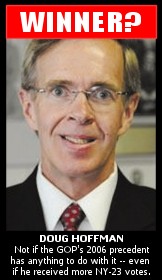
 A potentially interesting situation is underway in New York’s 23rd Congressional district where post-election canvassing of the recent Special Election for the U.S. House is still underway.
According to Syracuse’s Post-Standard, the post-election canvass shows the race between Conservative Party candidate Doug Hoffman, who conceded on Election Night, and Democratic candidate Bill Owens, who was sworn in as the district’s new U.S. Congressman last Friday, to be tightening as results are double-checked, errors are being found, and a few thousand absentee ballots are still uncounted.
The race, regarded by many as a a bellwether contest before next year’s full Congressional elections, appeared to have swung in the Democrat’s favor on Election Night, following the suspension of the campaign of Republican candidate Dede Scozzafava who threw her support to Owens after she’d dropped out just days prior to the election.
On Election Night, Owens was reported to be the “winner” by just over 5,000 votes, with 93 percent of the votes tallied, leading to Hoffman’s concession. Since then, various errors have been discovered in at least two different counties, resulting in a gain of some 2,000 votes for the Conservative Party’s Hoffman, bringing the latest tally to 66,698 to 63,672. Closer, now a 3,000 vote margin, but still favoring Rep. Owens.
There were, however, some 10,200 absentee ballots requested and distributed. And, as we understand New York’s state election laws, none of them have yet been counted. Many of those ballots were purportedly cast when Scozzafava was still in the race. At that time, according to Hoffman’s campaign at least, they might have had an edge in the then-three-way contest. So it’s possible, though believed to be a long shot, that Hoffman could gain enough votes in absentees to eclipse Owens.
This scenario — a Congressional candidate quickly sworn in, based on unofficial results shortly after a bellwether Special Election before all votes have been properly counted — should be a familiar one to long-time readers of The BRAD BLOG. A very similar situation occurred in the 2006 race to replace the jailed Republican Rep. Randy “Duke” Cunningham in California’s 50th Congressional district.
While Republicans who stood in support of the Conservative Party’s Hoffman this year — he was endorsed by the likes of Rush Limbaugh, Sarah Palin, Glenn Beck, Michelle Malkin and the Republican Party itself (only after Scozzafava was pressured to drop out) — are finding some cause for optimism in the still-narrowing margin. Limbaugh certainly has, at least according to his breathless reporting of the goings-on in NY-23 on his show this morning.
But the legal maneuvering and judicial precedent that the then-Republican-led House pulled in the Summer of 2006, in order to keep votes from being counted in the CA-50 Special Election and, indeed, to keep the voters of California from even being able to contest their own election, should ensure that Hoffman can no longer, legally, take possession of the House seat via any challenge in New York — even if he’s eventually found to have received more votes than Owens!…
Following the 2006 Special Election between Republican Brian Bilbray and Democrat Francine Busby, serious questions were originally raised by The BRAD BLOG about the legality of the electronic voting systems used in the race. The Diebold machines used, as we’d discovered, had been sent home with pollworkers for days prior to the election in what became known as “sleepovers”. Those sleepovers effectively decertified those particular systems for use, given several findings and pronouncements by both state and federal officials following the discovery that the optical-scan systems in question contained computer code in violation of federal standards and state law.
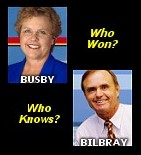 Additionally, more than 50,000 votes had yet to be counted at all when the CA Sec. of State’s office, then run by Republicans, hastily faxed a “certification” of the election, of sorts, to Congress, asserting that were no challenges to the election. That, despite the issues we’d very loudly raised about the unofficial results, and despite the fact that CA voters are allowed, by state law, to file a contest to any election in the days following official certification of any race.
A number of election integrity groups had issued statements of “no confidence” in those election results, the story was picked up by a number of print and broadcast MSM outlets — the Washington Post asked “How could this be allowed to happen”, CNN’s Lou Dobbs called it “a threat to American Democracy,” the Sacramento Bee reported the election showed “the threat to democracy is very real,” among many others — and the DNC’s Voting Rights Institute itself even called for a full “manual count” of all ballots in the race. That count would never be allowed.
Then, as now, the candidate believed to be the “loser” — Busby in that case, Hoffman in this one — had conceded before all the votes had been counted. Then, as now, the state sent notice to the U.S. House Clerk based on unofficial election results before all votes were counted, attesting to the name of the “winner” and that the race had not been contested. Then, as now, the “winning” candidate — Republican Bilbray in that case, Democrat Owens in this one — was quickly shuttled to D.C. to be sworn in by the Speaker of the House. Back then it was Republican Dennis Hastert. This time it’s Democrat Nancy Pelosi. Owens vote in favor of the House Democrats’ Health Care legislation proved vital on Saturday, following his swearing-in just one day earlier.
The bad news, however, for now-hopeful Republicans/Conservatives is that when the results of the Busby/Bilbray race were contested by a California voter, the Republican-leadership of the U.S. House Administration Committee sent a letter [PDF] to the CA judge in the case, arguing that neither CA voters nor the state courts had jurisdiction to contest the election any longer, once the candidate had already been sworn into the U.S. House.
“The Court should dismiss this action,” Paul Vinovich, Republican counsel to the House Admin Committee wrote to Superior Court Judge Yuri Hoffman. “State courts do not have jurisdiction to decide an action contesting the election of a member of the United States House of Representatives. That power is textually committed to the House of Representatives itself by the Constitution, a commitment that has been recognized by the Supreme Court.”
“The United States Constitution unambiguously states that ‘Each House shall be the Judge of the Elections, Returns, and Qualifications of its Members,'” Vinovich argued, quoting article I, section 5 of the Constitution. “As a result, the Constitution gives the House of Representatives ‘the authority ‘to determine the facts and apply the appropriate rules of law, and, finally, to render a judgment which is beyond the authority of any other tribunal to review.'”
“When plaintiff asks this court to decree following a recount ‘[t]hat the candidate with the most votes be judged elected,’ plaintiff is asking the Court to issue an order that the House of Representatives is bound by the FCEA [Federal Contested Elections Act] not to honor,” Vinovich instructed the judge in his letter.
On the House Republicans’ assertion of the Constitutional argument that it was the Republican-led U.S. House of Representatives — not the CA courts and not the voters in the state — who had jurisdiction over the results of the election at that point, the judge accepted the argument and dismissed the case. Democracy was denied. The argument withstood appeal to a higher court, essentially, as time wore on and the court found the complaint to be moot.
Of course, we were outraged at the time that any candidate would be sworn in before all votes had been counted, that the House of Representatives would argue that neither the people of California’s 50th district in San Diego, nor the courts of this state, would be allowed to determine their own Representative in Congress, and that the court was willing to accept what seemed such a patently absurd argument.
Nonetheless, the Republicans were successful in shutting down any and all state challenges and contests to that election — simply through a speedy swearing-in ceremony. An appeal to Congress itself, under the FCEA would have been decided by the Republican majority, just as such a contest today would be decided by the Democrats who now enjoy the majority. The Republican candidate from 2006, Rep. Brian Bilbray, elected on illegal voting systems, installed under an official vote count, with results that were never allowed to be challenged with a manual count, still sits in the U.S. House today.
Given where the New York race could be headed, Democrats would be wise to remember that 2006 precedent so strongly argued by Republicans, and Republicans would be wise to remember it’s never a good idea — no matter how much it appears to be politically advantageous in the short-term — to put partisan politics ahead of the small-d democracy of we the people.
• 2006 Republican House Committee Letter to CA Judge [PDF]


















That is simply poetic.
Nice piece Brad, reminding us how the Republicans argued the Cali voters had no say so in their own election yet go figure the New York Post had this in their rag just yesterday
Hmmmmmm?
Since the Bilbray / Busby contest was not particularly close, the results should have been allowed to stand. Further, note that the election result was certified. Was there a certification sent along with Owen to the swearing in event? Your hypothecations are stretching credibility.
There is no certification provided to winner, so a big question marks on the credibility of victory. This seems to be a fun tale, but it is hard-core reality.
as if precedent will stop them from making what they will out of this, even if it is only a disinfo campaign of how wronged they are.
#3 AACharley: The Bilbray/Busby was 49%-45%, and the Owens/Hoffman was 49%-46%. And you said the Bilbray/Busby contest “was not particularly close”.
Why do you think 49-45 isn’t close…but 49-46 is???
Bilbray defeated Busby by four percentage points – 49 percent to 45 percent in the heavily Republican district
http://legacy.signonsandiego.com/news/politics/50thdistrict/20060801-9999-1m1vote.html
So: AACharley thinks 49-46 is close…and 49-45 isn’t. Then questions someone else’s credibility.
Looking at absolute vote difference, the NY-23 race difference in votes is nearly half that of CA-50 in 2006. You have to be careful looking only at percentages. Things like vote count, and rounding off the decimal portion of the percentage can cause the numbers to look very similar when they really are not.
Just as reference, I got these numbers from Wiki:
NY-23 in 2009:
136,855 total votes: 3026 vote difference
48.7-46.5 : 2.2%
CA-50 in 2006:
134,302 total votes: 5530 vote difference
49.5-45.3 : 4.2%
Now having looked at the numbers, back when the “unofficial” numbers were a more than 5000 vote difference, with 93% of the votes returned, hoffman conceded. Now that they actually got the vote counts from the machines that they did not have initially, the vote difference is right around 3k.
I wasn’t able to find any information on CA-50 as to what the specific vote discrepency’s were outside of there being a chance for an invalid vote total. Here we have an actual vote adjustment bringing the vote difference much close.
Personally, I think once someone concedes, that is it. It is over, but I just wanted to point out that perhaps things are a little different than CA-50, although what happened in CA-50 is outrageous.
“I think once someone concedes, that is it. It is over”
Just, for the record, a concession has absolutely no legal baring on anything. It’s a political nicety. The voters still decide who won and who lost. IF the votes are counted, that is, and IF the courts (and Republicans) allow those totals to be used.
“The voters still decide who won and who lost. IF the votes are counted, that is, and IF the courts (and the Republicans) allow those totals to be used.”
I couldn’t agree more, but I don’t believe Republicans should be singled out as I believe that regardless of which party holds the house, we would have the same behavior if their candidate is the one that initially won. If the Democrats were to prevent the conservative from becoming the NY-23 representative, would you agree with their pulling the same stunt that the Republicans did back in ’06? In my mind it is still wrong, and just as deplorable if they were to try the same thing.
I also should have said “…that should be it…” in my original statement. I was stating my opinion, and if a candidate is conceding the race to his or her opponent, they are giving up, or admitting that they lost. If they are not sure, they should not concede.
PMan69 said:
While I appreciate the sentiment, that’s not necessarily the case. Some 6 elections were contested by Democrats under the Federal Contested Elections Act in 2006. Among them, the race in which 18,000 votes were lost in Sarasota, in a race decided for the Republican by 369 votes. The Democrats who controlled the House by then, refused to overturn or even examine actual evidence in any of those cases. They were all unanimously dismissed by the House Admin Comm. It’s hard to believe a Repub-led Admin Comm would have done same with all six contests had they been filed by Republicans.
No. But for the mitigating factor that it’s difficult to argue that a precedent set, and accepted, by the House (Republican-led at the time, but not objected to by Dems, to my knowledge) and the courts. As noted in the article, I disagreed with the argument, but it was accepted legally, so it would be difficult to stomach changing the rules, moving the goalposts to benefit Repubs, when the same folks did nothing to benefit Dems.
That said, if the voters of NY-23 preferred a different candidate than the one installed, and the ballots are there to prove it, I can’t imagine my NOT being in favor of that person being seated, no matter how dumb Democrats have been in the past.
So it certainly presents, as also noted in the piece, a potentially interesting situation should it come to that!
The democratic (small “d”) argument is a no-brainer. The political one, however, is less so.
Reply to Brad. “Just, for the record, a concession has absolutely no legal baring on anything. It’s a political nicety.”
I would agree this is true for the official count, i.e., the state must finish the vote count and declare a winner regardless of whether one candidate concedes on election night (before all the counting has been completed). If we are talking about vote recounts, a concession may have some effect depending on state law.
If you are correct, JJRay, I’m not sure which state law you’re referring to. (Happy to be schooled on something I don’t know about here, if you wish to cite an URL to support your assertion.)
COMMENT #8 [Permalink]
… Pman69 said on 11/13/2009 @ 10:23 am PT…
Looking at absolute vote difference, the NY-23 race difference in votes is nearly half that of CA-50 in 2006. You have to be careful looking only at percentages. Things like vote count, and rounding off the decimal portion of the percentage can cause the numbers to look very similar when they really are not.
Just as reference, I got these numbers from Wiki:
NY-23 in 2009:
136,855 total votes: 3026 vote difference
48.7-46.5 : 2.2%
CA-50 in 2006:
134,302 total votes: 5530 vote difference
49.5-45.3 : 4.2%
I still think that’s close and similar. You think that’s not similar? Here’s what I think isn’t close: 792,102 vs 3,000.
“Half” is a percentage, you say the difference was “half”, that’s 50%. That makes it seem not close when you say “50%” or “half”.
I’ll use the numbers you rounded up:
136,855 – 3026
134,302 – 5530
That’s EXTREMELY similar! More similar than I originally thought.
Here: this isn’t similar:
1,298,990 – 55,221
136,855 – 3,026
Are you two guys politicians or something? The two guys saying those numbers aren’t similar?
The issue before the CA court in the Busby/Bilbray contest pertained exclusively to jurisdiction. The court did not rule that Bilbray won the election; merely that it was the House of Representatives and not the courts that has the exclusive jurisdiction to determine whether to remove and replace a member once the representative is sworn in.
The court’s decision in the Bilbray case does not mean that Hoffman would have no remedy in the event that the still uncounted absentee ballots should put him over the top. His remedy would be to go before the House of Representatives, claiming that he should replace Owens as the duly elected representative.
I would note that if the recent Coleman/Franken election contest is indicative, it is highly unlikely that an absentee ballot universe of a mere 10,000, cast at the time it when it was still a three way race, in all probability, will not permit Hoffman to overcome a more than 3,000 vote gap.
From Brad’s article:
From Ernest (#16):
I’m trying to put this together. I take it this means that theoretically Hoffman could petition the House if the final vote count shows him winning.
Now what if, after all the votes are counted Owens is still ahead, but there is evidence that suggests a corrupted count. Because Owens was sworn in, does that mean Hoffman is now S.O.L., like Busby?
Or is there anything Hoffman could do, and was there anything else Busby could have done?
“Don’t concede until all votes are counted” seems to be the moral of this story.
Lora wrote:
That is correct. According to the Republicans’ 2006, court-approved precedent, the voters and courts of NY no longer have a say in the matter. Hoffman would have to convince the U.S. House to unseat Owens and seat him instead.
If Hoffman fails to timely file his election contest under the Federal Contested Elections Act within 30 days, yes, he’d be S.O.L.
In CA in 2006, before the Repubs pulled their “Constitutional” stunt, no contest was filed under FCEA for, among other reasons, the fact that the state contest could not even begin until *after* the election was officially certified by the state of CA. That didn’t happen until 22 days after the election (as I recall), and then the contest period begins. Yet, Bilbray was sworn in just days after the election itself.
Busby could have filed under FCEA within 30 days of Bilbray’s seating, but she wasn’t contesting the election — the voters were (and I don’t believe they may contest under FCEA, only the candidate). Of course, until ballots were actually counted, it was impossible to know who won or who lost, and we weren’t allowed to file for a count any ballots until *after* the 22 day certification period. Until then, we had only Diebold to go by. After that, the San Diego Registrar, Don Haas (one of the nation’s worst!) capriciously and arbitrarily decided to charge about $1/ballot for such a count — even while next-door Orange County was charging something like .14/ballot for same hand-count.
That would have amounted to tens of thousands of dollars to the citizen contestant which, as you may imagine, wasn’t available to them.
Hoffman’s only recourse at this time would be to file under FCEA in Congress. How he does that, without having evidence he actually won the election, or that there is reason to dispute the count will be up to him and his GOP attorneys.
And the moral of this entire blog. One we’ve been trying to get across to candidates and the parties and the public for years…
A bit off-topic, but I was wondering if Brad has seen this:
http://web.mit.edu/newsoffice/2009/rivest-voting.html
Ron Rivest is the ‘R’ in ‘RSA’, the public-key cryptographic algorithm upon which virtually all of your online-shopping is built. I haven’t seen Bruce Schneier comment on it yet, but he most certainly will (probably here: http://www.schneier.com/crypto-gram.html), and I would trust his opinion.
But do politicians have any interest in supporting a scientifically-endorsed tamper-proof voter-verifiable election system? Seems to curtail their options somewhat, and takes all the fun out of Election Tuesdays.
So funny a coincidence. I’m teaching a college-math-topic class to some very bright middle school kids, and we learned about RSA cryptography a couple of weeks ago. The proof of the algorithm was a little over their heads, but I enjoyed it. Mathematically, a very simple set of ideas using modular arithmetic. Yet in practicality the sheer size of the numbers involved render any kind of random guess-and-check search for prime factors impossible for even the fastest computers.
Cosimo –
Asked in another thread about the same thing, here’s the answer I offered:
And to your specific description of this scheme as a “scientifically-endorsed tamper-proof voter-verifiable election system”, um, not only does such a claim sound familiar (Sequoia, Diebold, etc. said same about their systems when they were selling them), but it seems you must be one of the developers standing to make money to make such a claim that so fervently seems to misdirect voters from what actually matters to them and their ability to oversee their own elections.
I read the article provided by Cosimo. RSA encoding is to the best of my understanding crack-proof due to the size of the numbers involved and the need to identify specific prime number factors for the decoding process (known by the decoder, these primes provide an instant translation).
But the issue here does not appear to be the encryption. The issue appears to be “Does the matching of my bubble code to the online bubble code necessarily mean my vote was cast for the candidate whom I cast it for?” And the answer to that still appears to be NO. It is still a faith-based system, in that I have to have faith in the integrity of the people working the databases, the security of the databases, chain of command, access, the integrity of the ballots themselves, and so on.
Nothing doing here, back to square one. It isn’t the mathematics of the system, the cryptography is fine. It’s EVERYTHING ELSE.
And, no matter who we elect, or think we elected, they turn immediately into clones of those we voted, or thought we voted, out….
BF@21 said:
Well, I NEVER! I had just read the linked article and was simply asking your opinion, as someone with the bigger picture on voting issues and procedures. As others have pointed out, the cryptography is not the issue – it’s rock-solid. Rather, the evaluation needs to be made on the application which uses it (and the humans using the application), and cryptography is not necessarily mutually exclusive with transparency. Banks don’t seem to have any confidence issues with cryptography. If only we valued democracy as much as we do shopping.
The details were sketchy in that article. But it seemed to me they were probably using a crytographic hash of the data to be able to verify it had not been altered. This of course does not make the overall system tamper-proof…but I certainly could not glean that from the details provided.
For the record, I am most certainly NOT involved as a developer or in any other sense. I do security software for a living, so it piqued my interest, that’s all. I’ll cut you some slack for all the good work that you do 😉
Cosimo –
First, my enormous apologies for the incredibly inartful wording I used in that reply to you! Was trying to get out of the house for a longish roadtrip, and was flying through comments/replies *way* to fast! Sorry. I know who the developers of that product are, and I know they are not you. So again, very inartful wording there. Hope you’ll forgive.
Was trying to suggest that only someone hoping to gain from such a product could use such a phrase as you did (as if an ad for the product). I did so poorly.
Now to the substance of your comment above…
You said, “Banks don’t seem to have any confidence issues with cryptography.”
Well, that’s because these are apples and oranges issues on a number of levels. Banks can check and re-check the cryptography to *their* satisfaction. Voters cannot (unless each one of them wishes to employ their very own set of computer scientists to do so.) On top of that, banks don’t have secret transactions, so there are ways that all parties involved in the transactions can track and/or verify the transaction, along with independent paperwork to verify their transaction in the case that somehow any encryption has gone wrong. All parties also have various forms of legal recourse if needed in such a case, and are able to track every step of the process — along with the independent paperwork — to make their case.
None of that exists in elections. The vote is cast, it’s then gone, and it’s up to the citizenry, as a collective, to be able to verify that ALL votes cast were counted as intended. Totally different ballgame.
And, as far as I can tell, the Scantegrity scheme still does not allow for any such collective verification that every vote was counted as cast.
Thanks for the reply, Brad. I completely understand. (To sorta quote one of my favorite movies, which ironically also has an IT security tie-in:) I just figured that somebody had a case of the Mondays 😉
Cryptography can work both ways. The little guys can also use it against The Man…for example, using open-source freeware like PGP to throw a little twist in Big Brother’s illegal surveillance schemes. (Google Phil Zimmermann to see how the gubmint harassed him for creating the original PGP.)
I’m sure there are smarter people than I actually getting paid to think about applying cryptography to electronic voting. While this particular scheme may not satisfy all the requirements of open-government types, I feel that cryptography will play a role, for the better, in some as-yet undesigned (or undisclosed, possibly suppressed) methodology. Cryptography can be used to verify that data has not been altered (cryptographic hash), and to verify the source of the data (digital signature), even without necessarily encrypting the data itself, so that we can all see it.
Check this out: Glenn Beck gets Hoffman to unconcede.