
Guest essay by Ernest A. Canning
“Somehow this madness must cease.”
– Dr. Martin Luther King, Jr., “Beyond Vietnam” April 4, 1967.
 On Jan. 18, 2010 our nation will observe Martin Luther King, Jr. Day, commemorating the extraordinary life of an intellectual and moral giant. The corporate media will fill the airwaves with excerpts of his uplifting August 28, 1963 “I Have a Dream” speech in which Dr. King called upon us to judge one another by the content of our character and not by the color of our skin. And, during that same holiday, the corporate media can be counted upon to ignore his April 4, 1967 “Beyond Vietnam” speech just as they have every year since the first Martin Luther King, Jr. Day in 1986.
Why? Because the egalitarian principles enunciated in “I Have a Dream” challenged only the now (largely) defunct Jim Crow regime.
While de facto, race-based economic inequality stubbornly remains as a vestige of slavery and Jim Crow, the elimination of de jure segregation posed no threat to the stark economic inequality created by an increasingly brutal form of U.S. capitalism and imperialism. It was the brutal reality of corporate Empire which led Dr. King, in “Beyond Vietnam,” to describe his own government as “the greatest purveyor of violence in the world today” — a point which exposes the hypocrisy in that same government’s celebration of the life of a man singularly devoted to non-violence.
If you have not read “Beyond Vietnam” in its entirety, you should. If you have, you should read it again, for Dr. King’s message is as applicable today as it was then.
Particularly, as we deconstruct the empty words used by our Harvard-educated President to justify an escalation of what Robert Scheer aptly describes as a “War of Absurdity,” and as we look “Beyond Afghanistan”…
We have met the enemy, and he is us.
Clarity on the U.S. roles in both the Vietnam and Afghanistan debacles requires self-reflection.
King understood this, explaining in “Beyond Vietnam” that “the war in Vietnam is but a symptom of a far deeper malady within the American spirit,” a malady, which if not confronted, would find concerned citizens organizing and marching against wars in dozens of conflicts for generations to come. As he observed:
He added:
The Truth about Empire and the Military-Industrial Complex
It is ironic that President Obama’s Dec. 1 Afghan escalation speech would be delivered in a hall named after the President (Eisenhower) who, in his 1961 Farewell Address warned us of the need to guard against a “military-industrial complex” whose “influence — economic, political, even spiritual — is felt in every city, every Statehouse, every office of the Federal government.”
President Eisenhower’s perception of the military-industrial complex’s “grave implications” to the “very structure of our society” echoed the warnings provided in President George Washington’s 1796 Farewell Address about the dangers to liberty posed by “overgrown military establishments” and by sociologist C. Wright Mills’ seminal work, The Power Elite (1956), which ominously foretold, “American militarism, in fully developed form, would mean the triumph in all areas of life of the military metaphysics, and hence the subordination to it of all other ways of life.”
During his Dec. 1 speech, President Obama said:
The President’s words are at odds with a reality of a brutal corporate Empire, which, as confirmed by John Perkins in Confessions of an Economic Hit Man has been erected over the past 60 years through fraudulent manipulation, corruption, covert subversion, assassinations, torture and military conquest — an Empire which is maintained by a global military presence.
Perkins’ analysis pertained to his own role as an Economic Hit Man (EHM). The EHM’s role is to convince corruptible leaders in developing nations to accept loans for massive construction projects, such as airports, hydroelectric dams, ports or industrial parks — all of which would benefit only a small, wealthy local elite. Most of the monies from these loans, which are funneled through such agencies as the World Bank and the International Monetary Fund, never make their way to the debtor nation. Instead they are simply transferred to the accounts of major construction firms such as Bechtel, Halliburton and its former subsidiary, KBR. The loans come, bearing an Orwellian label — “foreign aid.”
Perkins adds:
Set against President Obama’s denial that we “seek to occupy other nations” is the reality delineated by Chalmers Johnson in Nemesis: The Last Days of the American Republic (2006) in which he noted that a 2005 Pentagon Base Structures report on some 737 overseas U.S. military bases did “not begin to cover all the actual bases we occupy globally.”
As Johnson observed in The Sorrows of Empire, the task of this far-flung military establishment is not to protect the security of our nation but to maintain an “absolute military preponderance over the rest of the world, a task that includes imperial policing to ensure that no part of the empire slips the leash…”
In Imperial Delusions: American Militarism and Endless War (2005) Carl Boggs demonstrates how Mills’ depiction of American militarism has achieved its “fully developed form”:
During the Truman administration, the U.S. began deflecting our focus away from the “offensive” nature of history’s most awesome military arsenal with a simple change in nomenclature. The War Department became the Department of Defense. An ever-expanding percentage of the federal budget in furtherance of Empire is always justified as necessary for our “security.”
The reality was far better captured by the populist Jim Hightower in Thieves in High Places:
‘Strange liberators’
In the official version, set forth by Wikipedia, U.S. involvement in the Vietnam war began in 1959 “to prevent a communist takeover of South Vietnam as part of [a] wider [U.S.] strategy of containment.” The reality was better recounted by King in “Beyond Vietnam.”
The seeds of the Vietnam war were planted in 1945 when the Truman administration decided that the Vietnamese were “not ready” for independence. Covertly, we supported France’s efforts at re-colonization. By the end of the French occupation, U.S. taxpayers were funding 80% of France’s war cost, according to King.
The Vietnamese, King observed, must have seen us as “strange liberators.” What was to have been a temporary division between North and South Vietnam following the French defeat at Diem Ben Phu calcified as the U.S. supported a corrupt dictator Ngo Dinh Diem, who, King notes, “ruthlessly routed out all opposition, supported their extortionist landlords and refused even to discuss reunification with the north. The peasants watched as all this was presided over by U.S. influence and then by increasing numbers of U.S. troops who came to help quell the insurgency that Diem’s methods had aroused.”
As we previously detailed, covert CIA operations in Southeast Asia during the Vietnam War were funded by narcotics and aided by torture under the infamous Phoenix program in which as many as 46,000 Vietnamese lost their lives:
According to Joseph Trento’s, Prelude to Terror, President Diem and his brother were directly involved in the drug trade.
Covert CIA intervention in Afghanistan began in 1979 in response to the Soviet invasion when, per Trento, President Carter struck a Faustian bargain. Carter reversed an earlier decision to cut off aid to Pakistan in response to that nation’s refusal to abandon efforts to acquire nuclear weapons. The CIA not only intervened on behalf of the Afghan mujahideen, but began pouring money into Pakistan’s intelligence service, the ISI, which diverted much of these U.S. taxpayer funds into the development of “the Islamic bomb.”
Osama bin Laden and his band of merry terrorists arrived in Afghanistan courtesy of the CIA. President Reagan dubbed them “freedom fighters.”
According to P. Scott & J. Marshall’s Cocaine Politics (1991), the Bank of Credit and Commerce International (BCCI) would “go out of its way to attract [Afghan] drug money, facilitate arms transactions, and cater to the CIA, all the while enjoying an extraordinary, if still unexplained, degree of immunity from prosecution.” In Prelude to Terror (2005), Trento revealed that BCCI’s immunity derived from the relationship between George H.W. Bush and Sheik Kamal Adham, the former Director of Saudi Intelligence. “With the official blessing of George Bush as the head of the CIA, Adham transformed [BCCI] into a worldwide money-laundering machine, buying banks around the world in order to create the biggest clandestine money network in history.”
Opium production would drop off dramatically under the Taliban only to return with a vengeance following the late 2001 U.S. invasion. By October 2006 Afghanistan produced 87% of the world’s opium.
Ahmed Wali Karzai has been on the CIA payroll for the past eight years. He is linked to the Afghan heroin trade. Ahmed is the brother of Afghan President Hamid Karzai.
A nation concerned with the welfare of its own citizens does not facilitate the poisoning of its youth in order to finance foreign operations with drug monies. A corporate security state, bent only on the maintenance of Empire for the benefit of the privileged few, will do so at every chance.
As I noted in my five-part series earlier this year on the “History of CIA Torture,” (Part I, II, III, IV & V), quoting Naomi Klein’s The Shock Doctrine, “The widespread abuse of prisoners is a virtually foolproof indication that politicians are trying to impose a system — whether political, religious or economic — that is rejected by large numbers of people they are ruling….torture is an indicator species of a regime that is engaged in a deeply anti-democratic project…”
Either directly, or indirectly through surrogates or extraordinary rendition, torture, as well as gun and drug smuggling, were a consistent theme in Vietnam as they are now in Afghanistan, and throughout the history of the U.S.-led, corporate global project.
War is not the answer
The President’s Dec. 1 address was nothing short of deceptive. He invoked 9/11, noting that we were “attacked from Afghanistan”; that we were “compelled to fight a war in Afghanistan in the first place”; that the invasion of Afghanistan was authorized by a near unanimous vote in Congress (Rep. Barbara Lee (D-CA) being the lone dissenter), and that Afghanistan could be distinguished from Vietnam because the invasion was supported by 43 nations.
As we fully accept, for the purpose of this essay, the official version of 9/11, each of these points warrants deconstruction.
First, the President deliberately conflated al Qaeda with the Taliban, which did not “attack” us on 9/11. At most, the Taliban leadership, which General Stanley McCrystal suggests are not “ideologically driven,” became an accessory after-the-fact when they harbored al Qaeda after the attack. As revealed by Malalai Joya, a former member of the Afghan parliament who was expelled after she denounced the corrupt drug lords inside the Afghan government, and by Capt. Matthew Hoh, an Iraq war veteran who recently resigned his U.S. foreign service position in Afghanistan in protest of continued occupation, many Afghans have since joined the Taliban in response the brutal U.S. occupation and U.S. support for the corrupt Karzai regime.
Obama’s assertion that we were “compelled” to invade reflects the extent to which militarism has thoroughly permeated American society. Instead of seeing what General Douglas MacArthur described as a “malignant scourge” as the option of last resort, war is seen as the only option. Thus, we have an endless war on drugs, President Johnson’s long since abandoned war on poverty and a thoroughly irrational war on terror.
The nearly-unanimous Congressional authorization to use force and widespread international support for the invasion came at a time when most were reeling from the shock of 9/11. But as Naomi Klein so astutely notes in The Shock Doctrine, “shock wears off.”
With time comes the ability to reflect. We were not “compelled” to wage a war on terror. Indeed, a war on terror was not even a logical response to what amounted, not to an act of war inflicted by another nation-state, but an exceptionally heinous crime committed by a stateless organization.
The alternative response would have been the application of the international law; an effort to bring the perpetrators to justice before an international court and universal sanctions applied by a world body against any nation-state which would harbor the fugitives.
In War Made Easy, Norman Solomon quoted the poignant remarks of General William Odom:
Our presence in Afghanistan reflects the height of absurdity. Where the President claimed during his Dec. 1 address that Afghanistan and Pakistan are vital to our security as the “epicenter of the violent extremism practiced by al Qaeda,” Scheer says there are less than 100 members of al Qaeda still inside Afghanistan, who, per General James Jones, do not retain the “ability to launch attacks on either us or our allies.”
To defeat the ignoble 100, the U.S. is rapidly building toward an in-country presence of 100,000 American troops at a cost of $100 billion per year. NATO will also add 7,000 more troops, bringing a combined total to 140,000 foreign occupiers to that impoverished nation. To this, add some 104,000 “private contractors” aka armed mercenaries, who are paid more than three times the amount received by American troops.
The U.S. response to the cross-border Pakistani presence of al Qaeda looks like a replay of Nixon’s secret air war on Cambodia. It has included an increase in predator drone strikes, covert funding of 1/3 of the budget of Pakistan’s intelligence agency, the ISI — this despite the still unresolved questions as to whether the ISI not only funded the Taliban but whether the ISI sent funds to one of the alleged 9/11 hijackers — and an alleged covert presence of the infamous Blackwater/Xe in Islamabad.
Meanwhile, U.S. taxpayers fund the Taliban as well, as 20% of construction monies are used to fund a Taliban protection racket. That might seem irrational, but from the perspective of those who make a killing off the killing it makes perfect sense. Military spending, which now includes massive expenditures to companies like KBR and Blackwater, who fulfill the formally public support and combat functions, is contingent upon the existence of a viable, armed opposition.
As with the North Vietnamese presence in Cambodia, the cross-border presence of al Qaeda will increase the pressure for Obama to launch a cross-border military incursion — a tactic already urged in a Seth Jones New York Times editorial.
Looking at escalation, many have compared Obama’s folly in Afghanistan to President’s Johnson’s in Vietnam. But Obama repeats the mistakes of both Presidents Johnson and Nixon. His suggestion that we must confront al Qaeda in Afghanistan and Pakistan is but an echo of the policy of containment and the domino theory used to justify our presence in Vietnam. Obama’s assertion that the escalation will be used to train Afghan security forces to stand on their own and bring the war to a “responsible end” are but a repetition of Nixon’s “peace with honor” strategy entailing the Vietnamization of the War in Vietnam — a strategy initiated in 1969 by an expansion of the air war as U.S. ground troops were slowly pulled out. Six years later, on April 30, 1975, Nixon’s “peace with honor” ended with the Fall of Saigon in which the U.S. staged an eleventh hour evacuation of the U.S. embassy that was so abrupt that the helicopters used in the evacuation had to be dumped over the side of an aircraft carrier because of insufficient space aboard the ship.
There is no evidence that Obama’s “peace with honor” strategy would prove any more effective than Nixon’s. To the contrary, where Obama provides an optimistic 18 month window before we can begin to withdraw, General Stanley McCrystal conceded that if the Karzai government does not appear “legitimate” in the eyes of the Afghan people, we might have to stay “for years.” Moreover, Nixon at least had the good sense to negotiate directly with the North Vietnamese. So far, Obama’s approach is to offer the Taliban the opportunity to lay down their arms and join the government — an unlikely event given the enmity between the Pashtuns who make up the bulk of the Taliban and the Tajiks of the former “Northern Alliance” who make up the bulk of the Karzai government forces.
If the U.S. could not adequately train the Army of the Republic of Vietnam over a span of 19 years so as to withstand the 1975 assault, what makes the President think he could create an effective Afghan fighting force in the span of 18 months?
Obama’s description of al Qaeda as a “cancer” underscores the futility of the effort. If al Qaeda is a cancer, it long ago metastasized. As revealed by the prestigious Council on Foreign Relations, al Qaeda has “no single headquarters … has autonomous underground cells in some 100 countries.” On June 12, 2009, CNN reported “Al Qaeda operatives are leaving the battle zones along the Afghanistan-Pakistan border and heading for Somalia and Yemen, where they have set up training camps.”
No matter how many troops we pour into Afghanistan, irrespective of whether U.S. troops spill-over into Pakistan, the U.S. cannot defeat such an amorphous organization by way of military invasion and occupation. Even if it could, even if we could somehow capture and kill every last member of al Qaeda, we will not eliminate the potential for a future terrorist attack.
At best, under the official theory, al Qaeda and 9/11 entail a case of “blowback” which Chalmers Johnson describes in Sorrows of Empire as “the CIA’s term for the unanticipated consequences of unacknowledged actions in other people’s countries,” or more simply, that “a nation reaps what it sows.” 9/11 could well be the unanticipated consequence of our earlier covert intervention in Afghanistan as part of a deadly, global geopolitical game with the now defunct U.S.S.R., and the coupling of that geopolitical strategy with our oil resource-inspired imperial presence throughout the Middle East.
But who knows what deadly future consequence will arise from the obscene brutality our nation unleashed across the globe in the aftermath of 9/11.
End Stage of Empire?
By way of a comparison between the U.S. and Empires past (Spanish, Dutch and British) in Wealth and Democracy, Kevin Phillips develops a solid thesis to the effect that the end stage of Empire is marked by an outsourcing of a nation’s manufacturing base in search of cheap foreign labor along with an increasing reliance “on finance capitalism at the expense the more mundane production, a tendency to acquire a build-up of debt and increasing transnational loyalties.”
Certainly, recent events bolster Phillips’ conclusions. But there is also the issue of the financial drain directly inflicted not just by Empire but by the military-industrial complex; what Seymour Melman described in Pentagon Capitalism as “parasitic growth” which not only depletes the money that would otherwise be available to the civilian sector of society but siphons off the best and brightest minds to military research.
During his Dec. 1 address, President Obama acknowledged that the wars in Afghanistan and Iraq have already cost $1 trillion — a questionably low number which comes more than one year after Joseph Stiglitz, a Nobel prize-winning economist, estimated that the cost had already reached $3 trillion just for the Iraq war.
Context is required to comprehend the enormity of these numbers. Jim Hightower provided that context in Thieves in High Places when he converted dollars into seconds:
The monies spent in Afghanistan and Iraq are but a fraction of what we’ve spent on the military component of Empire over the past 60 years. A 2006 study released by the Stockholm International Peace Research Institute revealed that global military spending has topped $1.1 trillion and that the “United States account[s] for nearly half of the world’s spending.” The U.S. spends $1,600 for every American; China, just $31/person. Last year, the U.S. “spent about 44 percent more on defense than all other NATO members combined.”
At the end of a similar period in Afghanistan, the Soviet Union, economically depleted by its attempt to keep up with an increasingly deadly arms race, experienced a total economic collapse that was both sudden and precipitous. Unless we change course, and right soon, there is no reason to believe that our willingness to sink into an Afghan quagmire will not portend to the same fate.
===
Ernest A. Canning has been an active member of the California state bar since 1977. Mr. Canning has received both undergraduate and graduate degrees in political science as well as a juris doctor. He is also a Vietnam vet (4th Infantry, Central Highlands 1968).












Indeed, Ernie, indeed, and this has to be as clear to Obama as it is to us, and yet he chooses not to change course.
Some say it’s because he will be as assassinated as Dr. King if he changes course. Me. But I don’t view this as an excuse, given the global misery and death now attributable to his failure.
Others say that, politically, he had no choice. Which is even worse, but comes down to the same price for the world.
No matter what, it actually is all reducible to just this, to Obama’s unutterably wrong choice not to change course as he so famously promised.
It’s fine for everyone else to suffer and die as long as it isn’t him.
The People better snap out of it or all is indeed lost, but we’re awfully busy gaping and pointing at clowns, making a circus out of science to yank any credulity about our climate crisis, and scheming about ways to “work within the [shattered to smithereens] system” to accomplish what that hasn’t accomplished for anyone in decades.
Martin is spinning in his grave.
Well done sir, it seems you’ve been paying attention.
WOW!
Mr. Canning you have spelled it out well.
It would take a blind buffoon or a thoroughly evil bastard (like Dick Cheney) to not see the black hearted, grubby, greedy, money changer despicability (if that’s a word)in our dealings with the world….
Chickens are coming home to roost…and boy are they pissed.
Excellent article Ernest. Yes, Empire is the issue as all you quoted sources agree.
It’s been less than a week and Obama’s already pathetic excuse for a strategy in Afghanistan has been duck walked backward by several years, termed by Clinton and Gates merely a “process toward ‘transition ‘, and limited to a ‘conditionally based’ transition at that, plus scripted into supposed ‘demands’ and ‘pressure’ to expand into war in Pakistan. At this rate, what will 6 months bring? War with ten countries and a 20 year timeframe?
The reason that Obama, Clinton and Gates are all having extreme difficulty defending this faux strategy is exactly the same —
The key to understanding the impossibility of Obama’s dilemma is that he is trying to defend a Global Empire with American blood and treasure.
Obviously Obama will not articulate this reality, and thus his plan entails seminal incongruities, which are seen by a few, but sensed by the wider audience of Americans.
Obama has tried to gloss over these incongruities by using the historical techniques of Empires’ salesmen — he has engendered fear by characterizing the enemy as a “spreading cancerâ€, or ‘falling dominos’ like communism — but the real spreading cancer is the Global Empire that hired him to guilefully defend it with American blood and treasure.
Historically, the salesmanship of Empire has always been based on promising the domestic population that they will share the ‘spoils of war’, or the ‘safety of winning’, in return for fighting, and paying, for imperialist adventures.
But Obama, although a consummate salesman, will encounter increasing resistance from the American populus because of the unique incongruities of fighting and paying for a Global Empire with domestic dollars and dead, and without any benefits actually accruing to the American public.
Obama’s dilemma in selling and defending the escalation of war first in Afghanistan, and then in Central Asia and the greater Middle East, is precisely the same as his dilemma regarding his escalating defense of the very same Global Empire on Wall Street —- that all the benefits are privatized and all the costs are socialized.
Alan MacDonald
Sanford, Maine
Obama’s channeling Bush, not MLK. Great, well-written, well-researched article with lots of footnotes.
OUTstanding writing but to long. So full of historical relevance, footnoted facts, and quality statements that I think it would have been more digestible had you somehow made it into part 1 and part II or focused on King’s speech compared to Obama’s and then another blog on war costs and how the same corrupt greedy corporate cheerleaders are behind the “war on terror” or “night fighting”.
I made it through your excellent work Ernest, however, as important as your message is, I think it would be best to cut the size of this thang in half when posting on a computer blog so not to lose short attention span readers (like me) and or the benefit of the numerous informative gems you serve up in your writing. Much appreciated words!
Ernie, I would like to kiss your feet. Never in my life have I read such a calm, rational, comprehensible, and SUCCINCT summary of the perfidious history of American warmongering. I am grateful to you because never again will my head explode and my tongue waggle trying to put all the pieces together in a coherent narrative. You’ve done it. The moral bankruptcy of the Empire is laid bare in such simplicity that it cannot be denied nor argued with. My friends, PLEASE post/twitter/fb/email/network this article to EVERYONE including our illustrious ‘representatives’. Though they spout platitudes and blow smoke, they CANNOT face down the truth outlined so elegantly. We have in our hands a document that can shift the wind-let’s USE IT. Email it to all the talkshow hosts & pundits. Truly, I am not overstating the worth of this article. I’ve been trying to get ‘here’ for a decade. Mr. Canning, if you ever visit the Bay Area, please post here on BradBlog so I can meet you and shake your hand. Your courage and clarity astound me. (And I promise I will not throw myself precipitously at your feet :).) Sophia, in awe.
Thanks for the thought, GBD.
I’d considered writing a shorter piece, but I decided that what was missing from so many other excellent articles, such as the Robert Scheer piece I linked to, is a comprehensive understanding that places Afghanistan into the context of Empire and the military-industrial complex.
A great deal would have been lost by breaking it into smaller pieces.
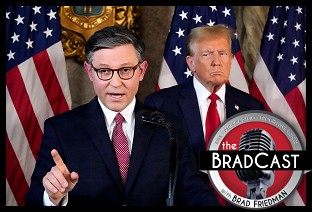
So I asked Brad to review and publish in spite of the length. It was Brad, by the way, who put together the excellent graphic in which MKL appears to be looking on as if he were Obama’s conscience — and the President looks as if he’s doing his level best to avoid the message.
I certainly appreciate all of the thoughtful comments.
Sophia, it would help if you and those you know would follow the link to digg. The higher their numbers, the greater likelihood that others will read it.
Great piece Mr. Canning. I’m going to take Sophia’s advice and send it to my Rep’s. No other piece that I know of, comes close to laying it all out on the table like you have here. Thank you.
Alan MacDonald @4
Yours was an outstanding comment…Well stated sir.
Nothing in this issue is/was/will ever be clear and simple. My understanding for why we invaded Afghanistan was to liberate some fo the most oppressed people in the world – their women. That’s why we were flooded for several years prior to the invasion with all those online petitions from all our friends, passing them along from all their friends. It is clear that, at least in the short term, woman in Afghanistan have made tangible progress. I use the word “tangible”, because it is visible and real. I do not use the word “significant”, because that is much harder to judge objectively. Certainly they still have a long way to go. The whole Al Kaida thing might have been an excuse to rally dissenters, but I don’t think that was ever the reason we went in.
I’m afraid, David Leonhardt, that you have fallen for what Sonaali Kolhatkar, co-author of Bleeding Afghanistan: Washington, Warlords and the Propaganda of Silence refers to as the “rhetoric of liberation” in which our government and corporate-owned media exploited Afghan women to justify this war of aggression.
Compare your unsubstantiated claim that “women in Afghanistan have made to tangible progress,” to the words of Ms. Malaia Joya [PDF], a former member of the Afghan Parliament, in a speech delivered on April 13, 2007 at UCLA:
If you are truly concerned about women’s rights, Mr. Leonhardt, you can start by joining the effort to investigate rape and violence against the female members of the U.S. armed forces. You can protest the efforts made in Congress to use the vital need for health care reform as an excuse for an assault on a woman’s right to choose.
There is enough corruption, hypocrisy and discrimination in our own country to keep us busy. We don’t need to be dropping bombs on someone else’s nation in order to address it.
Comment @12
a cyber thumbs up….
Well, while I don’t support bombing women to save them, it really isn’t exactly easy to discount the problem either….
It wasn’t my intent, 99, to “discount the problem” (meaning the atrocious manner in which not only the Taliban but Afghanistan’s tribal societies have treated women); but it was my intent to expose the U.S. government/corporate media false propaganda claim that we invaded to “liberate” Afghanistan’s women.
The manner in which the Taliban mistreated women was well known long before 9/11, yet, as Sibel Edmonds told Brad during the Mike Malloy Show, there was an “‘intimate relationship with Bin Laden and the Taliban…all the way up to September 11,’ 2001, by certain forces in the U.S.”
Then the Taliban’s gender-based oppression became a convenient propaganda tool for the Bush regime and the pliant stenographers of the corporate media who simply repeated the Bush/Cheney propaganda line.
I know it wasn’t, Ernie. It’s just a really sore subject for me. It was sore enough to begin with, and then got the sorer when assholes started using it as their excuse. It has been so bad for so long that, even knowing it’s just an excuse, the temptation to dream that they would actually solve this problem really, really messes with our heads and hearts. I have to sit on myself to keep from hoping we could wring that much from this travesty, when the brute reality is that we will not release the women from this hell. We are propping up Karzai! Might as well still be the Taliban.
This really hurts. 🙁
one of the best short pieces of writing on these subjects I have seen .
I was led to your article by a link on a comment board where I was posting, dismayed and astounded at the lack of attention paid by the article writer to Obama’s faux-philosophy and contradictions in his Nobel speech, in particular his relegation of King, whom he has often quoted and associated himself with (such as “the arc of the moral universe is long, yet it bends towards justice†and “the fierce urgency of now†– both from King’s speeches against the war in Vietnam), to a mere “North Star” guide, who however, as he declared, has no relevance to his “real” situation. Obama completely ignores the context of his those words in King’s message, and thus guts them of all meaning, revealing himself as a mere poseur who uses King’s words as a decorative, deceptive mask. Your graphic couldn’t be more apt. When January 18, 2010 comes around we will easily be able to separate the wheat from the chaff by judging the speakers on what they say and do not say.
So when I began to read your, “deconstruct[ion of] the empty words used by our Harvard-educated President to justify an escalation”, you had me from the outset. But you brought me much further along the path of my contextual understanding with this succinctly coherent and factual article based on all aspects of King’s message. You have gained a new and grateful reader. I will be referring to your article at all opportunity. Thank you so much for your dedication.
Well, er, Bluesky, Obama hadn’t made that crass speech yet when Ernie wrote this, but, yes, it was a great post.
Right you are, 99. I forgot my crystal ball when I wrote this essay; didn’t know in advance what Obama would say in accepting the Nobel.
I’ve thought about a possible follow-up which would demonstrate not only how far Obama’s Nobel acceptance speech strays from the teachings of MLK but how Obama’s defense of war is at odds with the UN Charter.
I thank you for your kind words, Bluesky, but all credit for the powerful graphic goes to Brad Friedman who pieced it together in editing this piece.
Well, Ernie, I think you should! Rip him a new one for daring to invoke MLK, let alone try to put his most precious words in the service of this fascistic capitulation. I want to do the same thing, only it will be ugly. It was agreed by all at my office that I should not take the Bar precisely because I’d spend all my time in jail from then on out… unable as I have been since forever to regulate my mouth in the face of indecency such that the wrong person doesn’t know entirely too well my boiling contempt. You seem to have maintained your ability to do that and make your point, which is a far cry harder than most will admit. I have a big circle of friends who caved completely, whose ideals have long since been subsumed by their imperative to regulate themselves in court, and so, yes, I really wish you would give this a go. It is the audacity of hubris and it should be smacked off that smug puss.
Arg! Total mix-up and crosswires! By “article writer” I meant the writer of the article which I was commenting on where I also found the link to this great article. It was that writer I was dismayed about. No critique whatsoever intended of Mr. Canning! In fact I think this article “Beyond Afghanistan” to have been very prescient. So sorry for being unclear.
I for one would be delighted if you wrote that follow-up article you mention, for Obama’s misuse of King is an abomination, and I’m sure none could write it better than you. Obama is relegating King’s words to the position of a feel-good pill: take 3 a day before marching off to war. I was very upset at all those many articles praising the speech for Obama’s wisdom: his delicate balancing act between the “necessity” and “reality” of war while nonetheless maintaining his idealism; upset at those discovering high-minded complex Niebuhrian philosophy behind Obama’s outright contradictions and inherent incompatibilities, manipulatively strung together.
There is clearly something lacking in a Harvard education if this is all the better it can produce. There are really 4 options: Obama doesn’t understand King, he arrogantly thinks he knows better than King, he believes King but is morally weak and lacks the courage to “walk the talk”, or he doesn’t give a heck and quotes him because the words go over so well.
That was “crossed” wires.
And yes, a comprehensive follow-up article that also highlighted Obama’s shallow understanding/acknowledgement of what a “just” war is, is also needed. We’re not asking him to forego our legitimate self-defense, as he implied. He even tried to puff up his military role while giving it the fatherly touch, saying he was “sworn” to “protect and defend my nation”, when in fact he was sworn to protect and defend the Constitution (and therefore its laws and treaties, which he is breaking.)
The Afghanistan-Pakistan war doesn’t even follow the criteria for a just war that he set out in his own Nobel speech.