
— Brad Friedman
[While I was off the grid for a brief vacation for a week in August, a short Op-Ed version of a piece I wrote for Commonweal Institute, where I am a Fellow, was published at CommonDreams.org. Unfortunately, I was off the grid, so couldn’t respond to some of the off-base coments left on the piece over there. In any case, here now is the full-length version of that Op-Ed. -BF] Last March, the country’s highest court found that secret, computerized vote counting was unconstitutional. Unfortunately, the country was Germany, and the Constitution violated by e-voting systems was the one that the U.S. wrote and insisted Germans ratify as part of their terms of surrender following WWII.
Paul Lehto, a U.S. election attorney and Constitutional rights expert, summarized the German court’s unambiguous, landmark finding:
- “No ‘specialized technical knowledge’ can be required of citizens to vote or to monitor vote counts.”
- There is a “constitutional requirement of a publicly observed count.”
- “[T]he government substitution of its own check or what we’d probably call an ‘audit’ is no substitute at all for public observation.”
- “A paper trail simply does not suffice to meet the above standards.
- “As a result of these principles,…’all independent observers’ conclude that ‘electronic voting machines are totally banned in Germany’ because no conceivable computerized voting system can cast and count votes that meet the twin requirements of…being both ‘observable’ and also not requiring specialized technical knowledge.
After the verdict in the case — filed by a computer expert and his political scientist son — Lehto wondered how it could be that open, observable democracy is seemingly an inviolable right for “conquered Nazis,” but not, apparently, for citizens of the United States…
Particularly since the debacle of Florida’s 2000 Presidential Election — when Republicans went all the way to the U.S. Supreme Court to argue that paper ballots should not be counted at all — the notion of publicly overseen paper ballot tabulation has been widely and unfairly discredited. The discreditors are often media who are too lazy to understand either Constitutional rights or the demands of self-governing democracy; election officials who are either too lazy or too frightened to stand up for those rights for the people they serve; politicians who are quite satisfied with the government’s direct control over election results; or the e-voting industry profiteers who have made billions in the wake of democracy’s 2000 disaster.
The citizen owners of American elections, however, are the ones who are ultimately left entirely out of the equation.
The argument is made that paper ballots can be easily manipulated; that voters are often sloppy in filling them out, and therefore “voter intent” may be difficult to discern; that human counters are prone to error; and, after all, in this age of computer commerce, entertainment, and everything else, technology surely provides the best answer to the “problem” of reliably counting election results. Technology, after all, is progress – so the argument goes.
Try telling that to Christine Jennings, the 2006 Democratic candidate for Florida’s 13th U.S. Congressional District. She was found to have “lost” her election by just 369 votes, even though some 18,000 votes completely “disappeared” on the electronic voting system on Election Day in Sarasota County, her strongest district.
Though Jennings’ race was counted on electronic touch-screen systems, even had voter-marked paper ballots existed, they ultimately wouldn’t have meant much unless they were publicly hand-counted in front of the citizenry as New Hampshire still reliably and accurately does in some 40% of its precincts at the close of the polls on Election Night.
 Technology does not always offer the most progressive solution to a problem, certainly not when citizen oversight and, thus, the constitutional right of self-governance, is scrapped in the bargain.
While hand-counted paper ballots are routinely discredited by those who stand to gain from secret vote counting, you’ll note the odd paradox that in the closest of elections, those same individuals are often the first to demand a fully public hand-count of paper ballots (in jurisdictions where they still exist) to determine who actually won and who actually lost.
In short, hand-counting paper ballots is no good at all, according to the oxymoronic logic of its critics, unless you really want to know who the actual winner of the election was.
It was the fully public counting of hand-marked paper ballots that gave evidence that the unofficial, electronically-scanned election night results in Minnesota’s recent U.S. Senate race were wrong. A hand-count settled the results of Washington State’s Gubernatorial contest in 2004. And in the 2006 Republican Primary election in Pottawatomie County, Iowa, a hand-count found that seven races had been tallied incorrectly by the county’s optical-scan system. Unfortunately, that sort of publicly observable counting has become the exception rather than the rule in this country, and it happens only rarely, in elections where the candidates can afford the extraordinarily high legal costs of a contest, or when the results are so obviously twisted that officials are left with little choice but to count the ballots by hand.
“Hand-counting paper ballots is recognized as the gold standard in state laws across the country,” Ellen Theisen of the non-partisan election watchdog organization VotersUnite.org told me. “Why settle for anything less?”
Theisen’s thoughts echoed Lehto’s interpretation of the findings of the High Court in Germany. “By letting software count our votes,” she said, “we give software control over our government.”
 She’s right. Theisen, like myself, has spent years observing, reporting, and documenting election failure after election failure as democracy’s corners were cut and voters rights stolen with proprietary, unaccountable, secret electronic vote-counting systems. She once thought, as I did, that hand-marked paper ballots, counted by optical-scan systems, coupled with post-election “audits” (really, “spot-checks” of a tiny percentage) would be reliable.
But then, for me at least, came the final straw: Iran. Yes, they had hand-marked paper ballots in the country’s contested Presidential election. The hard evidence of who actually won and who actually lost certainly existed at some point. But, as those ballots were never counted publicly, in front of the citizenry, all interested parties, and video cameras, we’re all left with the guessing game of who won and who lost, as based on our cleverest best assessments taken from selected pre-election polls, analysis of historical voting patterns, and the declarations of disbelief from passionate partisans.
Sound familiar? Unfortunately, it’s not just Iran. Post-election second-guessing and charges of foul play have become more and more the norm, rather than the exception, with each passing election cycle in the U.S.· — from Florida to Ohio to New Hampshire and to virtually every state and county in the country – and for good reason. ‘Democracy,’ as it’s practiced in our ‘shining city on the hill,’ has become Russian Roulette without the certainty.
Enough. The time to demand confidence in the accuracy of our elections is now. Not in the weeks just prior to an election, when the corporate media suddenly find “a story” in problems at the polls – and there are more and more each and every year, as more and more voters experience just how terrible our system of e-democracy has become.
Congressman Rush Holt currently has a bill (H.R. 2894) quietly moving through the U.S. House, co-sponsored at this time by 87 lawmakers. The bill would require a voter-marked paper ballot for every vote cast. That’s fine. But unfortunately, that requirement would not kick in until 2014, two federal election cycles from now, including one of them the 2012 Presidential Election.
More disturbing, however, are the provisions in Holt’s bill which give a federal stamp of approval to proprietary “trade secret” software vote-counting on unobservable computerized devices, the same type found unconstitutional under Germany’s U.S.-written constitution. Holt’s legislation, if passed as currently written, could be the golden ticket for decades of more and more secret vote-counting, more and more (small “d’) undemocratic elections. In short, his well-intentioned legislation takes several small steps in the right direction, and a couple of giant leaps towards all the wrong ends.
·”Hand counted paper ballots are the best available technology for conducting accurate, transparent, and observable elections,” John Washburn, a Republican/Libertarian-leaning election integrity expert from Milwaukee says. He has testified before the U.S. Election Assistance Commission on computer voting system requirements and he is no “Luddite,” as opponents to computerized democracy have long been derisively characterized by those who stand to profit in the e-voting industry. Washburn happens to be a long-time computer expert and programmer.
“I love technology and am not adverse to using technology to aid in the administration of elections.” But, he cautions, any “new technical solution should be no worse than hand-counted paper ballots when measured along the dimensions of security, observability, transparency, and accuracy.”
“I know of no electronic or Internet system which meets this simple axiom; i.e., ‘First, Do no Harm,'” he added. “I fear many of us technophiles are so blinded by the possible that we overlook the actual.”
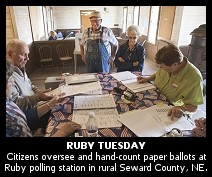
 For those who don’t understand how fully observable, precinct-based, Election Night hand-counting of hand-marked paper ballots works, one need look no further than those polling places in New Hampshire where the entire process is a matter of civic pride and community participation. We are not speaking about the centralized, behind-closed-doors, party-boss-counted paper ballots of the days of Boss Daley in Chicago or Landslide Lyndon in Texas.
In short, after polls close, a new, bi-partisan counting crew is typically brought in to relieve tired poll workers at each precinct. Each precinct’s crew counts its own ballots in carefully overseen, publicly observed groups of four – two calling out every vote, two marking each one down – as the citizenry watches, video tapes, and otherwise assures the process is on the up and up. The results are posted publicly before ballots are moved anywhere. They are never out of public oversight until the counting has been completed, which is usually done by enough counting groups to be completed before midnight on Election Night (often before some machine-counted precincts have finished!) It’s a very difficult system to game – at least without being easily caught.
It was, in fact, the public posting of precinct-counted paper ballots which tipped off the world to Kenya’s recently contested Presidential election, when the results announced by the central government didn’t match up to those posted at the polling places on Election Night.
I still remain open to other, equally transparent, equally accurate, equally observable, equally democratic methods for tabulating elections. But after more than five years of research, study, observations, and reporting, I’ve yet to come across any. To paraphrase Churchill, it may be the worst method for counting elections, except for all of the others.
Yes, if hand-marked, hand-counted paper ballots are good enough for “conquered Nazis,” Kenya, many citizens of New Hampshire (the site of our ‘First-in-the Nation’ Presidential Primary Election), and for elections when you absolutely, positively have to know the correct results, aren’t they good enough for every election, every time?
It’s time to demand that we begin moving forward, toward Democracy’s Gold Standard for all elections. Now. Not after computers have made voters completely irrelevant. It’s time for us to insist on pilot projects — not of new, even higher-tech vote-counting computers — but of publicly-overseen, hand-counted paper ballots at every precinct in our own localities, with the ultimate goal of extending that Gold Standard to all of America.
Now that would be progress.
Originally published by CommonwealInstitute.org…
For more information and a step-by-step guide to transparently and publicly hand-counting paper ballots in your community, see Hands-On Elections: An Informational Handbook for Running Real Elections, Using Real Paper Ballots, Counted by Real People
===
Brad Friedman is a Commonweal Institute Fellow, the creator and publisher of The BRAD BLOG and co-founder of VelvetRevolution.us.



















Paper ballots. Single payer. Simple and obvious (one would think).
Yes – I believe that Canada still uses a paper ballot. They actually have the election results available the night of the election! Observers from All political parties are present to witness the vote tabulation. As for filling out a paper ballot – it’s fairly simple to write an X in the box – next to your choice of candidate.
This IS the Gold Standard and should be used in the U.S.A.
Paper ballots do not preclude the possibility of fraudulent elections, but cases of ballot stuffing become a whole lot easier to spot, as we’ve seen recently Afghanistan.
E-voting opens the door not only to vote flipping on a grand scale — which is probably what we experienced in the 2004 Presidential election — but the ability to carry out a theft that is almost undetectable.
I think Joan nailed it. “Paper ballots. Single payer. Simple and obvious…”
What does it take to convince the people of this? How do we get them to care?
I posted too soon, before I read Canning’s post, but it puts me in mind of something I’ve been saying more and more lately, as an expansion of Lord Acton’s famous quote:
Power Corrupts, and
Absolute Power Corrupts Absolutely, and
No Power so Absolute as Invisibility.
Great stuff! Paper ballets must be manufactured under the the same secure process.
Several years ago, Dan Rather Report had an interview with the exemployees of a paper ballet manufacturing company who Cconfessed that under their protest certain ballets going to south Florida were intentionaly offset slightly and used inferior paper. Rember the Chads! No investigation yet!
E-voting opens the door not only to vote flipping on a grand scale — which is probably what we experienced in the 2004 Presidential election — but the ability to carry out a theft that is almost undetectable.
YAYYYYYYYYYYY!
GO BRAD!
Kind of embarrassing to see a self-proclaimed expert quoting his friends as experts all asserting that they are not aware of a system other than the one that they use to promote their own efforts — in effect casting aspersions on all alternatives while criticizing supports of other types of systems from potentially benefiting from their use — when there are better systems out there. Also, implying that statistical auditing requires no technical knowledge is misleading at best. Moreover, assuming that there will be 5 or more counters ignores the possibility of biased polling locations and intimidation; such an approach seems unrealistic even in the US, where we have trouble getting poll-workers and completely impossible unworkable in places like the examples cited of Iran and Kenya. A solution that would work in the US and help in other countries would allow public audit without requiring chain of custody and all parties observing every polling place — and such solutions do exist.
“Kind of embarrassing to see” someone with such a strong opinion posting anonymously, rather than standing behind the courage of your convictions, with your own name, as both I, and the experts quoted in the article have done.
In regard to “promot[ing] their own efforts”, that’s just silly. What efforts?? And what “better systems [are] out there”? I’m all ears.
As to your suggestion that I’ve implied “statistical auditing requires no technical knowledge” – um, huh?? What are you even referring to??
As to your more serious, anonymous criticisms:
We have trouble because we don’t pay them properly (which we’d be able to afford, if we stopped paying the corporations for machines that don’t work, and which count in secret), and because we ask them to be rocket scientists, forced to work impossibly long days during the week. Counting crews would come in *after* regular work days, be paid appropriately, work only a few hours, and in full view of everyone, including video cameras. Still worried about someone gaming that system? Good, you get to stop them by revealing the evidence to all (something you’re not allowed to do now, because you’re not allowed to witness the counting).
Huh? Why is it impossible? That said, I’m calling for democracy in the U.S. We can worry about Iran and Kenya later, by first setting the example here in the U.S.
Really? What are they? Haven’t heard of them. Feel free to share. And if you stand behind them, feel free to put your name behind it as well.
Have a feeling you won’t and can’t. Little wonder you seem to be opposed to transparency — and Constitutional self-governance in the bargain.
Interesting, Brad…
Was the “well meaning” line a peace offering to Holt?
Can you even afford to try and buy him back from the corporations?
Remember, he went looking to for buyers to pimp himself to. Remember Holt re: proprietary software “That’s a conversation we we’d like to have with the corporations…”?
And Brad, no further cries of “where are the throngs of pro-HCPB supporters?” from you?
Perhaps you have a dream that you can rewrite Holt’s corporate crapload of federal mandates into something decent… but as it starts off from HAVA, enshrines that debacle of a bill, and then promptly gets worse from there you’d probably have better luck trying to polish a turd into a platinum ingot.
It sure as hell ain’t the bill to try and squeak HCPB pilot projects in on.
Of course HCPB pilot projects… ones that are not designed to fail from the start… are a very good idea.
But it’s foolishness to try to get them in as part of a bill that’s a corporate giveaway and power grab.
Because no matter what you are told and no matter what you think is happening the bill will always turn out just like the corporations intended.
And they have no interest in viable HCPB.
That road is closed. You must choose another road.
ZapKitty said:
Actually, no. Not at all. Didn’t even have him in mind, as I recall, when writing this piece, other than in pointing out where his bill still fails, as noted.
No comment there, as I don’t know whether he’s in league with the corporations necessarily, misunderstanding and misdiagnosing the overall problem, or if he’s just trying to propose what he believes is a passable bill. Whatever reason, the current version of his bill has some huge flaws in it, and that’s what I was trying to point out where the article refers to him.
I believe I more likely had in mind some of the public interest groups, many of whom I *do* believe are well-meaning, but just entirely wrong or misguided in their support of the current bill, at this time.
Yup, there are a good number of charlatans out there, but not everyone who supports the Holt bill happens to be one.
Huh? Not sure what that has to do with this piece, which is my first, in a series, as a Fellow for Commonweal Institute, which hopes to identify and frame progressive values. I happen to believe that 100% transparency in elections, and thus, full oversight and thus, self-governance, is one such value. (Though, if you wish, feel free to clarify the point you’re trying to make there.)
I should also add, Zap, no federal legislation is required for hand-count pilot projects, as noted in my various published conversations on the point (don’t have time to look up the articles, but I suspect you’re aware of them) with folks like OH SoS Jennifer Brunner and LA County Registrar Dean Logan, etc., both of whom said they were open to such pilot programs, and both able to do them if they wished. No federal program or bill necessary.
We do need paper ballots, counted in plain sight. Both parties have stolen elections. I hope this will happen very soon.
Proper vote counting has one essential feature that too often goes unmentioned: Adversaries do the counting.
This essential check-and-balance is totally lacking in machine counts.
Some officials think (or at least claim) that the equivalent is accomplished by machine-counting the ballots a second time.
But the machine they have in mind for the second count is either the same machine used in the first count, or an exact clone.
This is like asking one person to count the ballots, and then asking the same person (or his clone) to count the ballots again.
If the results match, that offers little or no evidence that the first count was accurate.
Unless computers never make a mistake.
Roy Libscomb is exactly right. How many advocates of hand-counting would agree to one of the candidates performing the hand count on their own, then announcing their result without explaining how they arrived at it? And then, to add insult to injury, having that candidate conduct the recount?
The issue is not whether technology should be used in aid of vote counting. The issue is secret counting by one party that is not obliged to explain itself.
Caution: Self-serving statement follows…
If election integrity activists cannot convince registrars of the need for hand-counted paper ballots, a sensible step is scanning and counting paper ballots via at least two independent paths. Ideally, this would take place at the polling place before the ballots leave the room.
For those who still believe HCPB is the solution, this would be a step in that direction. For those who believe the problem is not technology, but the way technology has been used to allow election results to be calculated in secret, this is the solution.
Mr. Lehto’s summary of the German Constitutional Court decision is incorrect.
I will take as an example, one statement:
“A paper trail simply does not suffice to meet the above standards.”
Paragraph 121 of the decision explicitly and specificially names VVPATS, as well as scanners, as useable in elections for getting an initial count, so long as the results can be checked by hand.
Electronic voting machines are not “totally banned” in Germany. They will not be used in the upcoming election because there is not a system available that provides a paper trail. But the court made it clear that systems that provide a paper trail could be used in the future, so long as the results are hand-checkable.
Everybody has the right to their own opinion about what the court decision should have been. They should not, however, be mispreresenting what the court actually did say.
To quote the court’s own press release:
it is “constitutionally unobjectionable that § 35 of the Federal Electoral Act permits the use of voting machines.”
http://www.bundesverfassungsgericht.de/en/press/bvg09-019en.html
I agree in spirit with Mitch and his self-confessed “self-serving” statement. He’s one of the movers in Humboldt County’s trailblazing “Election Transparency Project.” The project’s mission is to scan images of all ballots cast in California’s Humboldt County and to publish those images on the Web.
Far from some blue-sky daydream, this project is already operational. It launched in June of 2008, and has publishing ballot images ever since then.
This excellent project is a quantum leap forward in transparency. We owe a debt of gratitude to Mitch, to his fellow volunteers, and to County Clerk Carolyn Crnich, who envisioned, created, and supervised this project.
So it’s with some regret that I report that this leap forward has some deficiencies. (Mitch, please correct me if I’m wrong on any of these.)
* The imaging is done by computerized scanner, which entails the same lack of transparency and the same potential for unnoticed errors that all computers are heir to (even those using open-source software).
* The process lacks the checks and balances of adversarial processing. For each set of ballots, the project employs only one scanner (or a clone), managed by one organization.
* The scanning is done elsewhere than in the polling place.
* The general public cannot easily ascertain whether the published set of images is an exact match for the actual ballots.
These limitations can be overcome by imaging technology that–
* is not computerized,
* can be implemented in the polling place,
* can implemented in full view of the public,
* can be verified as accurate beyond a reasonable doubt at any time afterwards,
* can be copied and distributed without limit.
The technology that ideally fits these specifications is the movie-film camera, supplemented by having the films copied digitally and posted on the Web. Authenticity of the published copies would be confirmed by allowing anyone to compare them to the original films.
That’s a only rough sketch of an ideal process. Its trustworthiness would have to be guaranteed by adequate, extensive checks and balances. (See below.)
Admittedly, movie-film cameras are in short supply today. But fortunately videocams are trustworthy enough to serve as substitutes. (That may no longer be true when videocams become more computerized–especially if they become user-programmable.)
* *
It’s heartening to see videocams receiving more and more press as possible tools in the polling place.
Their role, as commonly envisioned, would be to document activities in the polling place.
While this is an excellent use, it falls short of the full potential of videocams.
It still leaves us with having to assume that a vote count is correct if the camera caught no anomalous behavior.
That’s less than full transparency. Full transparency would allow us to see for ourselves that the vote count is correct.
Do videocams have the potential to bring about full transparency?
They do, if they’re granted one additional role: Capturing and publishing the contents of the ballots, so that anyone and everyone can count the votes for themselves.
Transparency doesn’t get any better than that.
To be trustworthy, of course, this strategy must be buttressed with careful checks and balances. Some of these are discussed at
http://e-grapevine.org/citizensaudit.htm (That document includes a proposal for a touch-screen ballot marker to help compose, error-check, and print the voter’s ballot. The proposal has no bearing on the use of videocams, and can be safely ignored by those so inclined.)
@Gary Dee # 2
More about Canada: consider two cities: Calgary, population 1,000,000, where ballots are counted by hand; and Edmonton, population 700,000, which uses opscan systems.
In last two elections, Calgary totals came in earlier than Edmonton’s.
Costs: Calgary, $2/voter; Edmondton: $7/voter.
“Automated vote count ‘too costly’â€
Sun [Calgary] 2007-10-17 03:03:05 MST
http://calsun.canoe.ca/News/Alberta/2007/10/17/4582641-sun.html
Also: Ireland and the Netherlands have scrapped DREs and gone back to hand-counting paper ballots
[interesting story of activists who showed how – and posted on YouTube, reading a voter’s choices…
Other countries using hand count: Germany [before the Court decision and continuing], Italy, Switzerland, UK…
Thanks, Roy, for your gracious reply.
I agree that the Humboldt project has some deficiencies, but I also agree that it’s a great leap forward. I think election integrity advocates need to be willing to push the ball a few yards at a time, rather than constantly looking for a touchdown. (Forgive the metaphor; is that football or basketball, anyway?)
The cited deficiency with which I most agree is that we are not scanning at the precinct; I would be thrilled to find a jurisdiction that wanted to do a test of at-the-precinct-at-the-conclusion-of-voting scanning.
But Roy and I just disagree on some of his other concerns. First, I don’t think film as opposed to scanners would necessarily be an improvement. We could discuss that at length, but this is probably not the best forum. And, in any event, I’m sure many imaging approaches other than scanners are possible; I’m working on one now.
As for adversarial counting, I think the critical aspect is redundant counting by different parties, using different equipment. The Humboldt project implements a second count, done to confirm or challenge the accuracy of the primary, official count.
As for the ability of the public to easily confirm that the images reflect the actual contents of the ballots… it’s an issue. I think the most practical solution is having members of the public invited to attend the scanning sessions (or filming sessions, ‘cam’ing sessions, or whatever), able to confirm that the contents of the generated physical artifact (DVD, filmstrip, or whatever), as replayed on THEIR computer (slide projector, whatever), matches photocopies of a random sampling of the ballots being scanned. Because the Humboldt project prints a serial number on each ballot as it is scanned, this check is easily implemented. We’ve already done this ourselves, though we think of ourselves as the “members of the public,” since that’s who we are.
Finally, I’d like to redirect attention to what I still think is the critical point you made: unless you are willing to put your faith in the one entity doing the counting, you have to have two or more entities counting to know if the count is correct. Airplanes and space flight use data from three instruments for critical information; when one doesn’t agree with the other two, it’s taken out of service. This is common sense in many fields; just not (yet) in elections.
We’ll get there.
Great article! No getting around the simple logic of hand counting, hand marked ballots in public. No machine will ever improve on the basic transparency of that method and we can start immediately, unless the congress jacks us around for 10 more years trying to please the voting corporations.
Canadian experience and some ways to improve the Humbolt
election transparency process
I’ve been a DRO (poll judge) at federal, provincial and local elections in Canada. My only concern was making sure I didn’t screw up running the poll or counting the ballots. I think that’s going to be primary concern of local election officials. All we want to do is get the job done without anybody complaining. That’s why election officials want to use systems that eliminate human intervention or discretion. — touch screens are better than scanned ballots, scanned ballots are better than punch cards, punch cards are better than hand counted paper ballots.
At one time, I liked the idea of touch screen voting that when complete printed out a paper ballot that the voter could see before it was dropped in a ballot box. I don’t like that now.
I don’t like hand counting of paper ballots where there are a lot of offices to vote for (President, senator, representative, governor……dog catcher).
Although there are problems with handicapped voters, my preference is paper ballots electronically scanned at the polling place. That’s standard. But you can answer a lot of problems if you add that all ballots cast have their images scanned an put on the internet. See below for details.
Currently, provincial and federal elections still use paper ballots. Local election methods vary, with the most popular method using large paper ballots that are counted by a scanner.
FEDERAL AND PROVINCIAL
Federal and provincial elections are easy. There’s only one person to elect, some who represents your riding (what’s called a district in the US). Ballots are almost all black with candidates names and party affiliation printed in white. After each candidate there a white circle. Behind a privacy screen is a large pencil like a carpenter’s pencil. You count a vote if there’s a mark in just one circle (X preferred). They don’t have to use the pencil. If they put identifying info on the ballot, it isn’t counted. Even with 2 election officials (DRO and poll clerk) and representatives of candidates, a smart DRO can get ballots counted and call the riding (district) office with results in under 30 minutes.
LOCAL Elections
When local elections used and counted paper ballots, it was much harder. The ballot could be a 18 inches wide and 24 inches long with 6 to 8 different offices to vote for. After the poll closed, it took a lot longer to identify problem ballots and then count up everything. I was still one of the fastest back to the ward election office. I did it once and never did it again — it’s difficult not to make a mistake. So this is similar to US elections where you can have a lot of offices to vote for. But there aren’t so many offices that they can’t all fit on one large ballot on one side of the ballot paper.
That’s why they’ve changed to paper ballots counted by scanner. After you mark the ballot, the ballot inside a secrecy holder is fed into the scanner. If there’s problems with how the ballot is marked, the ballot is spit back into the holder and the voter can correct it or get a replacement ballot. City of Toronto estimated this method took at peak times 24 seconds per voter.
Changing the process
Aside from handicapped concerns, the present paper ballot method works great for federal and provincial elections. It’s easy to hand count ballots and if there’s issues then the ballots can be counted again. Nor are they likely to change the methods for local elections as there just isn’t that much concern if one mayor or another gets elected.
ADDING TRANSPARENCY TO ELECTRONIC COUNTING OF PAPER BALLOTS
I’m pretty sure this has been thought of already. Is there a good way to leverage the internet to make checking the imaged ballots less painful? Yes, turn verifying ballots into some type of captcha process as is now done to have humans decide what a word from a book is when the scanner couldn’t figure it out. So a human sees a ballot image accompanied by how it was counted. They can agree or disagree with how it was counted. If enough people see the same ballot and disagree with how it would be counted, then it gets kicked aside for careful scrutiny.
You can control abuse by requiring some minimum/maximum per IP address and rejecting anyone whose count of ballots varies from the machine count by more than a couple of percent. And there’s lots of people looking at the same ballot.
I violated my own rule that I check on the internet before I post anything.
A search of captcha verifying voting brings up lots of ideas.
I have always taken one issue with making scanned ballots available to the public. I do not see how you could prevent subtle stray marks that could be used to identify a particular person’s ballot.
I’ve been told that this is not an issue; that mail-in ballots have far more potential for vote-buying or coercion. However, I doubt strongly that mail-in ballots represent the standard we should beat in order to have election integrity.
I have not heard a convincing argument that shows how scanned ballots available to public view would not be vulnerable to being identified by biased parties that have purchased votes or threatened voters to vote a certain way and use a subtle stray mark to identify the ballot.
This may not be a very practical way to tip an election, but if we are going to protect the secret ballot, let’s do so.
COMMENT #24 [Permalink]
… Lora said on 9/18/2009 @ 7:36 pm PT…
Worried about subtle marks on ballots.
Off the top of my head, why not limit the quality of the scans and the valid ways to mark a ballot.
You’ve got to decide ahead of time what you’re worried about and what’s the purpose of checking whether the ballots were scanned correctly.
My view is that putting images of paper ballots online is to (1) increase public confidence that the votes are counted reasonably properly (2) determine the accuracy of the scanner and its software and (3) help identify ballots that are questionable and the number of those ballots.
If there are enough ballots in dispute then it triggers a manual recount with the advantage that questionable ballots will have been mostly identified.
This is all a back up procedure.
Anyhow, the real problems as Minnesota illustrated come from absentee ballots. From anti-fraud view, absentee and mail ballots should be discouraged as much as possible.
Shel,
That sounds good. AFter thinking about this, I picture a plexiglass sheet that fits over the paper ballot with openings only where a ballot might be marked to vote. Everyone uses the same kind of pen.
Agreed that mail-in ballots and absentee ballots in general are a very weak link in the chain of election integrity and ought to be discouraged.
Meg Whitman is the next sarah palin!!!
Fallout from Whitman voting controversy may be lasting
By Steven Harmon
Contra Costa Times
09/30/2009
“Her reply to a KGO caller’s question Wednesday is helping to keep the controversy alive.
When asked whether she had voted before 2002, she said, “So the answer is that I don’t think the Sacramento Bee article is entirely accurate, but actually it doesn’t really matter because my voting record is not good.”
The Poizner campaign seized on the comment, pressing her to reveal what she thinks was inaccurate. Jarrod Agen, a campaign spokesman, said the issue is not going away.
“She’s had a complete lack of transparency with voters and the press on this,” he said. “She’s told multiple conflicting stories as to the why and when that that creates a problem because she’s not being honest. This will last until they answer the question of did she vote before 2002 and, if not, why?””
http://www.insidebayarea.com/argus/localnews/ci_13455342
ROTFLMMFAO ! ! !
Simple… Just have a printout with the number of votes before yours, and totaled after yours, with your vote clearly Identifiable. Also, have a machine receipt number, and a voter number… This is IF machines were used.
Also, these results should be made available to everyone online, in real-time. We don’t need a tally counter if we have real time results, which IS possible today and wouldn’t really matter for voters.
It wouldn’t matter that much in real time and to say that some would see their candidate losing, then go to the poll to vote, so what… That is THEIR right to vote if they only do it once. All this secrecy in a Constitutional Republic, code-named democracy, is not necessary.
That is my opinion… but, anyway, always use paper ballots and get a copy.
This is just another facet of the US society which justice only comes to those with money; he who has the gold wins.
This has has happened to our court system. Just look at the death penalty system in criminal courts, and what tort reform has done to civil cases.