
Guest blogged by Ellen Theisen, VotersUnite.org
The actions and attitudes of election officials all too often seem like Alice’s experiences down the rabbit hole. So, it’s nice occasionally to report on positive developments by public officials who actually listen to the concerns of citizens, rather than simply ignoring serious defects discovered in our voting systems. I’m happy to report such a story today. For a change.
On May 6, Patty Murphy, Voting Systems Support, Secretary of State’s Office, notified my VotersUnite.org colleague and fellow Washington state resident John Gideon and me that two new voting systems were to be tested for state certification here on May 13 through May 16, and that the Review Board would hold a hearing on May 23. The Board’s job is to thoroughly review certification applications and make recommendations to the Secretary of State. The two systems were:
- An ES&S AutoMark/optical scanner system, tested against federal standards and qualified by NASED.
- A new, untested touch-screen/optical scanner system made by Sequoia Voting Systems
John and I were concerned about the Sequoia system. Pierce County, WA, voters recently voted to use Ranked Choice Voting (RCV), a system where voters may specify their preferences in particular races on the ballot as “first choice,” “second choice,” or “third choice.” However, no state-certified system had the software needed to tabulate RCV ballots. So Sequoia developed their software specifically for Pierce County. They had applied for “emergency†provisional certification from the state, which would allow them to bypass state requirements for independent testing to the federal standards.
Tabulating RCV ballots is much more complicated than tabulating traditional ballots. With RCV, after voters mark their first, second, and third choices for certain offices, the tabulation is done in a series of “rounds.†The candidate with the fewest “first choice†votes after each round is eliminated; then in the next round the second choice on those ballots is counted as if it were the first choice. Rounds continue until one candidate has the majority of the votes. For a fuller explanation, see the Pierce County website.
John and I had planned to go to the testing on May 14, but at the last minute the testing for that day was called off so officials could investigate a problem that had shown up the previous day.
As we found out later, officials had found the Sequoia system had tallied votes wrong.
Later in the day, the SoS office’s Murphy emailed us to let us know what happened…
On Tuesday, when we started the machines, we ran zero reports. They were all zero because they show all the tabulated results by precinct (the portion that was zeroed out). However, when we moved the memory packs to the reporting software, it added up all the cast vote records, and reported those results.
In other words, the Sequoia system checked one set of electronic ballot records and reported an “empty ballot box,†but then used a different set of ballot records to tabulate the votes. This is exactly like checking one ballot box to ensure that it’s empty before opening the polls, and then using a different, unchecked ballot box for the voted ballots to be tallied at the end of the day. But the unchecked box hadn’t been empty.
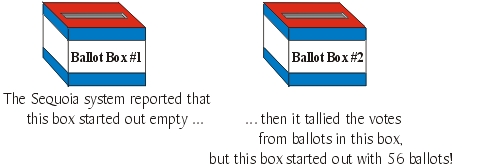
John and I both wrote up testimony, which we immediately sent to Patty Murphy. As you can imagine, we objected to having a system certified when, in testing, it reported that there were “zero votes” to start, but actually had 56 votes already in its secret, unobservable “ballot box”!
Patty passed our testimony along to the Review Board so they would have time to read our statements before the hearing. (Here’s John’s [PDF]. Here’s mine [PDF].)
We also had several email exchanges with Patty. She answered all our questions thoroughly and promptly, and at our request she even sent us detailed charts showing how each ballot in each test was marked.
On May 23, the Review Board hearing to discuss the certification testing arrived. Both John and I had oral testimony ready since the agenda showed a period allowed for public comment. We had seen the state provisionally certify quickly-developed, untested software prior to the 2004 primary election, in spite of our objections, so we were fearful of what the outcome of the hearing might be.
Presiding over the hearing was Shane Hamlin, Assistant Director of Elections for Washington State. The four members of the board were:
- Joaquin Avila, Visiting Asst. Professor of Law, Seattle University, School of Law
- Debbie Cook, Director, Washington Assistive Technology Alliance
- Michael Rooney, Elections Specialist, Pierce County Elections
- Kim Wyman, Auditor, Thurston County
Thurston County uses ES&S equipment, so without hesitation, Kim Wyman recused herself from the decision regarding ES&S. Michael Rooney recused himself from the Sequoia decision, since it would impact Pierce County.
Patty Murphy started out by summarizing the ES&S system, the testing, and the findings. She also added a new recommendation we hadn’t heard before — a recommendation to certify new AutoMark software that hadn’t been tested with the rest of the ES&S system.
Neither John nor I had intended to comment on the ES&S system, but at that point, we both changed our minds. John pointed out that federal voting system standards don’t allow for “mix and match†but that a system has to be tested and approved as a whole. New software on the AutoMark would mean the system no longer met federal testing standards. I added that since the AutoMark software interacts with the Unity software to generate ballots, it was essential to test that they were compatible with each other.
Steve Pearson, a representative on-hand from ES&S, said that SysTest, one of the Voting System Test Labs certified by the U.S. Election Assistance Commission (EAC), had tested the compatibility and would be issuing a report within a week. He pointed out that the EAC certification process takes so long that they decided to have SysTest do the testing and provide a report outside the regular EAC certification process.
John and I gasped! ES&S was attempting to do an end-run around the EAC certification process!!!
John moved to a chair with a microphone, and when Mr. Pearson was finished with his statement, Hamlin indicated for John to go ahead. John used the word “circumvent†instead of “end-run†— a respectable touch I thought. Pearson denied that charge, of course, but John’s point wasn’t lost on the board.
Their final unanimous decision was to recommend certification for the NASED-qualified ES&S system, and approval for the new AutoMark pending a satisfactory report from SysTest. Knowing ES&S’s history of promises made and promises broken, John and I don’t expect that report anytime soon.
The next part of the hearing dealt with the dangerously inaccurate Sequoia system.
First, Patty Murphy presented information about the system and the county’s testing and findings. (Here’s where the “transparent†part of this article’s headline comes into play.) Patty thoroughly described the problem that had occurred, the discrepancy in the results, and the possible workarounds proposed by Sequoia — which involved “patching†the software in both the scanner that falsely reported a blank ballot box and in the WinEDS software that counted ballots from the “stuffed†ballot box.
Then she added a new thought we hadn’t heard before: the possibility of using the Sequoia Edge touch-screen machine, the central count optical scanner, and the WinEDS tabulating software without using the flawed, precinct-based Insight scanner. I thought that sounded like a possible solution.
Regarding the complex algorithm used to tally RCV ballots, Murphy pointed out that software, of some type, would be needed to tally such ballots correctly. She explained how they tried hand-counting just 14 RCV ballots with seven ranked contests and found that it was “horrendous.†Using software to tally this sort of balloting was absolutely essential. She found that it simply couldn’t be done any other way.
In other words, if this system weren’t approved, it would be impossible to comply with the mandate from Pierce County voters. Quite a problem to present to the Board.
Pat McCarthy, Pierce County Auditor, spoke first. She said that she was so concerned about the flaw discvoered on the Insight scanner, she had decided not to use it at all, contrary to her original intention. I was impressed. Too often, we see elections officials ignore the problems with voting equipment and use it anyway, claiming that their administrative procedures can make up for the flaws. But McCarthy had listened to the evidence and had decided to reject the equipment, regardless of what the Board recommended or whether the SoS certified it. How refreshing to observe a responsible decision, responsive to evidence.
But she wasn’t the only official to respond to the evidence that day.
(Here comes the “participatory†part of our headline.) I can tell you some of the subsequent interaction, but I can’t remember the order in which things were said because Shane Hamlin, the Assistant Director of Elections for Washington State, who presided over the hearing, allowed John and me to speak as much and as often as we wanted. We gave our initial comments, and then, as we had other things to say during the proceedings, we went back to the microphone and spoke.
And we were heard.
Let me say that again for emphasis: We were heard!
Edwin Smith from Sequoia was there to represent their system that had failed during testing. He attempted to claim that the miscount wasn’t really an accuracy issue, because it had been caused by an operator error that could be handled through proper procedures. But the Review Board heard John’s statements about the accuracy requirements in federal and state law and acted on them responsibly — as you’ll read in a moment.
(Ed Note: Smith is the Sequoia VP who recently sent an intimidating email to two Princeton computer-science professors, threatening them with legal action by the company should they independently examine the touch-screen voting machines made by Sequoia which had failed during New Jersey’s recent Super Tuesday primary election, as requested by NJ county election officials. Smith’s strong-arm tactics momentarily succeeded until a state judge ordered Sequoia be ignored, and the state’s machines undergo testing.
Smith was also the man responsible for hiring a so-called “independent” examiner to review the same failed machines on behalf of Sequoia. Smith was subsequently reprimanded, and the “independent” examiner, Mike Gibbons, was released from his job after The BRAD BLOG revealed some disturbing information about Gibbons.)
I pointed out that what Smith referred to as “operator error†was actually good testing, and I saw heads nod among the Review Board.
I also asked how many ballots were expected in the election, and McCarthy estimated “400,000.†I told the Board I was concerned about the fact that they had only tested 178 RCV ballots and yet planned to tabulating some 400,000 in the election. I reminded them about the disaster that occurred in Denver in 2006 when they used voter check-in software that hadn’t been stress tested under conditions that would actually be in place on a live election day. The system crashed under high volume and disenfranchised tens of thousands of Denver voters that day.
This was when it became evident to me that we were in a discussion with other concerned citizens rather than “testifying†in a phony “hearing†before officials whose minds were already made up.
Patty Murphy asked if I would be less concerned if all the ballot records were made available so that citizens could run their own checks on them. As we discussed that idea, I found out that Pat McCarthy was already planning to post the individual ballot records on the Pierce County website immediately after the election. When I pointed out that it would be essential to have complete counting rules, the format of the records, and some sample records as soon as possible so people could begin developing independent programs right away, Patty and Pat agreed to make them available very soon.
To get us back on track, John emphasized again that using a system that miscounted votes was a violation of federal law that could not be ignored.
Debbie Cook then summed up the options concisely, said it was time to take action, and made a motion to recommend approval for the system, with a stipulation prohibiting the use of the Insight scanner. Joachin Avila suggested adding another amendment — the approval would depend on a legal decision that the system would not violate the accuracy requirement of federal law as long as the Insight wasn’t used.
The Review Board unanimously passed the motion as amended. We hope Sam Reed, Washington’s Secretary of State, will accept their recommendation.
After the hearing, John and I agreed that the staff — Shane Hamlin and Patty Murphy — had been stunningly welcoming of our participation, that we had truly been heard, and that the Board had acted wisely and responsibly in a difficult situation.
Quite a day, to find ourselves UP the rabbit hole into sunshine and sanity. For a change.
… 🙂
Zap! I thought you’d died!
I have lost so much faith in ALL the people involved in the electoral process, that I keep wondering “where’s the trick?”
CharlieL…don’t give up and don’t forget..Clinton balanced the budget and the true looting of our treasury is only now becoming noticeable. Lack of food, gas and housing WILL change opinion re. “If I take this bribe, will I be able to stay in politics?” There has to be a huge number of bribed local election officials getting worried about their careers right about now.
The unpublicized truth is that there are a lot of elections officials who are really trying to do a good job for the people. But they only make it into the news when their electronic systems give them grief, or when they do something outrageous like test their systems in a way that that frightens their vendor (e.g. Ion Sancho and Bruce Funk).
Wilber ~ Whaddabout Exspokestool Scott Mcclellan’s new book … Proves that it’s incongruous for the normal human conscious to lie … Good on ya Scotty!
Congratulations, Ellen and John! What a shot in the arm! And thanks especially to the Review Board and the involved county officials, for appreciating and moving to meet the needs of a healthy democracy.
And a special note of thanks to Patty Murphy and Pat McCarthy for their vision of publishing the ballots on the Internet.
When all voters can view the cast ballots and can count the votes for themselves, there will no longer be any question of whether the counting was done properly (apart from the generally small number of ambiguously marked ballots in any election).
This resource will wipe away a host of concerns about the security and reliability of voting in our country.
When such a proposal has been raised in the past, objections have quickly come forth–the cost would be exorbitant, the ballot images might get hacked, and so on. Most of these objections are easily laid to rest. (See http://e-grapevine.org/citizensaudit.htm.)
The one remaining knotty objection to this proposal is that, if not executed properly, it could in some cases compromise the anonymity of the ballot. Here are some scenarios:
1. A voter has unique way of making checkmarks on the ballot.
2. A voter is intimidated into putting seemingly “stray” (but intentionally voter-identifying) marks on the ballot.
3. A voter is intimidated into casting a certain, identifiable pattern of votes on the ballot (most likely in “off” or “minor” contests).
If such concerns can be successfully addressed, then publishing the ballots will come into its own as the obvious and only way to render elections not merely “transparent,” but “fully transparent.”
Thank you, Roy. Yes, it’s exciting, but I think I didn’t make it clear in the article. What will be posted are the electronic ballot “images”. That is, the electronic records of the ballots, listing each person’s choices — not pictures of the ballots themselves. This, then, bypasses concerns about the anonymity of the ballots.
Thanks for calling attention to this! It is absolutely crucial for private ballots to remain truly private, so every person can vote his/her conscience.
“What will be posted are the electronic ballot “images”. That is, the electronic records of the ballots, listing each person’s choices — not pictures of the ballots themselves.”
So, if it is an electronic record, how do we know the votes were accurately recorded as cast?
Raincity,we don’t. We’re trusting that Sequoia’s unobservable, proprietary 400C optical scanner software and hardware will correctly identify the marks on the ballots and report them accurately in the electronic records.
This is why John and I have been pressing the WA legislature to institute at least minimal spot checks (sometimes inaccurately called “audits”). So far, no luck. But we’re hopeful for next session.
Ellen: “What will be posted are the electronic ballot “images”. That is, the electronic records of the ballots, listing each person’s choices — not pictures of the ballots themselves.”
Raincity Calling: “So, if it is an electronic record, how do we know the votes were accurately recorded as cast?”
Ellen: “Raincity,we don’t. We’re trusting that Sequoia’s unobservable, proprietary 400C optical scanner software and hardware will correctly identify the marks on the ballots and report them accurately in the electronic records.
“Trusting” is the antithesis of “checks and balances.”
The need for “trusting” is minimized if images of the actual ballots are published. Publishing the ballots has benefits that are so great–perhaps indispensible–that it’s worth the modest cost and effort it would take to resolve the few issues mentioned in my previous message.
I should point out that checks and balances for the published images would require that they be created not solely by the election jurisdiction but also by civic groups and private citizens, who are permitted to observe and photograph the ballots in the polling place after the polls close.