
For months, supporters of Rep. Rush Holt’s Election Reform Bill (HR 811) – from computer scientists such as David Dill and Avi Rubin to extremely powerful advocacy groups such as People for the American Way (PFAW) and VoteTrustUSA — have been telling critics who believe that Direct Recording Electronic (DRE) touch-screen systems are antithetical to democracy that an amendment to his bill, requiring a ban on such systems, could not be passed by Congress.
They appear to have accepted the talking point as gospel, and thus have argued that any attempt to amend the current bill (and the matching one in the Senate) is a fruitless endeavor, and we should therefore support the bill as is because something is better than nothing.
In the case of PFAW, they’ve actually been responsible, in no small part, from selling that line to the public.
Never mind that if the many respected Election Integrity advocates and computer scientists repeating that unsubstantiated argument actually announced they would not support any federal Election Reform legislation that failed to include such a ban — one which most of them have said they’d support (PFAW not included) — we might actually get such a ban added to the bill.
Nonetheless, despite my best efforts, I have yet to be able to find a single congress member who supports the bill as currently written, without such a ban, who will go on record — or even admit off-record — that they would vote against the Election Reform bill if it included a ban on DREs.
I have yet to be able to find one.
Anyone have a name for me? Even just one?
Equally notable, DRE systems, by their design, are against the law and in strict violation of the Help America Vote Act (HAVA) of 2002, which the Holt bill is meant to amend.
Section 301 of HAVA expressly requires that any electronic voting system “permit the voter to verify (in a private and independent manner) the votes selected by the voter on the ballot before the ballot is cast and counted.” And yet, by design, electronic DRE systems allow for no such verification by the voter.
At best, a voter may verify a “paper printout” said to represent the electronic ballot, the one which is actually “cast and counted” on a DRE system — if the DRE in question is equipped with a VVPAT printer. Of course, that’s only if the voter bothers to verify it for accuracy. Unlike with a paper ballot system, “voter verified” by definition since the voters have marked the ballots themselves, it is impossible to determine whether or not such paper printouts were ever verified by the voters.
(Holt’s bill requires that all DRE systems must have paper printouts, thus their oft-repeated, misleading sales line that the bill will “ban paperless electronic voting machines.” Very clever, eh?)
And while the voter may or may not verify the accuracy of that DRE paper printout — studies by electronic voting supporters, of all people, at CalTech and MIT [PDF] and elsewhere, have shown that the vast majority of voters do not — that paper printouts are never counted on Election Night. That fact will remain true even under the current provisions of the Holt Bill.
Instead, as will be required by Holt, just a tiny 3% of those paper printouts will ever be counted by anyone or anything in most cases (some times as much as 10%), as part of an “audit” provision in the Holt bill. That audit will take place days after the media have already been given the name of the “winner” of the election as based on the results reported from the 100% voter-unverified electronic ballots as cast and counted on the DRE voting systems.
While it is strictly impossible for any human being to determine if his or her actual ballot is accurate before it is cast and counted on a DRE voting system, and strictly impossible to determine if a voter has actually verified that the paper printout supposedly representing the ballot has accurately reflected his or her intent, some say that’s okay, because the 3% to 10% “audit” later on will most likely catch any discrepancies days after the election.
For those who believe it’s just fine that 90% to 97% of the votes said to be represented by such paper receipts will never be tallied by anyone or anything, because a post-election audit will somehow be effective in reversing inaccuracies reported on election night, I’d remind them of Bush v. Gore, when the Bush Team went all the way to the Supreme Court to argue, successfully, that their client would be “irreparably harmed” if a count of the actual paper ballots, which actually existed in that contest, had proceeded because the media had already announced George W. Bush to be the “winner” on election night.
I’d also remind them that Christine Jennings in Sarasota is still fighting for the seat she most probably won in Florida’s 13th congressional district last November. Despite having been announced the “loser” on election night, even the voting machine company’s only expert placed on the stand in the state election contest admitted that were it not for problems on the touch-screen DREs, Jennings would likely have won the election she was certified as having “lost” by just 369 votes. While thousands of dollars are spent on attorneys to try and reverse the election night finding in state court and in a federal congressional challenge, the Republican Vern Buchanan continues to sit and vote in Congress.
Computer scientists have confirmed to me that “paper trails” added to those DRE voting systems in democratic-leaning Sarasota, where 18,000 electronic ballots failed to report a vote in the race, would have reflected the same inexplicable undervote rate. Nonetheless, Holt supporters point to the election and say over and over again — without evidence — that the bill would keep such a disaster from happening again.
With all of that in mind, it seems fair to ask for the name of just one Congress member who would vote against counting the votes actually verified by his or her constituents. Just one. Anybody?
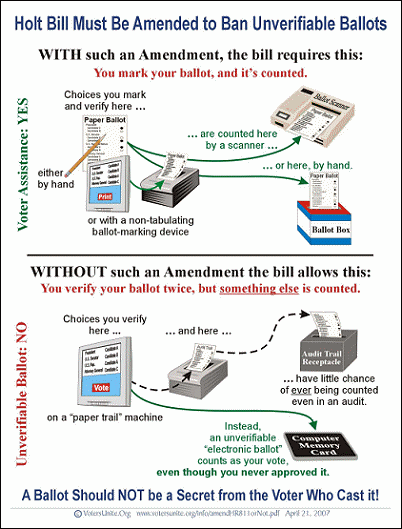
(See the graphic at the end of this article, created by VotersUnite.org, to better understand how it is impossible for a voter to verify his or her ballot before it is cast and counted on a DRE voting system, and how DRE paper printouts serve only to offer voters a false sense of security that their votes will actually be recorded as they intended.)
Holt Bill supporters such as computer scientists and voting machine experts like professor Avi Rubin of Johns Hopkins and professor David Dill of Stanford, along with Warren Stewart, policy director of one of HR 811’s most ardent supporters, VoteTrustUSA, have all gone on record stating that DREs should never be used.
Rubin: “[A]fter four years of studying the issue, I now believe that a DRE with a VVPAT is not a reasonable voting system.”
Dill (who has been circumspect in his public comments, but has been more direct in private emails that I reviewed as sent to others): “I would personally prefer to see optical scan machines used nationwide.”
Stewart: “While this broad based movement embraces a wide range of proposals and positions, it is unified in the conclusion that the direct electronic recording of votes to computer memory is inimical to democracy.”
That’s just a small sampling, and only from amongst supporters of the Holt bill.
And yet, with those rather direct pronouncements against the use of DREs, all of those quoted above have been quoted, time and again, as saying that while they’d rather not see DREs in use, an amendment to require a paper ballot — one that is actually tabulated after being verified and cast by the voter — could not be passed by Congress.
Fair enough. But where is the evidence for such a claim?
I have yet to hear the name of even ONE congress person who would vote against verified ballots.
The line, originally propagated by Holt’s office and widely echoed by the well-financed pro-Holt lobbying efforts by People for the American Way (PFAW) and elsewhere, suggests that a DRE ban could not succeed. The line has subsequently been passed on as accepted gospel by folks like Dill and Rubin and Stewart and the majority of the Holt-supporting minions.
Never mind that such a ban has already been passed by the new Republican governor of Florida, Charlie Crist, and the Republican state House and Senate down there, Holt supporters at the federal level (mostly Democrats and their public-advocacy supporters) have taken it for granted that they could not pass a similar ban.
And yet, in all the months I’ve been trying, I’ve been unable to come up with a single name of a single congressional Holt supporter (the bill currently has 216 co-sponsors) who has said they would not vote for the bill if it included such a ban.
With all of those Congressional supporters, I’m sure there must be some who would not vote for the bill if it included such a ban, yet I’ve been unable able to identify any of them, so far, and none of Holt’s most ardent supporters have been able to give me a single name.
If they did, of course, we might be able to find out why any such congress member would be opposed to banning such dangerous devices almost universally agreed to be “inimical to democracy,” as Stewart testified to before Congress, along with Rubin. Especially since perfectly acceptable, wholly verifiable, and far less dangerous alternatives exist, as needed, for use by blind or disabled voters. Such voters may require such assistive devices to help them cast their votes “in a private and independent manner” as required by HAVA, and the good news is that they do not need a dangerous DRE system to do it!
“No exception needed or wanted for voters with disabilities,” said Paul Edwards, former President of the American Council of the Blind, on behalf of the Florida Council of the Blind, in a recent statement headlined “All Voters Deserve Paper Ballots – Voters With Disabilities Must Not Be Left Behind,” used to announce the strategic partnership between FCB and the Florida Voting Coalition.
“The very purpose of HAVA Section 301 was to provide an equal opportunity to voters with disabilities. ‘Equal’ doesn’t only apply to the ability to cast a private and independent ballot…it also applies to the ability to cast a secure ballot,” Edwards said.
“Our message today is, NO THANK YOU,” the blind voters advocate added in the announcement, “We don’t want [DREs] and should not be forced to use them. Paperless electronic DRE voting systems are fit for no one.”
Dan McCrea, co-founder of the Florida Voting Coalition, explains in the same statement that, “For years proponents of paperless electronic DRE voting systems have claimed that their systems are the only solution for voters with disabilities.”
“That’s just not true,” he says. “Non-tabulating ballot marking devices provide superior…facilities to allow voters with disabilities to cast a private and independent vote, and they are HAVA compliant. But unlike failed DRE systems, they allow all voters to vote on one uniform, paper-ballot-based, secure voting system.”
Their announcement, ironically enough, is posted on the site run by Warren Stewart’s VoteTrustUSA, the number #1 Holt Bill supporting group in the Election Integrity community.
One such particularly pernicious example is found in the deceptive and misleading “Frequently Asked Questions” page as posted at Holt’s congressional Web page, and as authored by his lead HR811 legislative aide, Michelle Mulder. Note the deceptive bait-and-switch tactic used in the following, as she conflates non-verifiable DRE systems with non-tabulating, verifiable electronic ballot marking devices:
For now, we’ll set aside the above strawman distraction of “two classes of ballots,” since they already exist, by definition, in a system which uses DREs at the polling place, along with paper-based optical-scan absentee ballots in the same election. Or even DREs and op-scan systems used side-by-side in many precincts on election day as many jurisdictions already do in a practice perfectly allowable both now and even under Holt. Further, the latest version of Holt’s bill, recently reported out of committee to the House floor, further legislates in favor of “two classes of ballots,” by allowing citizens to request paper ballots if they wish, instead of being forced to use a DRE system (unfortunately, the legislation allows those ballots to be ghettoized, as a separate class of ballot, to be counted days after the election when the DREs have already been used to establish a “winner).
What is most notable, for the purposes of this article, about the above paragraph from Holt’s official document, is the sleight-of-hand used to deceptively take the concern about “DRE print-outs” and quickly mutate it into one of “the assistance of a machine to create a paper ballot” for disabled voters.
There are voting machines such as the AutoMARK which may be used by those who “require the assistance of a machine to create a paper ballot,” but which do not cast and count an unverifiable electronic ballot. Rather, such assistive machines, often referred to as Ballot Marking Devices (BMDs), help provide true paper ballots to be printed and verified by the voters before they are then cast and counted by another device or by hand.
Of course, the author of the document, Mulder, and Holt himself, know the difference very well between dangerous DRE systems, and less-dangerous, verifiable, non-tabulating electronic BMD devices for use by the blind and disabled. I’ve discussed that point personally with both of them on numerous occassions. The conflation quoted above therefore is purposely deceptive, and in my opinion, unforgivable, given the ramifications it will have, if successful towards passage of this bill, to both America and the world.
There is more such egregiously misleading disinformation on that same official Holt page, but I’ll leave that for another day.
And yet Holt’s office is not the only one carrying off such a knowing disinformation campaign on this specific issue.
In precisely the same vein, Holt’s most powerful public-advocacy proponent, PFAW — which actually advocates the use DRE systems as preferable to paper ballot systems, by the way — continuously makes the same dishonest conflation in single-minded pursuit of building support for this currently very flawed bill. Their published analysis of the Holt bill [PDF] argues (misleadingly) that “DREs afford voters with disabilities an opportunity to cast an independent secret ballot— something that optical scan paper ballots cannot fully do.”
While their analysis may be true, as taken literally, it’s deceptive for its misleading by omission. As my hours of discussions with PFAW’s Executive Director Ralph Neas and others involved in lobbying for the Holt bill at the organization confirm, they know full well that there are non-DRE devices available which offer the exact same advantages for “voters with disabilities” without the many dangers posed by DREs. Nonetheless, they purposely continue to conflate and confuse the issue publicly and, I would argue, opportunistically in hopes of lobbying for the bill as written to allow for the continued use of the DREs which they’ve stated that they prefer to paper-based systems (for reasons that they have failed to satisfactorily identify to me or anyone else that I know of.)
If we could learn the names of these purported pro-DRE congress members, perhaps we might be able to make certain that such members are well informed about less dangerous and truly voter-verifiable alternatives which have the additional advantage of complying with the rule of law under HAVA.
Until then, however, I keep waiting. And marveling at how many well-intentioned, well-educated Election Integrity advocates — fighting, ironically enough for transparency and verifiability in elections — are willing to accept, on faith, a talking point from the bill’s author and most powerful proponent (PFAW), without even bothering to get transparent, verifiable information on the #1 talking point concerning why a DRE ban could not succeed in Congress.
So, anybody? Any names? Just one? I’m waiting…
Brad Friedman is an investigative journalist, blogger, proprietor of The BRAD BLOG, and an authority on issues related to American election integrity.
Excellent graphic. It is difficult to explain to people why a DRE vote is not verifiable even with a “paper trail.”
It sounds like there’s a serious problem in Congress and that somebody really really wants to keep electronic voting systems — including Democrats.
Brad, I hate to break it to you, but saving Democracy is all in your hands. Yep, it’s all on your shoulders…no pressure.
I suggest sending an article such as the one above to the Democratic Party presidential candidates’ campaigns and urge them to publicly support an amendment to the Holt bill.
If any of them takes up the issue, even a little, then we’ll know who we can trust. The others…well, they can take a flyin’ leap.
Brad, call on your 6 or 7 best friends if you must, but do this great thing and save Democracy for us all.
BTW, I like the blog color scheme.
Brad, if experts say that an amendment to ban DREs could not be passed by Congress, then what are all the possible reasons you can come up with for their not passing an amendment? The only one I can think of is lobbying by DREs. But I want to know if there might be other reasons, as well.
FYI, in my literally hundreds of e-mails I have sent to my rep, the only one I never received acknowledgment for was one in which I asked her directly if she had taken any $$$ from DRE lobbying, and if she had, I request of her that she return it immediately, because her taking of it will come back to haunt her later.
Brad, C&L has a link to Murray Waas who has The Mighty Thor by the balls, maybe you already seen it ?
All this confusion does not help the movement. The division does not help the movement. The notion of divide and conquer looms on the horizon.
I can’t tell anymore whether the movement is a battle between activists to gain the supremacy of one faction, like the democrat v republican realm, or something else either better or worse.
I know of no official definitions of “DRE”, “paper ballot”, “electronic ballot”, or “count a vote” in the law as it currently exists.
Where is the statutory definition and where are the cases construing that definition? Without it cacaphony rules the day.
Until official definitions exist, which all movement players agree to, the movement is just a bunch of groups who consider themselves to be the “one true church”.
And since the movement is without any authority to define the terms of art or to uphold the law, it is simply a tug of war.
So, the bottom line is that the movement is dizzy these daze and at war with itself.
Those who could fix “the problem” (congress and the courts) (if only there was one “the problem” defined by a consensus in the movement) are seen as “them”.
{Ed Note: Post by Brent Turner of Open Voting Consortium deleted. He has already been advised not to use different names when posting to The BRAD BLOG, as per the rules, has been given many warnings, and has violated this rule repeatedly nonetheless. Thus he is no longer welcome to post here.}
You couldn’t get a single member of Congress to say they would vote against such a DRE ban?
Why couldn’t you get a single member of Congress to introduce a DRE ban, then?
Maybe Members of Congress are just careful of what they say to you, on or off the record.
Feinstein says that she thinks voter-marked paper ballots are the way to go (quote is near the end of her press release), but she hasn’t introduced a DRE ban. I think she would introduce a DRE ban if she could it through the Senate.
In the meantime, tens of millions of votes won’t even be auditable in 2008, unless federal legislation makes them auditable. Tens of millions of votes not auditable, or at least a check on the potential for abuse of power that a minimum 3% random audit provides… maybe those computer scientists who want optical scan and support 811 know what they’re talking about.
Keep Paying Attention said:
As the author of this post knows well, I don’t have the $20 million budget that PFAW has. So clearly, they’ve got me beat in being able to trick Congress into voting for bad bills.
I know. And as long as folks like you enable her to pass legislation that doesn’t do what’s needed, or what it pretends to do, she’ll continue to walk all over you.
I know that it was easy to get Florida Republicans to ban DREs, but somehow, Democrats in Congress can’t possibly do it. As long as you keep enabling them and making excuses for them, they won’t need to.
As you know well, they won’t be “auditable” after Holt passes either, since you can’t audit a piece of paper for which there is no way of knowing whether it was verified as accurate by the voters, as on DRE voting systems.
But if you wish to have an audit that says a rigged election was not rigged, then Holt is the way to go. Keep up the bad work.
As for auditability, a paper trail system that will be checked even by a minority of voters can check boldness in those who might be tempted to rig an election.
811 requires instructions to voters on the importance of verifying the paper be prominently displayed in every polling place.
811 encourages op-scan with its a paper durability requirement and funding for states. There would be fewer DREs in use if Holt passes.
This is the only federal legislation likely to make even a step forward in 2008.
How about a movement by those who care to send in questions to the networks during the debates.
The question might read:
Do you favor legislation which would outlaw all Direct Recording Electronic (DRE) voting machines before the 2008 election and provide for a minimum manditory audit of 3%? If you do, would you vote for such and amendment to Rush Holt’s bill in the house or Diane Feinstein’s bill in the Senate? As you are no doubt aware, the Republic Governor and the Democratic legislature in Florida just passed such a measure.
I will send it in to CNN now for the Republican debate and again to the other networks whenever there is a debate. If they see this question often enough, they might use it during the debates.
If it is “the only federal legislation likely to make even a step forward in 2008,” improve it. The integrity of American democracy is not something that the US can compromise without sacrificing its very fabric as a nation and obliterating the remnants US moral authority abroad. Who do you serve — sociopathic corporate interests or voters?
I live in San Diego County where our elections are overseen by Deborah Seiler and Michael Vu, both having a less than stellar record when it comes to clean and fair elections. I think the Board of Supervisors needs to be recalled, Walt Ekhard, Deborah Seiler, and Michael Vu fired. We need to elect a Board that supports a system of voting that counts our votes as we cast them.
I sent in my question to the general comment line but if somebody can tell me where else to send it I will resubmit. I thought they had a comment line specifically for the debates, but I could not find it.
So, you don’t have the 20 million smackers? Well, the voting machine companies do. And they, working in combination with a vast majority of election officials who like and want to keep their DREs, can use that money to get congress members to vote against a bill banning DREs.
Get it?
Karen (#12), we have an incredible Sec of State in California now, thanks in part to Brad’s support of her leading up to the June primary.
She has a website, and I suggest that you send her staff an e-mail with your concerns about the election integrity in your district.
You can also send e-mail messages to Boxer and Feinstein. You won’t be wasting your time.
As “Keep Paying Attention” well knows, even before she said the following…
…It doesn’t matter whether voters check that paper trail or not. The fact is, a) there can be no way to know if the paper trail (“KPA’s” Holt bill calls it a “paper ballot) was checked or not by the voter and b) Even if it was, it can still be gamed by bad guys to match the internal numbers.
A warning to KPA – The posting of knowing disinformation will earn you one or two warnings, before you’re banned entirely. Post whatever you like here, even if it’s something I may personally disagree with. But if it’s the same garbage you have posted elsewhere, and been well-instructed that it is bullshit, you won’t be posting here for long. Capiche?
Yes, with “Election Integrity” advocates like you out there enabling these guys through your constant rationalization for bad legislation, and your inability to stand up for what our democracy requires to ensure real integrity, there is little doubt that Holt is “the best that we can get”.
Your good friends in Holt’s office notwithstanding, “KPA”, I’ll put Election Integrity over politics, and American democracy over cowardly deal-making of your favored brand any day. And, unlike you and Holt’s office and PFAW, I don’t find it necessary to mislead people with phony information in order to do it.
And oh, yeah. My real name stands behind every damned thing I write, say or do.
Good night and good luck.
Doesn’t this smell like a HUUge pile of shit ?
It’s like ‘PFAW is on the job Libs, you can all go back to sleep now’
Either PFAW was bought off/scammed by the EVM Mfrs, or Neas is an operative IMO
Brad #16
We ought to be at least as accurate in our statements as electronic voting machines are suspected to be:
(House Web Site, emphasis added).
“Who cares” is the motto of the electronic voting machine companies and it seems to be leaking over into the movement too.
I could not find the term “ballot ballot” (your term) in either version.
However the term “paper ballot” appears 49 times in the original, but “paper trail” appears zero times in the original.
The term “paper ballot” appears 36 times in the version that came out of committee, and “paper trail” appears zero times in it.
Is there another version? I know that the Senate version S. 559 has some goodies in it that neither version HR 811 has. But I did not see “ballot ballot” in it either.
For those who are not legislation challenged, the three (at this time) versions must be fused or morphed into a final version for both the House and the Senate to approve or disapprove.
Its that bi-cameral thang. Peace and love!
{ED NOTE: Dredd, “ballot ballot” was my typo. Yes, I meant “paper ballot” and have edited my original comment accordingly. But yes, Holt now says “paper ballot” throughout, when they are referring to “paper trails” or “paper records” which will never actually be counted by anyone or anything. They did a FIND and REPLACE to last years HR 550 to change “paper record” to “paper ballot” in this version. For giggles, at one point they had a phrase which read “the paper ballot of the ballot” and a few other smile-worthy effects of changing the word “record” to “ballot” as they did back before introduction in the 110th Congress. — BF}
I propose that an “Election and Voting Machine Dictionary” be attached to or made part of HAVA.
It must define:
It is time to acknowledge what I said in post #5 upthread and drop the ego based LOUD CACOPHONY and elevate clarity instead. The way the movement defines things is whoever yells the loudest, has the most money, or the coolest fans gets the “say”. 🙂
Any good law library has an entire volume of definitions and phrases called “Words and Phrases”.
These A-Z volumes detail what courts across the nation have legally defined words and phrases to mean. In binding court decisions.
It helps to use these definitions so that when a term is used it means something real.
A case that is making its way around the MSM shows how important definitions are:
(AP Report, emphasis added).
For whatever it’s worth, I just put together another letter to send to my local newspaper about the amendment to HR 811 to ban DREs. Feel free to use this letter as a starting point to put together your own letter to send to your paper and to your representative:
A quick search of the SFGate website for Holt Bill turns up nothing, but since my search skills are not the best, I won’t go so far as to write that the Chronicle hasn’t reported on this piece of national election legislation.
Here is what I’ve learned from internet news sources:
(1) “There is copious evidence that e-voting machines are prone to malfunctions and vulnerable to malicious software attacks…”
(2) Supporters of HR 811 “say that an amendment to ban [e-voting machines] could not be passed by Congress.”
(3) At least one investigation has “yet to be able to find a single Congress Member who supports the bill as currently written, without such a ban, who will go on record — or even admit off-record — that they would vote against [HR 811] if it included a ban on [e-voting machines.]”
I have a very responsive representative, Lynn Woolsey, who has always responded to my inquiries sent to her offices, and in some cases has taken action based on my inquiries … except in the case of my inquiries into whether or not she’s accepting campaign contributions from e-voting machine companies.
The only valid conclusion I can come up with is that the lobbying efforts of e-voting machines to tap into the federal stream of money generated by HAVA are successfully winning out over our democracy.
Help! We sat by during the run-up to the energy crisis and let Enron et al run all over us with their energy rip-off propaganda machine. Now we’re doing the same thing with the e-voting propaganda machine.
Who on Capitol Hill is on the take from these e-voting machine companies, and to the tune of how much money? Or, what are the reasons behind our Congress apparently choosing to ignore what computer scientists and advocacy groups are telling them about e-voting machines, and the fact that they are antithetical to democracy?
Thank you for saying, “INVISIBLE”
I fucking said that shit travels at 3e8 early on and people laughed at me.
And I said it here. I think…
http://sacxtra.com/Hacked1.jpg
Nope.
I am just a dumb guy that don’t know nothing.
One of the mythical “little people”
I fuckin sure ain’t a journalist!
Maybe if the polling places were invisible too?
(I MUST go back into happy mode now)
the mythical i
Dredd –
Be sure to see the “Ed Note” I added to your post at #18.
Had to find somewhere to say I’VE JUST GONE SCREAMING NAKED OFF A CLIFF! Thank you… but I’m not even sure I feel better now.
Brad,
Thanks. Now I understand your argument to be that operationally the use of the term “paper ballot” really means “paper trail”.
That is a reasonable argument IMO.
I was shocked when the Republican congress passed HAVA promptly after the Florida debacle in 2000. Then came the gotchas and it all made sense. No need to run it down here – if there is anyplace where the readership is fully aware of the problem, this is it.
I’ve never posted here before and it seems that, as usual, I’m on the tail end of the thread. Before the 06 elections, however this was my key issue. I posted everywhere I could find a single liberal about this issue and my strongly held belief that if we didn’t win that election, future elections would be about as meaningful as elections in the old USSR. Now that investigations are revealing the colossal extent of the treasonous assault on our democracy (caging, leaked investigations of vote fraud allegations, use of the Justice Department to criminalize being a Democratic officeholder, perversion of the civil rights and voting rights divisions to do the opposite of their intended mandate, voter suppression, caging, vote flipping and erasing “magic box” machines and so on) I realize that I was only seeing the tip of the iceberg.
It is completely incomprehensible to me therefore that after two consecutive stolen presidential elections and god knows how many congressional, state and local seats stolen, any Democrat could be stupid and venal enough to allow even the possibility much less the virtual certainty that this will continue to the point where our elections are predetermined by the counters.
I have long since stopped believing that the Democrats actually represented me; bankruptcy “reform”, back door trade deals and the like would have disabused me of that notion if it still existed in me after the Democratic congress passed the Reagan tax cuts. Still, I thought that simple self-preservation would make banning DREs the number one priority of Dems in congress.
Not sure any more who is stupider – me or them.
Them – I think.
Duped again.
Yes. I’m ashamed to admit it but I was just duped by Kathy Dopp into writing an email to MoveOn.org supporting their effort to fast-track the HR811 bill. I didn’t read far enough into her email until before I spun off into one of her links and did the MoveOn thing. Then I went back and saw that she was putting down BF, trying to deter her readers from seeing what he had to say. Whenever someone starts in by saying not to bother reading someone else’s lies and deceptions, I become suspicious. So I came here to read for myself what Brad had to say, and of course, here I am now with egg on my face.
ItShay! Now I will have to write and call my congressman and my senator and send email to everyone I know, and all of that, to try to undo the damage I just did. I’m so pissed at MoveOn for not being on the right side of this. I didn’t know they were.
Last time I listen to Kathy Dupe (Dopp) on anything.
Too bad about her. She had some good ideas back in 2000. Maybe she thinks that on balance that it’s the right thing to do to “ban paperless DRE” machines, but it’s just so wrong of her to try to dupe people into thinking that they are supporting “paper ballots”. But I’ll bet it’s more likely that there is a lot of friendly advice coming her way about how the thing to do is to get 811 now, and later we’ll amend it, blah blah, and if you support us, we’ll continue to fund your project…probably all very persuasive
This feels so filthy. It’s just like how we needed to rush to enact HAVA, to prevent the problems of Gore v. Bush in 2000, and then found out that things were so much worse.
And this is my real name.
John Dowd
P.S. Someone wanted some definitions. Surely “ballot” is defined somewhere in legal documents as “the physical, solid, human readable things that are counted to determine the outcome of elections, and then are preserved forever, or at least for some number of human lifetimes, in official archives, as the sole, legal record of those elections, blah blah”.
This stuff doens’t have to be complicated. Unless the goal is to dupe us.