
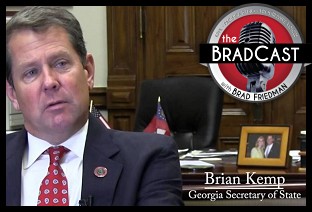
 The fallout — and disturbing mysteries — following a lawsuit filed in Georgia after its U.S. House Special Election last June get curiouser and curiouser, as we learned late last night that the state Attorney General’s office has now quit its defense of the Secretary of State and the state’s other top election official defendants in the case. We discuss all of those bombshells and still-dropping shoes with one of the plaintiffs in the lawsuit on today’s BradCast. [Audio link to today’s must-listen show follows below.]
We’ve been covering this entire mess for months now (years, really), but particularly since the lawsuit [PDF] was filed in July, after the somewhat surprising results from June’s U.S. House Special Election in Georgia’s 6th Congressional District, where GA’s former Republican Sec. of State Karen Handel reportedly defeated Democratic candidate Jon Ossoff, but only on the state’s 100% unverifiable Diebold touch-screen voting systems. (He defeated her nearly 2 to 1 on the only verifiable ballots in the race, the mail-in paper votes. Everything else regarding the results is unverifiable speculation.)
Late last week, we learned via Frank Bajak at the Associated Press, that technicians at Kennesaw State University’s Center for Elections, which has been contracted to program all of Georgia’s computer voting and tabulation systems systems for some 15 years, “wiped clean” the election server that was used to program the elections, ballots and tabulators, just days after the suit was filed in July. Its two backup servers were also subsequently wiped and “degaussed three times” in August, the day after the suit was moved from state to federal court.
GA’s chief election official, Republican Sec. of State Brian Kemp, claims he knew nothing of the server deletions until AP’s report last week. Previously, a huge fan of the Center for Elections at Kennesaw, Kemp cited the “gross incompetence” and “undeniable ineptitude” of the folks at KSU for whatever happened. Nobody has yet to take credit, however, for giving the instructions to delete the servers which held critical evidence that plaintiffs had hoped to have forensically investigated as part of the lawsuit. And then yesterday, in another flip-flop, Kemp called the entire matter “#fakenews”.
All of that is disturbing on its own, but even more so in light of revelations earlier this year that the election server in question — which stored personal data for all of GA’s 6.7 million voters and the electronic ballot programming and administrative passwords for the state’s voting and tabulation systems — was left completely accessible online, no password necessary, for at least 6 months. Kennesaw was notified about the vulnerability by a data security researcher in August of 2016 (months before last year’s Presidential election), but they failed to secure the server until after Politico’s Kim Zetter revealed the vulnerability just prior to the GA-06 U.S. House race this year. (Samantha Bee’s Full Frontal covered much of the story up to this point on her show last night, posted here.)
Then, on Wednesday evening, AP’s Bajak offered another bombshell in reporting that the Republican state Attorney General’s office, which had been defending Kemp, Kennesaw and the state Elections Board in the matter, has now pulled out from defending them. The reasons offered by the state AG and Kemp’s campaign for Governor (he’s running in 2018) have conflicted with each other or with known evidence obtained during the multi-partisan lawsuit, which a Kemp campaign spokesperson describes to AP yesterday as “a tasteless nothingburger cooked up by liberal activists who know their lawsuit is nothing short of stupid.”
One of those “liberal activist” plaintiffs, Republican MARILYN MARKS, a longtime Election Integrity advocate and Executive Director of the Coalition for Good Governance, joins me today to try and help us all figure out just what the hell is actually going on in this increasingly disturbing case.
Marks confirms that nobody still knows who ordered the server deletion, nor why the state AG has dropped out of the case. “It’s an enormous mystery, and the mysteries continue to increase every day,” she says.
“I think that Brian Kemp is — and rightfully so — getting a black eye here,” Marks tells me. “What he has done is shameful. There’s no way to explain it. So I’m sure his defenders and campaign managers are doing everything they can to go on the offensive and try to make other people look like they are to blame, and that their candidate is innocent. But I think when people step back and say, wait a minute, if they erased the servers — and they did it twice — they did it for some reason. And it wasn’t because our lawsuit was stupid.”
She goes on to explain the “number of conflicting stories that Brian Kemp’s people are telling” about when and why the compromised servers were deleted and why the AG’s office is no longer willing to defend the case. She also details whether any of the information plaintiffs had hoped to examine from the servers might still be available in what is believed to be a partial copy of the servers obtained by the FBI when they came in to examine the reported data breach that occurred earlier this year, when the servers were discovered to have been left vulnerable online.
Marks’ appearance on today’s show comes just days before Georgia voters head to the polls for municipal elections being held next Tuesday, which will also be overseen by Kemp, programmed by Kennesaw, and run on the same wildly-hackable, 100% unverifiable touch-screen voting and tabulation systems that lead to this entire mess in the first place. She recently wrote [PDF] to Kemp and other election officials to ask them to make paper ballots available to voters since, as she tells me today, if the system was contaminated during the months it had been left vulnerable on the Internet, “They wouldn’t have had time, even within the last year, to have cleaned up everything. Because, as you know, that malware can travel down to the memory cards, the voting machines, the optical scanners, and the jump servers down in the counties. Things could have traveled there in the last six months, year, two years — and there’s been no effort to try to disinfect all of the various components. I mean, there are 27,000 of these touch-screen voting machines in Georgia. There’s no way that they should be in use when we know that this system was subject to a high degree of risk.”
There is much more today in my conversation with Marks than I can adequately summarize here. So please give today’s show a listen for the full story — or, as much as we know about it to date — along with many other mind-blowing details.
Also on today’s show, a few other items, including Trump’s non-scientist nominee for the USDA’s chief scientist post, rightwing talk radio host Sam Clovis, withdrawing his nomination after becoming entangled in the Special Counsel’s investigation of Team Trump (as you might have been able to predict, had you listened to Tuesday’s BradCast with guest Marcy Wheeler); Clovis’ fellow climate science denier Rep. Lamar Smith (R-TX), chair of the U.S. House Science Committee announcing he will not run for re-election; and, in the latest Green News Report, Desi Doyen reports on, among many other things, EPA chief Scott Pruitt removing all of the scientists from the EPA’s scientific advisory panels…
CLICK TO LISTEN OR DOWNLOAD SHOW!…
[audio:http://bradblog.com/audio/BradCast_BradFriedman_MarilynMarks_AGQuitsGAServerWipeCase_110217.mp3]
(Snail mail support to “Brad Friedman, 7095 Hollywood Blvd., #594 Los Angeles, CA 90028” always welcome too!)
|



















Had to be a Russian connection.
Would there be some synonyms for ‘bombshell’ lying around unused? Anywhere?
Russians? I don’t know. The Republican Party seems capable of enough skullduggery all on their own. If Kemp is responsible for election fraud, he belongs in jail. He also needs to grow up.
The interview with Marilyn Marks was stunning. What she said was so important – it should be shouted from every mountain top; real media outlets should be looping this. I hope this interview will win an award at least so more attention will be drawn to the absolutely corrupt and dire situation that elections face with voting equipment that does not meet the burden of proof that our votes are being counted as cast. Kudos to you, Brad for your ongoing dedication to this.
Re: Allin @3.
For long time readers of The BRAD BLOG, the Marilyn Marks interview was both powerful and accurate but certainly not “stunning.”
The threat to democracy posed by easily hacked and/or manipulated e-voting systems, that are also prone to systemic error, and the need for verifiable hand-counting of paper ballots lie at the core of the election integrity message that Brad Friedman has conveyed over the past thirteen (13) years.
I touched upon a portion of that history in Why Do Georgia Election Officials Insist on 100% Unverifiable Elections.
It is a threat that is not only posed by foreign hackers, be they Russian or any other nationality, but potentially by domestic hackers and, most especially, by election insiders. The availability of centralized e-vote tabulation carries with it a vulnerability to wholesale manipulation of the “official” tally.
H/T on the Alternet reprint, Brad. Over a hundred comments, and counting.
https://www.alternet.org/activi...tion-officials
One thing not mentioned during the interview that is worthy of note is that on July 10, plaintiff’s counsel submitted a letter to all counsel in the case, asking them to notify their “clients of their obligation to take reasonable steps to preserve and retain all hard copies and electronically stored information.”
He reminded defendants of their “preservation obligation” which mandated that they suspend “data destruction” policies and retain “and to take “reasonable steps necessary to prevent the destruction, loss, override or modification of relevant data either intentionally or inadvertently.”
Either the attorneys for defendants failed to communicate this to KSU, which I seriously doubt, or the Aug. 8 degaussing must be seen as a deliberate destruction of evidence in violation of KSU’s “preservation obligation.”
Re my comment @6, the central question is whether KSU wiped the data with the intent to deprive the plaintiffs access to data that could have established that the official results of the GA06 election were the product of illegal manipulation.
Rule 37(e), Federal Rules of Civil Procedure, provides that a District Court Judge may, “upon a finding that the party acted with the intent to deprive another party of the information’s use in the litigation: (A) presume that the information was unfavorable to the party…(C)…enter a default judgment.”