
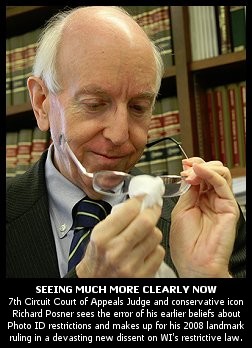
 If you read just one top-to-bottom dismantling of every supposed premise in support of disenfranchising Photo ID voting restrictions laws in your lifetime, let it be this one [PDF]!
It is a dissent, released on Friday, written by Judge Richard Posner, the Reagan-appointed 7th Circuit Court of Appeals judge who was the one who approved the first such Photo ID law in the country (Indiana’s) back in 2008, in the landmark Crawford v. Marion County case which went all the way to the Supreme Court, where Posner’s ruling was affirmed.
If there was ever evidence that a jurist could change their mind upon review of additional subsequent evidence, this is it. If there was ever a concise and airtight case made against Photo ID laws and the threat they pose to our most basic right to vote, this is it. If there was ever a treatise revealing such laws for the blatantly partisan shell games that they are, this is it.
His dissent includes a devastating response to virtually every false and/or disingenuous rightwing argument/talking point ever put forth in support of Photo ID voting restrictions, describing them as “a mere fig leaf for efforts to disenfranchise voters likely to vote for the political party that does not control the state government.”
Posner is, by far, the most widely cited legal scholar of the 20th century, according to The Journal of Legal Studies. His opinions are closely read by the Supreme Court, where the battle over the legality and Constitutionality of Photo ID voting laws will almost certainly wind up at some point in the not too distant future. That’s just one of the reasons why this opinion is so important.
This opinion, written on behalf of five judges on the 7th Circuit, thoroughly disabuses such notions such as: these laws are meant to deal with a phantom voter fraud concern (“Out of 146 million registered voters, this is a ratio of one case of voter fraud for every 14.6 million eligible voters”); that evidence shows them to be little more than baldly partisan attempts to keep Democratic voters from voting (“conservative states try to make it difficult for people who are outside the mainstream…to vote”); that rightwing partisan outfits like True the Vote, which support such laws, present “evidence” of impersonation fraud that is “downright goofy, if not paranoid”; and the notion that even though there is virtually zero fraud that could even possibly be deterred by Photo ID restrictions, the fact that the public thinks there is, is a lousy reason to disenfranchise voters since there is no evidence that such laws actually increase public confidence in elections and, as new studies now reveal, such laws have indeed served to suppress turnout in states where they have been enacted.
There is far too much in it to appropriately encapsulate here for now. Ya just really need to take some time to read it in full. But it was written, largely, in response to the Appellate Court ruling last week by rightwing Judge Frank Easterbrook which contained one embarrassing falsehood and error after another, including the canards about Photo ID being required to board airplanes, open bank accounts, buy beer and guns, etc. We took apart just that one paragraph of Easterbrook’s ruling last week here, but Posner takes apart his colleague’s entire, error-riddled mess of a ruling in this response.
Amongst my favorite passages (and there are so many), this one [emphasis added]…
And this one…
And remember, once again, this is written by Richard Posner, the conservative Republican icon of a federal appellate court judge — the judge who wrote the opinion on behalf of the 7th Circuit Court of Appeals approving of the first such Photo ID law in the country in 2008, the very case that rightwingers from Texas to Wisconsin now cite over and over (almost always incorrectly) in support of similar such laws — now, clearly admitting that he got the entire thing wrong.
One last point (for now): Our legal analyst Ernie Canning, who (along with me) will undoubtedly have much more to say on this dissent in upcoming days, suggests we award The BRAD BLOG’s almost-never-anymore-bestowed Intellectually Honest Conservative Award to Judge Posner. And so it shall be.
Now go read Posner’s dissent…
(Snail mail support to “Brad Friedman, 7095 Hollywood Blvd., #594 Los Angeles, CA 90028” always welcome too!)
|















But it was a dissent. Which means he was on the losing end of the argument, right?
AngrySpittle asked @ 1:
Sorta kinda. We’ve covered it so much, I didn’t want to muck up this quick piece with the full background. But, in very short, the U.S. Supreme Court has, for now, blocked WI’s Photo ID voting law from being implemented in November.
Previously, a 3-judge panel of GOP-appointees on the 7th Circuit Court of Appeals had unanimously voted to overturn the U.S. District Court which, after a full trial, found the law to be unconstitutional and a violation of the Voting Rights Act. The plaintiffs appealed the 3-judge panel, asking for a full hearing by the 7th Circuit judges. They split 5 to 5 against have a full hearing. Posner’s dissent (essentially) rebuts the 5 judges who voted against a re-hearing — though the Supreme Court essentially overruled them (for now) by vacating the order.
So, if you’re doing the math: 6 federal judges in the WI case voted AGAINST the Photo ID law, 5 federal judges voted to uphold it. Nonetheless, that minority “won”, until SCOTUS came in and put everything on hold for now, until (hopefully) well after the November election.
Posner’s dissent here will be very important in the next round of wrangling over not just WI’s Photo ID law, but those currently being challenged in other states. He has been called the most-cited federal judge, and his opinions are well-respected by the Supreme Court. Perhaps even moreso in this case, since he is the judge who originally upheld the first such Photo ID restriction in Indiana back in 2008.
Make more sense now? Sorry I couldn’t give you a shorter answer in this particular complicated case! 🙂
Great work, as usual, Brad.
Thank you for doing it, again and again.
I’m awaiting the outcome of Ohio’ similar law suit. That could be just as important, as it’s a different court.
I’m so tired of this anti-ID argument that always misses the point.
Bottom line is that common sense, which is far from common anymore, says when doing something as important as casting your vote you should have to provide hard evidence of your right to do so.
Despite what society has told you, not voting is NOT a sin. If you pay little to no attention to what the candidates stand for, don’t vote. If you are blindly voting Democrat or Republican because “that’s what Dad did” or because your friends think you should, don’t vote. If you’re voting merely because the skin tone of the candidate matches yours, don’t vote.
If you DO care about and pay attention to the issues, you’re not going to let needing a photo ID stand in your way of casting a vote.
Put another way, if you’re too lazy to get a voter ID. Or you find it too burdensome, most likely you’re not a particularly engaged voter anyway.
Jeremy @5,
And if you’re too lazy to deal with(read)the informed rebuttals and information that completely destroy your arguments; if you’re too invested in living in your own private Idaho bubble of willful ignorance while self-righteously parading your abandonment of critical thinking as if you know anything; than maybe you should be banned from commenting at a site where due diligence(doing your homework) and critical thought are valued.
DL,
Yes, because commenting on a blog and voicing my OPINION is equally as important as voting for the people who will determine the future of this country.
I read the blog and I read the judges dissent. I happen to disagree with it.
Don’t bother tearing me a new one for being an ignorant fool so full of himself as to disagree with a well-respected judge. There were several other well respected judges that disagreed with him as well.
It’s his OPINION. And this is MY opinion. No doubt you consider mine considerably less valuable and no doubt it’s largely because it differs from your own.
I agree with some of his points, particularly about a few other forms of ID that could be accepted. But at the same time the forms we do accept (or want to) are fair and reasonable.
And again, the idea that foreign born folks or poorly educated folks will find it difficult to learn of and adhere to a voter ID law does nothing to convince me that they are likely to know what they are voting for when they get into the booth.
All of this, my OPINION. Try and rise above the standard crap of typical comment sections and have a reasonable discussion without devolving to name-calling and belittling, people might actually consider your points on occasion if they’re not immediately placed into a defensive mode.
Have a GREAT day!
Jeremy, You say you read it. You say you disagree. But you offer no argument or evidence to refute anything Judge Posner is saying about the unreasonable, unconstitutional, additional burden the proposed law places on tens of thousands of voters.
Do you think you’re modeling the tone and substance of argument you’re suggesting I’d be better off using? Are you joking?
And it’s weird that you’re talking about attitude of presentation when your primary point seems to be utterly snobby–those people are too stupid to vote.
Jeremy says he doesn’t want immigrants and poor people to vote. But then we already knew that’s what this shit is really about.
Jeremy @ 5 said:
I’m glad that, unlike millions of your fellow Americans, you would have to take absolutely no additional steps in order to enjoy the right we all have to vote, other than showing up and voting. I’m sorry, on the other hand, that, despite your claims to the contrary, you didn’t bother to read Judge Posner’s dissent, otherwise you’d realize that for an untold number of your fellow citizens, taking those extra steps to enjoy the same right you are able to enjoy without those extra steps has nothing to do with being “too lazy”. For thousands, if not millions, no matter how hard they tried, they’d still lose their right to vote under this type of law which you seem to support.
That you were too lazy to actually read the opinion and find that out is a shame.
Then, digging his hole deeper, Jeremy @ 7 said:
Most states already require such “hard evidence” — (in fact, all states require it when registering already via federal law) — and there is no problem with it. The only time it becomes a problem is when Republicans pass laws that are meant to disenfranchise voters by limiting the type of “hard evidence” that can be used to a very narrow set of state-issued Photo ID that they know many Democratic-leaning voters do not have.
If you are too lazy to have learned that already, I’m sorry. It’s common sense that you should understand what people are doing to take away your rights. Lucky for you, there is no requirement for you to understand that before you do something as important as cast a vote.
It’s not because you’re an ignorant fool that I’m tearing you a new one. It’s because its offensive when those too lazy to learn how rights work try to encourage them to be taken away from others.
Really? Who? Because none of them have yet replied to Posner’s opinion.
No, yours has considerably less value because it contains no supporting evidence, unlike Posner’s. You failed, in fact, to cite a single issue that he got wrong. His facts are supported with evidence, you have offered nothing but disinformed opinion here.
Okay. Why is it “fair and reasonable” to accept a concealed carry permit, but not a state-issued Student ID? Why is it “fair and reasonable” to accept a military ID, but not a veterans ID? Why is it “fair and reasonable” to force someone to pay money for the right to vote, that others do not have to pay, in violation of the 24th Amendment that bans poll taxes? Why is it “fair and reasonable” to enforce a restriction on voting that could disenfranchise up to 300,000 legally registered voters without being able to identify a single incident of fraud that might have been prevented by such a restriction?
I look forward to your independently verifiable evidence to support any response you may have to any of those questions — or even, as I said, one issue on which Posner is wrong in his legal opinion.
As to your earlier claim that voters shouldn’t vote (or be allowed to vote?) if they don’t understand the issues, you should thank your lucky stars that isn’t a requirement for voting. Else you and your friends, and the folks who watch Fox “News” (cited in study after study as having the most misinformed viewers) would be shit out of luck.
Don’t worry. I won’t let anybody take away your vote, just because you are dreadfully uninformed on the issues about which you are voting. You’re welcome.
Thank you, Brad, for your ongoing efforts to protect our voting rights. Where’d we be without you?
i doubt prosser has had a change of heart
more than likely he is assured that between all the new touchscreens,and controlling the gab reps are safe in wisconsin
so he might as well clean up his rep for the sc appointment he has been promised
I have found and posted the actual voter list software used widely throughout the USA (TN, WI, PA, CO, KS…) for Accenture voter registration and voter histories. I located the files on a magnetic backup tape of the hard drive of a county elections IT employee, part of a 120-gig set of discovery files. The Accenture voter registration / voter history software is highly problematic, and has been reported switching voter parties in Colorado, and losing voter histories in Tennessee. Although it is now widely known that Accenture voter list software gets it wrong, just WHY the program misreports voter information so often has never been explained. I am hoping that by releasing this software to the public, it may shed light on what’s really going on with our voter registration systems. I also posted a Tennessee file with work orders and release notes which shows the Accenture software has a history of tripling votes in certain (‘random’) voter histories, going back to 2004. Except it is not random: Other files I discovered prove it is with primarily suburban Republican precincts that votes are somehow being recorded twice and sometimes three times for certain voters in the voter history report, and this didn’t just happen in 2004; it also happened in the 2008 presidential primary and in May and August 2010, and according to election commission notes in Shelby County, also in the 2012 presidential primary.
Brad,
Now you need a few select judge-like actors to do dramatic readings of excerpts of the opinion. I read the whole thing – thanks for insisting – but a video recreating Judge Posner’s sarcastic outrage would go viral.
Yeah, let’s just go over to the corner DMV and pick up a photo ID. No prob!
Check out radio talk show host Thom Hartmann’s trouble-free trip last spring to the Washington D.C. DMV to get a driver’s license. What could possibly go wrong?:
Make no mistake about it: getting an ID is not easy and it’s not practical. I know this from personal experience. Earlier this morning I went down to the Washington, D.C. DMV to get my new driver’s license renewed. Other than a vision test, the requirements to get a driver’s license are the same as the requirements to get a voter ID, so the crap I went through this morning to get a new driver’s license is just like what people in North Carolina and Texas have to go through if they want to vote.
http://www.thomhartmann.com/blog/2014/05/war-voting-comes-home
Nobody’s saying that everyone’s attempt to get a photo ID would be as festooned with hurdles as Thom Hartmann’s, but most people seem to think he’s a smart guy, and if HE has difficulty with the education, opportunity for transportation, and economic wherewithal that he has; I wonder how much trouble someone who lives far from where they can get an ID, has limited funds, and has limited transportation would have in obtaining one.
Jeremy @7 wrote:
Willfully uninformed and, indeed, misinformed comments, like those you’ve provided, are worthless, or as The Guardian’s C.P. Scott so aptly wrote in 1921:
The comments you deposited at this site reveal, on their face, that you didn’t bother to so much as read what the erudite jurist had to say. The words “common sense” — as applied by you in your posted comments — are merely a reflection of your preconceived bias.
if you follow the “Intellectually Honest Conservative Award,” this article is still not on that page …
correction, if you follow the “Intellectually Honest Conservative Award” LINK, this article is still not on that page
https://bradblog.com/?cat=194
you know what i mean
Thank you, Nemo! Good catch. Have fixed it!