
 The political world exploded tonight with the stunning reported defeat of Republican House Majority Leader Eric Cantor to little-known “Tea Party” candidate Dave Brat.
Cantor’s loss was so unexpected that Democrats didn’t even bother to nominate anyone to run in Virginia’s 7th Congressional District until last night, reportedly during a conference call, when they decided to put up a professor named Jack Trammell (from the same Randolph-Macon College where Brat works) as their nominee, just before today’s deadline.
“A conservative challenger is expected to fall far short of defeating House Majority Leader Eric Cantor (R-Va.) in Tuesday’s congressional primary,” wrote Rachel Weiner in Virginia’s local paper known as the Washington Post just this morning. “The question in this race is how large Cantor’s margin of victory will be.”
So, there’s more than enough speculative analysis complete guess work out there for you elsewhere about what all of this portends, from the same political pundits and geniuses and well-sourced insiders who had no clue that Cantor was about to become famous as the first sitting House Majority Leader to lose in a primary race since either 1899 or…forever, depending on who you listen to.
But, pretty much just as soon as it appeared that Cantor was about to be announced the “loser” in a blowout of an election late today, questions started coming in to us, via Twitter and elsewhere, with concerns about the integrity of the reported results and if there could have been any chicanery behind them…
Well, good question, of course, given that the reported results in this earthquake of an election haven’t actually been verified by any human beings. Rather, the results, from 9 different counties (and one city) that make up the impossibly gerrymandered 7th District, which Cantor helped carve out for himself, are all based on the numbers reported by the oft-failed, easily-manipulated computer tabulators from the alphabet soup of different types of electronic voting and tabulation systems used in each of the separate jurisdictions that comprise the district.
More on those systems in a moment. Here are the unofficial results — district-wide totals and then county-by-county — of the VA-07 election as reported at the Virginia State Board of Elections website as of 11:59pm ET tonight, with 100% of precincts reporting…

As to the type of voting systems used in each jurisdiction, there are — as in the rest of the country — principally, two different types used: optically-scanned paper ballots systems (in two of the largest jurisdictions) and 100% unverifiable Direct Recording Electronic (DRE, usually touch-screen) systems in all of the others. The DRE systems are made by several different companies, the paper ballot systems are made by ES&S, the nation’s largest voting system vendor.
All of the voting systems used in VA-07 have been found by computer scientists and e-voting experts to be vulnerable to error, malfunction and malfeasance, and — whether it’s a paper-based system or a 100% unverifiable touch-screen system — each one uses a computerized central tabulator to total up all of the numbers from the vulnerable memory cards deployed in the systems at each of the various precincts in the jurisdiction.
Paper-ballot op-scan systems, unlike DREs, are verifiable after an election, if any human beings ever bothers, or are allowed, to examine the paper ballots by hand to make sure the computers tallied votes correctly. Paper-ballot op-scan systems can fail to report accurate results. For example, three elections were incorrectly tabulated by the paper-ballot op-scan system in Palm Beach County, FL in 2012. The computer errors there resulted in two losing candidates being declared the “winner” on election night by the computers. The problem was only discovered thanks to a sharp-eyed Election Supervisor before the actual winners of the elections were ultimately determined via a court-ordered hand-count of the paper ballots.
Hand-counting paper ballots is the only way to know if a paper-ballot op-scan system has tabulated results accurately or not. Mistallied ballots are not uncommon with such systems.
With all of that said, here are the types of voting systems used in each of the jurisdictions in VA-07, as sorted by the number of votes reportedly cast in each one, according to the same unofficial totals as shown above…
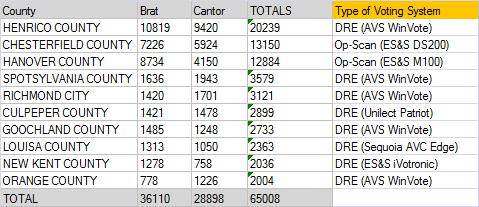
And here are the same numbers, as sorted by the margin of victory in each jurisdictions for Brat…

As you can see, two of the three largest voting jurisdictions respected their voters enough to allow them to use hand-marked paper ballots, tallied by precinct-based ES&S M100 and DS200 op-scan systems. If anyone wanted to verify the results of the 26,034 votes reported by the tabulators in Chesterfield and Hanover Counties, they could do so (presuming the chain of custody for ballots is secure, and they were allowed to do so by law.)
No votes — none of the 38,974 reportedly cast — from any of VA-07’s other 8 jurisdictions can ever be verified as having been recorded accurately as per the intent of any voter. Not even one vote. So those numbers are lost forever. Whatever the computers reported is what the results will be, whether they are accurate or not, and there’s nothing anybody can ever do about it.
As to those M100s and DS200s used in the two largest counties today, The BRAD BLOG wrote about the same ES&S M100s back in 2008, when Oakland County, MI, was trying to get help from the U.S. Election Assistance Commission concerning the same precinct-based op-scan systems which, during pre-election testing, the county said, had “yielded different results each time” the “same ballots were run through the same machines.”
In 2008, West Virginia also reported problems with their M100s. In 2010, the newer ES&S op-scan systems — supposedly better ones — the DS200s were found to have mistallied votes in New York City, including a failure rate of 70% in some precincts.
As we’ve noted many times, problems with voting systems and tabulators often show up only days — and sometimes weeks and months (or even years, as with the NYC incident cited above) — later. Late last year, in Virginia, coincidentally enough, some 3,000 votes were discovered to have been left out from the final computer tabulator totals in the exceedingly close statewide race for Attorney General. Those missing votes were only noticed in the days following the election, as citizen experts pored over the reported results, attempting oversight, and looking for potential anomalies and inaccuracies in the incredibly close contest.
Three days ago, the Washington Post reported that Cantor’s internal polling showed him 34 points ahead of Brat. Tonight, it’s a given among the pundit class, that those numbers were simply wrong and tonight’s completely unverified computer-reported results are correct, showing Cantor losing instead by more than 11 points.
Those results may be correct. Or they may not be. Nobody actually knows. Given the broad reported victory by Brat in several different counties, on several different voting systems, it seems, at first glance, unlikely that malfunction or malfeasance gave him the edge. Still, nobody actually knows that, as election results, even where they can be verified by human beings, will likely never be.
Given the surprising “blow-out” “upset” nature of tonight’s reported victory of Brat over Cantor, the pundit class will now twist themselves into pretzels to backwards engineer reasonable “explanations” for Cantor’s defeat, no matter how thin the evidence to support their theories. We’ve seen it before. Too many times, in fact.
After pretending to know why the results were the opposite of what they thought they’d be a day earlier, most pundits will then quickly focus on the political ramifications of the reported results, rather than bother to try and verify any of them to make sure they are actually accurate and that the Republican primary voters of Virginia actually elected who they now think they elected as their nominee for the U.S. House of Representatives.
UPDATE 6/11/2014, 10:30am PT: True to form and prediction, the pundit class is hard at work offering backwards engineered explanations for the completely unverified results in a race where the powerful incumbent is said to have lost to a virtual unknown, even after outspending him 20 to 1.
Since last night, we have been instructed by the political professionals that it was all due to Cantor’s position in favor of “amnesty”! No, it was his lack of support for immigration reform! No, it was his lack of support for his “conservative” colleagues! No, it was cross-over voting by meddling Democrats! No, it was GOP anti-Semitism! No, it was the power of Rightwing Talk Radio! No, it was corruption and crony-capitalism!
Any of those explanations may be correct. But, the fact is, it’s all guesswork. None of them have a clue why Cantor theoretically lost, but they’re willing to say anything no matter how little evidence there is to support it. Anything, that is, except for informing the electorate of the fact that nobody actually knows for sure if Cantor lost or not, because nobody has bothered to verify any of the results as accurate.























When considering the opportunity for fraud, it’s worth noting that the challenger’s initial victory was getting his man elected local party chair at the party convention (over Cantor’s guy). So there would be an opportunity to mess with the voting machines or tabulators that most challengers would not have.
P.S. The challenger is a college professor. Does he have any close supporters in the computer science department?
Any truth to the rumors I’ve been hearing that Democrats took advantage of the open primary to get rid of Eric Cantor?
Here’s some (alleged) numbers (from Washington Post article) that only deepen the mystery. Reported turn out in 2014 is 65K vs 47K in 2012. Cantor got 79% of vote in 2012, that is 37K to 5K. If all 18K 2014 new voters voted against Cantor, but other 2012 voted the same,then Cantor would still have won 37K to 23K. But the reported total is 29K to 36K for challenger. Would require about 8K former Cantor voters to switch sides (or stay home and be replaced by new voters) — 20% erosion of existing support along with whatever else might have happened.
Edit #3 above. 2012 would be 37K to 10K (not 5K). (This does not effect the other calculations.)
SO the question is whether Cantor would squeal on the system that just ousted him? Most politicians don’t rock the boat because the system put them in office. Will Cantor cry foul or is his interest in landing a lobbyist job more important. The only problem is that no one supposedly likes Cantor. Do you have to be liked to be a lobbyist?
Maybe someone can interview Cantor on his opinions about unverifiable election equipment.
Randy D @ 1 said:
While Brat’s guy was, indeed, elected as local party chair recently, I’m not sure that would necessarily give him any more opportunity to mess with machines or tabulators than anybody else. (Anybody other than actual election official insiders, of course.)
CambridgeKnitter asked @ 2:
I’ve UPDATED the piece above with some links to a few of the many explanations the MSM is putting forward today (aka, pulling out of their butt) to explain what happened. One of them is the cross-over voting thing, as discussed — and, largely dismissed — right here.
Interesting that Virginia’s SOS, Levar Stoney, was appointed by Terry McAuliffe in 2013 after he served as deputy campaign manager for McAuliffe’s successful run for governor in 2013.
Alex asked @ 5:
No, but it helps if you’re liked by lobbyists, as Cantor is…in spades!
i have to admit when i first heard cantor lost i lmao
but seriously brad you get it right again…there is no way to know if this result is correct, just like there is no way to know if the 2012 result was correct…..or if the koch brothers bought both results
now mississippi doesn’t have this problem…since they do not tell the pesky voters anything until they certify
It looks like Cantor just bitch-faced his way out of a job. If this election isn’t exposed as a total fraud (as so many others haven’t), it’ll be another instance of the Republicans’ Frankenbag Monster out to destroy its creator.
This reminds me of the olden days of Brad Blog when we fingered Firelight who had taken over substantial operations of the California Republican Party (San Diego GOP Chair Revealed as Infamous International Software Hacker).
They were the greatest hackers of their day.
But they are not through yet (The Military NSA Can’t Hack My Car Nor Can AGW Make Us Extinct).
We’ve come a long way, maybe.
Thank you for covering this story. Just heard on PBS NewsHour that Cantor’s internal polling was so confident that they were leading the race that he decided to spend the day in Washington instead of campaigning back home. Unfortunately, like too many candidates they concede before investigating any possible irregularities. I can’t imagine that his campaign is not a bit concerned.
EXCELLENT article. I just want to add the fact that having an even farther right-wing guy for GOP candidate makes voters too scared to vote for 3rd parties, even when there’s hardly any practical difference between the Democratic & GOP candidates. As long as most voters are too scared to vote for progress, the 1% are happy.
As we saw in the 2012 elections Republican internal polling gave them confidence that Romney would win. So the fact that Cantor’s polling gave him the impression he would win is not really a cause for suspicion. If the majority of the “unbiased” polls had Cantor leading handily but the election went the other way, that leaves a lot of room for doubt.
Thanks for your truth telling, Brad. Other than that, as you already say, it has been the same old same old. When will they ever learn.
I just noticed that in Culpepper County the type of voting system used was a DRE named “Unilect Patriot” If you pronounce it, it could sound like unelect patriot. Is that the intention, to oust patriots, because that’s what it seems like to me?
Or it could be pronounced “uni-lect” which makes it seem like it tabulates for just one candidate.
Either way it seems like a Freudian slip, and very uncharacteristic of conservatives to name something that does exactly what the name implies.
I tend to think that this is more likely a case of a politician who is hated by a lot of regular voters in his district, and has grown to be out-of-touch with said voters, getting his “comeuppance”. He quit spending much time in the district, in fact spent the weekend before his primary campaigning for others out of state, and may not have even bothered to cast a vote in the primary, since he was out of the district until almost poll closing time on Tuesday. And apparently when he did travel in the district he acted like a prima donna, traveling in an armored SUV with a Secret Service-like private security detail.
Also, his primary polling firm, McLaughlin & Associates, has been shown to be laughingly wrong in recent years in predicting Republican victories. They were a major part of the reason that all the Fox pundits were so wrong about Romney on Election night 2012. Also, Cantor represented the establishment status quo, who, if anything, would game the results to favor the incumbent, so you’d think. So, unless we hear about some serious internal rumblings of corruption from withing the BoE’s of his district, this is probably a case of the hubris of a politician who got too big for his britches coming back to bite him.
Interesting that at least two counties in Virginia (not included in District 7) bought brand new voting systems for this election: Stafford County bought something new from ES&S and Prince William County bought something new from Hart InterCivic.
So now we have more unknowns being thrown into the mix, and with no apparent faults and all the attention thrown to District 7, the salesmen will go right ahead and sell those machines around the country.
Virginia had that issue with the WinVote using a wireless connection, which they outlawed but still kept doing. Could the votes have been hijacked through wireless interception? Interesting that the least amount of swing was noted in WinVote counties.
Unless someone recounts the two counties which have recountable paper – and not just by putting them through the scanners again – or unless someone confesses to rigging, we may never have any solid way of knowing anything.
GENEDEBS @18–
Maybe Cantor lost for the reasons you suggest. The point is there is no way to know. That’s not the way it’s supposed to work in a democracy.
Also–Cantor has been an asshole for a long time. He was an asshole two years ago and won in a landslide. Why did it matter all of sudden that he’s an asshole? And matter enough to get thumped by a rival that he outspent by nearly 5 million dollars. The asshole theory leaves a lot unexplained.
Whatever happened to exit-polling? was that outlawed along with the paper ballots?
David Lasagna and Dexter:
I tend to think there wasn’t electoral chicanery involved in this election, mostly because it was a very powerful establishment officeholder who was upset. Usually with these things it’s the challenger who gets defeated under suspicious circumstances. It also doesn’t “feel” to me like a suspicious election. I remember ’04, and how badly the results in Ohio smelled to High Heaven right after they were announced. This just doesn’t have the same vibe to it.
As for exit polling, someone has to pay for it, often the media does if it feels the ratings need to predict the outcome before the votes are actually counted. In this case no one saw the result coming. Cantor’s own polling people were laughably, wildly wrong in forecasting an overwhelmingly easy win, and Brat didn’t have any money to poll. No, I think that in the case of this election, the rule of Occam’s Razor – “When you have two competing theories that make exactly the same prediction (an unexpected upset), the simpler one is better”, is the way to look as this. In other words, an election fraud conspiracy is the far more complicated explanation, and just doesn’t seem all that probable in this case.
It’s not that I don’t believe this sort of thing happens sometimes. I fully believe that Max Cleland was robbed of his Senate seat in in GA in ’02 by electronic fraud, as well as the hapless Alvin Greene “winning” the SC Democratic Senate primary several years ago, so no I don’t dismiss electoral conspiracy out of hand. But I also am not inclined to see it behind every unexpected outcome. Sometimes sh#t does happens, and I’ve enjoyed watching an A-hole like Cantor go down the way he has. Let’s hope the Democrats down there get behind Jack Trammell and pull off the even greater upset.
Bratt, the college professor of economics, has his position paid for by a grant funded by the Koch Brothers. Though they did not seem to give oodles of money to his campaign (why give money if you can buy results), Bratt has as much or more power and influence behind him than Cantor. Since Citizens United elections have become the battle of the billionaires, not of ideas. Cantor may have the name recognition and prestige, but Bratt had the money and stronger influence, because the politicians bend to the money more than to the individual.
GENEDEBS @ 22–
Yes, you may be exactly right. But again, what I’m saying is there is no way to know for sure. My point is that not knowing for sure here, there, and everywhere is not good enough. Not if we’re interested in having a democracy.
GENEDEBS-you referred to:
.. the rule of Occam’s Razor – “When you have two competing theories that make exactly the same prediction (an unexpected upset), the simpler one is better”
If you’re the Koch brothers which is simpler, paying millions of dollars to campaigns to print and espouse lies to get your kind of politician in office, or pay similar millions of dollars to technology companies to rig elections (where the coding is kept secret and the fix hidden) with a better guarantee of outcome.
If I was the Koch brothers I would go the way of “correcting” the tabulators, that’s much simpler (and more predictable).
Here’s the email I just sent to Rachel Maddow(wonder if she’ll even see it)–
Dear Rachel,
Here’s the topic I’d bring up if by some miracle I found myself in your company at a bar sampling some of your famous concoctions.
You’re an elections junkie. Everybody knows that. Well, here’s a partial list of the computer scientist/cyber-security experts who say our voting machines are not secure or reliable.
David Jefferson–Lawrence Livermore Lab.
Roger G. Johnson–Argonne National Lab(Vulnerability Assessment Team).
J. Alex Halderman–asst. professor of electronic engineering and computer science U. of Michigan.
Steve Stigall–CIA
Steven Spoonamore–cyber-security expert in credit card fraud.
Google any of these guys and electronic voting. How is this info not part of the conversation? Especially for an elections junkie?
thanks for all your work,
love,
Dave
Dexter asked @ 21:
Yes, sort of.
That said, the media only tended to Exit Poll races they felt were either close, or that they needed to report on how the electorate felt about this or that. It’s expensive. The media has cut way back (see the link I just gave you), and this was not one of those races, apparently.
Maybe the theory proffered above is backwards…
The local party organizations usually have a hanfd in recruiting and “supervising” pollworkers on election day. Cantor’s people lost the local party chair election earlier this year.
So maybe it’s not this election that was fixed but rather several of his previous elections. If Cantor didn’t have people in the precincts ready to stick a special USB drive in the machines to reprogram them, he’d do much worse without their “help” this year.
Karma’s a bitch, ain’t it? I wonder how Cantor likes losing an election due to election fraud? It should happen to Republicans a few more times. Maybe then we can get a Federal law passed that requires paper ballots, a videoed precinct vote tally uplinked in real time to the internet. No machines necessary. I can be patient to wait for an accurate and fair election result.