
 Scrambling to prep for today’s BradCast on KPFK/Pacifica Radio, so this will have to be quick today, but you’ve probably already read about the U.S. Supreme Court’s horrible 5-4 decision in the McCutcheon v. Federal Election Commission case by now.
If not, Andrew Kroll’s explainer “The Supreme Court Just Gutted Another Campaign Finance Law. Here’s What Happened.” is excellent, as is Ian Millhiser’s “How The Supreme Court Just Legalized Money Laundering By Rich Campaign Donors”.
[Millhiser will be joining me this evening on The BradCast.]In (incredibly) brief, the SCOTUS ruling means that aggregate limits — put in place 40 years ago, after the Watergate scandal — that a single person may contribute to federal candidates and political parties were found to be an unconstitutional violation of First Amendment free speech rights. While limits of contributions to individual federal candidates of $2,600 per election (that’s $2,600 for a primary and another $2,600 for the general) and $5,000 to a political committee stay in place, the aggregate amount they may now give to many candidates and political parties will now be lifted.
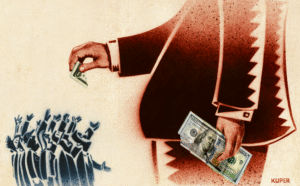
So, where a single donor could previously give no more than $117,000 to all federal candidates and political committees during the 2012 cycle, that limit has now been entirely trashed. As the SCOTUS minority argued in the case, the ruling will now allow a single individual to give up to $3.5 million in a cycle, if they give to all federal candidates running. In turn, those candidates and political parties may now pool that money and divert it to the most needed races.
This ruling is great news, for an incredibly small number of very wealthy people. As Richard Wolf and Fredreka Schouten encapsulate it at USA Today…
So this new decision will now allow those 600 — 600 individuals! — who had maxed out their $117,000 aggregate campaign contribution limit in 2012, to buy an even larger slice of our democracy in 2014.
Mind you, this decision deals only with campaign money given to candidates and political committees — the old-fashioned type of political committees, not the Super PACS. Limits of giving to those organizations had already been done away with by the Supreme Court’s infamous Citizens United ruling in 2010. On top of that, of course, there are the non-profit, so-called 501(c)(4) “social welfare” organizations, such as Karl Rove’s Crossroads GPS, which already have no limits on how much money they can receive from donors they do not have to name and, according to a recent FEC decision, those groups may now spend the majority of the funds — hundreds of millions, if they like — on political ads without repercussion.
That FEC decision is being challenged in federal court, as we reported in detail in February. Given the current Supreme Court’s general predilection for taking away virtually all limits on how much of our democracy that rich people can buy, it seems that case, even if successful at the District Court level, could ultimately be overturned as well by these Supremes, in order to favor the “free speech” of the super-rich over the “free speech” that folks like you and I can afford to purchase.
“Taken together with Citizens United v. Federal Election Commission, today’s decision eviscerates our nation’s campaign finance laws, leaving a remnant incapable of dealing with the grave problems of democratic legitimacy that those laws were intended to resolve,” Justice Stephen Breyer wrote in the minority’s dissent.
This current Supreme Court majority is in place thanks to the 2000 election of George W. Bush, in which he received fewer votes than his opponent Al Gore (even in Florida) and his 2004 re-election in which massive election irregularities took place in Ohio, but went completely unchallenged by his opponent John Kerry.
In case we need to remind you again: Yes, elections — and election results — matter.
















When the going gets tough, the Democrats sign petitions. (and I am a registered Democrat)
Since the politicians can’t control themselves, and it seems to be in the rich’s best interest to manipulate elections, we need to make accepting large donations anti-democratic (pro-oligarch).
My bumpersticker for this election on politicians:
Don’t trust anyone raising over 30 (million dollars).
or
Don’t trust any one (donor) with over 30 (thousand dollars).
It seems that the SCOTUS takes the phrase “put your money where your mouth is” literally. Hey Roberts, you do know the difference between a metaphor/figure of speech/exaggeration/play on words and plain speech. When they say “put your money where your mouth is” they don’t mean money is speech, just that one should back up what they say with something that might have value to them.
These morons are doing intellectual contortions to rationalize that this will be good for our democracy and not have any ill effects. These SCOTUS members who voted for this could have been found under the same rock as Cheney. No I am not saying they actually live under rocks.
At the risk of being pilloried: I support the SCOTUS rulings that are being denounced here.
I’m well aware that our country is better described as a plutocracy than as a democracy, and that this “government of, by, and for the wealthy” is damaging, both for our nation as a whole and for large segments of it in particular.
But I’m not convinced that the SCOTUS rulings are violations of the constitution, nor that they are contrary to the long-run interests of our nation.
Our nation is based on the belief that free discussion (which is the aim of “freedom of speech”) is essential to a democracy.
The corollary is that, in the political realm, incorrect ideas should be met, not with suppression, but with correct ideas.
Rather than suppressing political statements from any segment of our population, we should be promoting political statements from all segments of our population.
If that’s true, what’s the appropriate national response to the tsumani of political ads from members of the 1%? Public financing of campaigns is one option. There are surely many others.
But whatever fixes we devise, they shouldn’t be “quick fixes” that sacrifice the long-term interests of our nation.
Roy Lipscomb said @ 4:
Let the pillorying begin!!! 😉
Correct. But only if one believes that money = speech does today’s ruling make any sense along the lines that you seem to be suggesting. Does the loudest (richest) voice (citizen) get more speech than anybody else? Because that’s the system the Supreme’s have now created. The guy with the loudest voice (most money, in this case) gets all the speech he wants. The quiet (poor) guy, gets nothing.
If having ideas was the same as having money, I might be with ya on that!
I agree. Now if there were only a way to let people know about those options, say in millions of dollars of TV ads. Oh, wait. Neither you nor I can afford those. So, Lincoln’s rule wins: “Whoever can change public opinion, can change the government.”
Nonetheless, I applaud your optimism! Whether it is deserved here or not. 🙂
There is only one way to enact sensible campaign financing – Get out the vote! There are enough Democrats in this country to reverse Congress on this issue. The two-party system controls Congress and that is not going to change in our lifetimes. Get rid of Democrats who are only worried about being reelected. GET OUT THE VOTE!
Brad wrote @ 5:
No, money doesn’t equal speech, any more than a computer equals speech. But both help distribute one’s ideas more widely.
More to the point:
The aim of the “get money out of politics” movement isn’t to have the super wealthy spend that money on other things. The aim is to rein in ads (a form of speech) from certain citizens. That’s the bare, unvarnished fact, regardless of how it’s spun.
No question, the movement has its heart in the right place. Their motivation is that every segment of society have an equal political voice. But the movement wants to accomplish that by reducing the speech of the wealthy. Logically, what’s next? Reducing the voice of the middle class, because it’s louder than the voice of the poorer classes?
In a democracy, doesn’t it make more sense to ensure that all ideas and all segments of society get equally high (instead of “equally low”) access to the podium?
That’s what I propose. As I stated in posting # 4,
[W]hat’s the appropriate national response to the tsumani of political ads from members of the 1%? Public financing of campaigns is one option. There are surely many others.
Hey Brad! Did you happen to catch Pres. Carter on Thom Hartmann on April 1? He said that Bush didn’t win the election in 2000. Also, Thom played a tape of LBJ saying Nixon was committing treason!
Also up at YouTube