
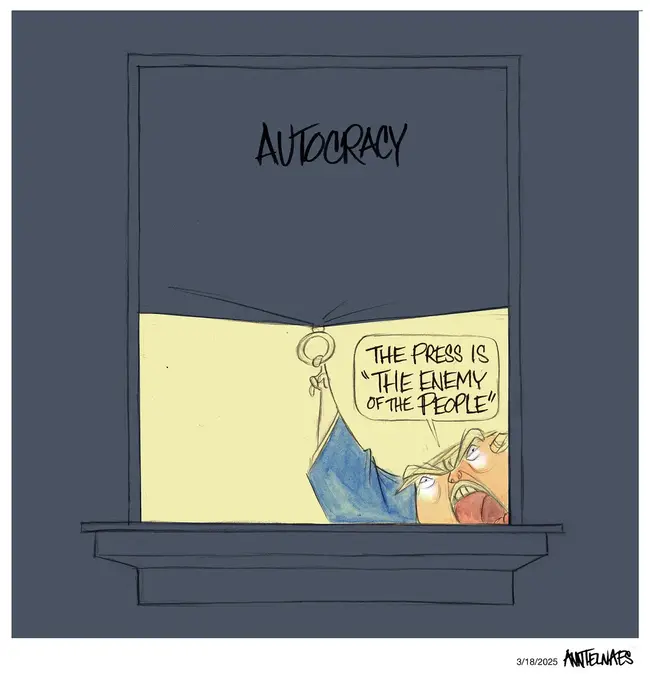
 It must be nice to be the king and get to decide who does and doesn’t get to vote for (or against) you and your friends, just like the
 King Governor of Iowa…
If the changes go into effect, as expected, a new application will be in use starting April 9. The state will gather public comment on the proposed changes through Jan. 28, and a legislative rules committee will review them in February.
Anyone convicted in Iowa of an “infamous crime” — including all felonies and some aggravated misdemeanors — loses their right to vote and hold public office. To get those rights back after they serve their sentences, they have to apply for and obtain clemency from Branstad under an executive order he signed in 2011.
…
Branstad, a Republican, in 2011 signed an order that reinstated the individual application process, making Iowa among the more difficult states for offenders to win back their voting rights. The move rescinded a 2005 executive order signed by former Gov. Tom Vilsack, a Democrat, that automatically restored voting rights to felons once they completed their sentences.
So Branstad both decided, on his own, that voting would be more difficult for certain selected individuals and he is also the sole decider if those people can vote again. Lovely.
What right does the government, much less one person, have to take another person’s right to vote away?
To be fair, many other states do very same thing and we’re glad that, if the changes go through in Iowa, it’ll be slightly easier and less confusing for voters. But why must there even be a fight for the right to vote for those who have already served their time in jail?
For that matter, why shouldn’t someone convicted of a felony or a misdemeanor have the right to vote even while in jail?
Why shouldn’t Nelson Mandela have had the right to vote when he was a political prisoner? Why shouldn’t former AL Gov. Don Siegelman, a political prisoner now in the U.S., have the right to vote? Why shouldn’t the tens of thousands of people in jail for marijuana convictions — some of whom are now in jail for something that is now totally legal — be allowed to vote? Why shouldn’t millions of people most directly affected by the specific laws passed by lawmakers elected by their fellow citizens have the right to vote on the people who wrote and passed those very laws?
Before it was violently crushed by the state, when the Occupy movement was at its peak in late 2011 and appeared to be working on “demands”, we offered just one, non-partisan, two-part suggestion for them to put forward:
As to the second part of that suggestion, publicly-counted hand-marked paper ballots, that’s already how the Iowa GOP runs their own caucus (and with no Photo ID required, by the way).
But as to the first part, allowing everyone to vote, that’s a different matter, apparently. And it’s one they must not have really meant when they adopted the slogan on the Iowa state flag: “Our liberties we prize and our rights we will maintain.” Or, perhaps it just depends on who they mean by “our”.
Occupy may have been crushed by the kings, but the citizens — all of the citizens — can and should still have their right to vote them out of office. Our suggestion to Occupy still stands — for Iowa and for the rest of the nation. You’re either for representative democracy or you’re against it. We’re for it.


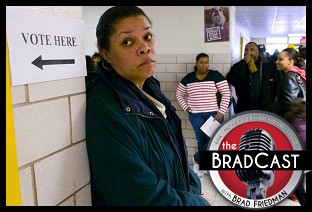




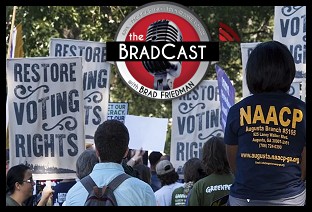











I’ve never understood the reasoning behind preventing citizens from voting, even if convicted of a felony. Especially when plenty of rich people who are convicted of felonies are allowed to remain in positions of power, or when the rules like they have in Iowa allow someone, a single person especially, to decide if someone gets to re-earn their right to vote.. isn’t that a HUGE recipe for corruption?
Not to mention, felonies are handed out like candy to the poor who can’t afford fancy lawyers, while rich kids who kill people are handed probation without a felony attached.
Simply insane.
If you aren’t willing to follow the law yourself, then you can’t demand a role in making the law for everyone else, which is what you do when you vote. The right to vote can be restored to felons, but it should be done carefully, on a case-by-case basis after a person has shown that he or she has really turned over a new leaf, not automatically on the day someone walks out of prison. After all, the unfortunate truth is that most people who walk out of prison will be walking back in. Read more about this issue on our website here [ http://www.ceousa.org/voting/vo...nfranchisement ] and our congressional testimony here: [ http://judiciary.house.gov/hear...legg100316.pdf ].
Roger Clegg –
So legislators can make any law they like to throw people in jail — let’s say, making marijuana a felony or African-Americans must drink from a different water fountain — and then when people are not “willing to follow the law”, they should both be imprisoned and lose their right to vote?
How about if some very liberal leaning town decides that being a member of the Republican Party is against the law. Should people lose their right to vote while they’re in jail and afterwards…until the liberal Governor decides, by his own graces, to let the Republicans vote again?
The fifteenth amendment of the United States, Passed by Congress February 26, 1869. Ratified February 3, 1870.
Section 1.
The right of citizens of the United States to vote shall not be denied or abridged by the United States or by any State on account of race, color, or previous condition of servitude–
Section 2.
The Congress shall have the power to enforce this article by appropriate legislation.
I read previous condition of servitude to mean just that: once you have served your time for any crimes, your right to vote cannot be denied.