
 As of late Saturday, just 55 votes separated the Democratic candidate from the Republican in the Virginia Attorney General’s race, according to the State Board of Elections (SBE) website. 55 votes out of more than 2.2 million cast after four days of canvassing, double-checking and processing a number of provisional ballots cast across the state during last Tuesday’s election.
The state’s 55 vote spread, however, is still larger than the margin cited by the election geeks who have been following this race on a county-by-county and often precinct-by-precinct (even ballot-by-ballot) level. And they have been consistently and correctly ahead of the SBE-posted numbers. One of them, Virginia political expert and self-identified “vicious campaign insultant,” Ben Tribbett declared just a 15 vote margin earlier Saturday, after the spread had been just several hundred over the last few days. Late tonight, after a few more provisionals were tallied in the City of Richmond, Tribbett adjusted his tally to a 44 vote margin.
Another one of those geeks, Dave Wasserman of the non-partisan Cook Political Report, predicted Friday night on Twitter that, after all provisional ballots are added in, “this thing could be single digits.” It looks like he wasn’t kidding.
For what it’s worth, it’s the Republican state Sen. Mark Obenshain currently leading the Democratic state Sen. Mark Herring by either 55 votes or 15 votes or somewhere in between right now. But there still remain between 400 and 500 provisional ballots to be adjudicated and possibly added to the totals in heavily Democratic-leaning Fairfax County as of Saturday night, according to Michael McDonald, a specialist in American elections at George Mason University in Fairfax.
Indeed, it was a surprise edict concerning provisional ballots, as issued by the Republican State Board of Elections, that stopped the Fairfax County Electoral Board dead in their tracks on Saturday before they were able to adjudicate all of the county’s provisionals as previously planned.
All of this, before a likely “recount” — of 100% unverifiable touch-screen votes in most VA counties and, barring a court order, no more than a computer re-scan of most of the paper ballots in the others — that is almost certain to be requested by whichever state Senator named Mark finds himself “the loser” of the final canvassed tally as of midnight, Tuesday, November 12th, the deadline for certification of the election…
New rules for provisional ballots?…
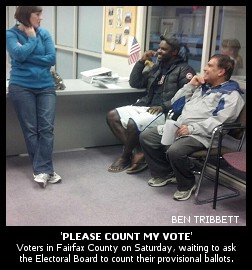 The SBE’s edict today, posted in full here, could make it more difficult for provisionals to be accepted by the Fairfax County Electoral Board. In Virginia, when a provisional ballot is cast on Election Day — because a voter didn’t have the proper ID, they were voting at the wrong precinct, or they found themselves not on the rolls for some reason, for example — the voter has three days after the election to show up at the local election headquarters with the proper ID and/or other information to argue the case as to why their ballot should be counted.
Each provisional ballot is sealed in a green envelope until the local Electoral Board decides whether to accept or reject it after that three day deadline has passed. Voters may show up to plead their case in the person to the Board, as was to have been the case in Fairfax on Saturday. When voters don’t show up, an attorney may be present on his own to argue on behalf of the ballot being included in the count. At least, that had been the way Fairfax County had traditionally proceeded, until the SBE issued its memo declaring “the provisional voter must also be present if a person claims to be there to represent the voter as his/her legal counsel…There shall be no legal counsel or representative present in the meeting without the voter being present.”
The instruction led the Republican-majority Fairfax County Electoral Board to extend their deadline for voters to come in and plead their case until Tuesday. On Saturday, according to Tribbett, they voted “2-0 with 1 abstaining to condemn [the] state board of elections ruling prohibiting legal rep for voters not here.”
The action to allow voters more time to argue for inclusion of their provisional ballots also resulted in plaudits for Fairfax County Electoral Board member Brian Schoeneman — a Republican and former Bush Administration staffer — from normally ideological opponents, and also condemnation from at least one of his fellow Republicans, who asked: “Why is Brian Schoeneman, who purports to be a Republican, helping Democrats by extending this deadline?”
For his part, Schoeneman took to Twitter to explain what was going on and to respond to questions about the ruling. He tried to calm concerns by asking that folks “don’t blow the SBE issue out of proportion. This is simply a disagreement between lawyers. It has little impact on voters.”
“To be clear, this wasn’t an SBE change. They believe this has always been their policy,” he said, adding “This was reminder guidance to localities. Not every locality had our past practice.”
That practice, he explained, is “to allow voters to present us with evidence as to why they voted provisionals. It’s a courtesy to them.” He tweeted late Saturday that provisional voters “don’t ‘need’ to come in. They may if they want. They are given a sheet when they vote provisional explaining it.” Schoeneman went on to vow, “we will review every ballot on a case by case basis and decide each ballot, regardless of whether the voter appears.”
There are more provisional ballots this year than in previous years, it seems, though the reasons for that are not yet crystal clear. Both changes to ID requirements this year, as well as a massive purge of some 40,000 voters from the rolls just weeks before the election — due, supposedly, to duplicate registrations elsewhere — are thought to be among the reasons for the larger than usual number of provisional ballots.
Because of the SBE announcement, the Electoral Board in Fairfax County, the largest single voting jurisdiction in the state, issued a statement Saturday explaining provisional ballot review would continue at “Fairfax County Government Center, Room 315, until Tuesday,” with hours added on Sunday from 1 to 5pm; Monday 10am to 4pm and on Tuesday beginning at 1pm “or an hour after the Electoral Board returns from a meeting at the Courthouse – whichever is later.”
About those 3000 ‘missing’ op-scan votes…
On Saturday, Fairfax County also confirmed the results we reported here late Friday for several thousand re-scanned absentee ballots in that County’s 8th Congressional District. Those votes had been noticed “missing” late Thursday night, once again, by the election geeks, in a bit of very smart detective work. They had noticed that thousands of ballots seemed not to have been included in the initial tallies reported by the County to the SBE. They noticed that the percentage of tallied absentee ballots, compared to the number which had been sent out, was much lower in the 8th district than the neighboring 9th and 10th districts in the same county. In fact, the return rate in the 8th district was the lowest in the state, according to the citizens pouring over results spreadsheets since Election Night on Tuesday.
The error, as we noted Friday, was chalked up to a faulty Diebold paper ballot optical-scan machine on Election Night and confusion about results tapes thereafter. Today the Fairfax Electoral Board said in a statement…
The final results of our investigation determined that there were errors in the tabulation that reduced the final vote tally by approximately 3,200 votes. Those errors were corrected in the canvass.
That correction resulted in an overall pick-up of some 1,130 votes for the Democrat Herring, enough to put him in the lead over the Republican Obenshain, but for another computer tabulation failure discovered in heavily-Republican Bedford County on Friday. The reconciled numbers in Bedford resulted in an overall pick-up of 431 votes for the Republican, allowing Obenshain to remain in the lead by just over 100 votes by Friday night.
Neither computer tabulator error in either county — both use systems made by different manufacturers — has been fully explained at this time.
With provisional votes added on Saturday to the totals in most of the counties around the state, the gap between Herring and Obenshain has closed to an impossibly small handful of votes. So it’ll all likely come down — at least until a “recount” down the line — to those 500 or so provisional ballots in Fairfax. Given that the County otherwise voted by about 58% to 41% in favor of Herring, Democrats seem to believe they will ultimately have the edge in the officially certified vote on Tuesday. But, given the closeness of the race, the twist and turns over last several days, and the fact that VA hasn’t seen a Democratic Attorney General in almost 20 years, nobody knows for certain what other surprises may occur between now and the Tuesday deadline.
Suffice to say, for now, as George Mason University’s McDonald noted wryly this afternoon: “If you cast a provisional ballot in Fairfax County two guys named Mark would like to talk to you.”
UPDATE 11/11/2013: Republican requested re-canvass in Richmond City results in Democrat Herring finally taking the lead over Republican Obenshain. Full details now here…
Previously related #VAAG coverage at The BRAD BLOG…
• E-Voting Trouble Reported During Today’s Elections in Virginia, New York, and Elsewhere [11/5/2013]
• ‘Recount’ in Virginia AG Race? Good Luck With That. (But, Perhaps You Can Help) [11/6/2013]
• BREAKING: Thousands of Votes Discovered ‘Unaccounted For’ in Virginia AG Race [11/7/2013]
• Tallying VA’s ‘Missing’ Op-Scan Votes; And Other Surprises in the Incredibly Close VA AG Election [11/8/2013]


















best tweet so far
repubs will want to out law math before next election…lol
seriously great job
hopefully “interested parties” are hard copying results,changes,ect
Shouldn’t this (and other elections results in the past few days) be the last straw? Shouldn’t there be some type of backlash towards those that are doing everything they can to win elections by fraud, deception, disenfranchisement, other? Either the American electorate or some party or group, has to start pushing back hard in all 50 States.
Brad: An important point, which you touched upon, is that just three weeks before this election, the same VA State Board of Elections (SBE) that handed down the new provisional ballot edict, sought to purge 57,000 suspected out-of-state voters. That list included 7,984 names in Fairfax county.
All three members of the SBE were appointed by VA Gov. Bob McDonnell (R).
A federal judge subsequently refused to grant an injunction that had been sought by the VA Democratic party.
On the plus side, Fairfax County Deputy Registrar Gary Scott promised to “carefully review every name before removing anyone from the list.”
One wonders how many of the provisional ballots now at issue are the product of the purge.
Brett Zink @2 wrote:
Brett, when it comes to continued participation in faith-based virtual elections conducted on the 100% unverifiable Direct Recording Electronic (DRE), usually touch-screen, voting systems, the last straw should have been the South Carolina 2010 U.S. Senate Democratic primary in which these electronic black holes declared Alvin Greene to be the winner.
As I explained in Still Clueless About Touch-Screens in S. Carolina:
The numbers were beyond absurd. Lancaster County paper absentee ballots went to Rawl 84% to 16%. The unverifiable touch-screens in the same county, however, said Rawl lost [in Lancaster County] by 17%. Greene received more votes than were cast in 25 Spartanburg County precincts. The votes of 50 other precincts were missing from the final count. Statewide, the virtually unknown Greene somehow managed to capture 60% of the vote, according to the iVotronic DREs.
Denied access to the iVotronic memory cartridges, source codes, and machines, Rawl nonetheless presented an impressive five-hour case to the state Democratic Party Executive Board in contesting the race. Two computer scientists testified that system malfunction provided the only reasonable explanation. Voters said they saw their votes flipped to Greene. Campaign workers saw poll workers swapping out memory cartridges during the election.
Rawl’s challenge of the machines was ignored by most of the mainstream media and summarily rejected by the Democratic Party’s Executive Board, largely for what has been described to The BRAD BLOG by insider sources as “political reasons”.
The silence in the MSM over the fiasco that is our e-voting systems is so profound that it calls to mind the proverbial question: If a tree falls in the forest but there is no one close enough to hear it crash to the ground, did it really make a sound?
It is nothing short of scandalous that, as reflected by this map, most of the good people of Virginia, who were fortunate enough to have cast a vote, have no way of knowing whether their votes were counted.
Jim DeMint, President, The Heritage Foundation, and the guy who beat Alvin Green.
Greene
I adore you, Ernest. You too, Brad. Thank you for this coverage! FWDING it to all my VA voters (which includes MOM / DAD and all my high-school pals. They’re SWIMMING it all the new info re: this botched election.) Wish I had millions – it’d be all yours. xoxo!
Count me in on the adoration bandwagon.