
 As noted at the top of today’s BradCast, it’s worth buckling up before listening. [Audio link to show follows below.]
We begin, gently enough, with the news of California’s Supreme Court temporarily nixing a billionaire’s statewide initiative from this November’s ballot which, if adopted, would split the state into three. We explain why the Court removed the measure, for now, thanks to a challenge by an environmental group.
Then, with Donald Trump’s own Director of National Intelligence, Dan Coats, warning this past week that “the system is blinking red” in a way that hasn’t been seen since just before the 9/11 attacks, the multiple and ever-changing positions by the President of the United States in recent days, regarding whether Russia interfered in the 2016 election and is actively doing so in advance of the 2018 midterms, is all the more head-spinning. Coats was referencing warning signs being reported by U.S. intelligence agencies regarding ongoing attacks and intrusions on America’s critical infrastructure — including our wildly vulnerable electoral systems.
Moreover, new reporting on Trump being read into explicit source details weeks before he was inaugurated in early 2017 regarding Russia’s alleged 2016 election intrusion measures, make his ongoing denials, ever-changing positions, and dizzying White House spin to explain them all following Monday’s summit with Putin in Helsinki, all the more bewildering. Nonetheless, his own intelligence apparatus and appointees continue to contradict the President, even as the GOP-controlled Congress fails to take any substantive action to either place a check on Trump or even to help protect this November’s crucial elections.
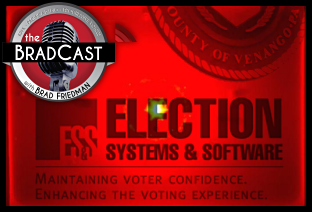
At the same time, after the FBI informed Maryland just days ago that its entire election system was being hosted on a private commercial server said to be owned by a Russian oligarch tied to Putin (as discussed in detail on yesterday’s BradCast), we learn this week that the top U.S. election system vendor, ES&S, has been lying about remote access software and modems installed, for many years, on systems still used by a majority of U.S. voters.
The new revelations may help explain an exclusive special report published by The BRAD BLOG back in 2011, with an officially-commissioned independent analysis finding that, among other concerns, Venango County, Pennsylvania’s ES&S election management system had been accessed by an unknown and unauthorized computer for “several hours” from a remote location. As we reported at the time, ES&S and the County’s Board of Commissioners went to considerable lengths, after those revelations, to block a further, independent forensic analysis of the system.
And now, perhaps, we may know why. Kim Zetter reports this week at Vice’s Motherboard that the company lied to her and New York Times‘ fact-checkers earlier this year in advance of her February article at the paper on the inclusion of modems and pcAnywhere remote access software included with the election management systems sold to customers from 2000 to 2006. After previously insisting the company had no “knowledge that our voting systems have ever been sold with remote-access software”, ES&S reversed itself in a letter to U.S. Senator Ron Wyden, she reports. But they have refused to respond to the Senator’s subsequent follow-up queries or to appear at recent Senate hearings on U.S. election system vulnerabilities.
As Zetter details, pcAnywhere was found to include multiple and serious vulnerabilities over the years, which would have allowed unauthorized intruders to change election results with little chance of detection. Moreover, she explains, many questions remain about why ES&S lied, which jurisdictions around the nation may still feature the same, easily-exploitable flaws, and about electronic voting and tabulation systems manufactured by the nation’s other top vendors, believed by expert to likely have included similar remote-access vulnerabilities.
All of that (and more, including our latest Green News Report), just over three months out from this November’s midterm elections. Told you to buckle up…
CLICK TO LISTEN OR DOWNLOAD SHOW!…
[audio:http://bradblog.com/audio/BradCast_BradFriedman_TrumpRussiaBlinkingRed_ESSRemoteAccessLie_071918.mp3]
(Snail mail support to “Brad Friedman, 7095 Hollywood Blvd., #594 Los Angeles, CA 90028” always welcome too!)
|


















The “vulnerabilities” are not a bug, they are a feature.
Wyden says he doesn’t like this but declined calls by a few House Representatives to have debates on the alleged Electors from some of the many States. In 2001, I asked him at a town hall meeting in Cottage Grove, Oregon why he did not support the Congressional Black Caucus effort to investigate the fraudulent Electors from Florida. He replied that I shouldn’t vote for him if he didn’t like it.
As long as the Democratic Senators rubberstamp questionable outcomes from the States, it seems unrealistic to expect accountability in our voting systems. Rhetorical outrage is nice, but Senators can actually block ratification, if they want to.
I’ve researched the history of CESI and ES&S.
CESI’s founders all had ties to the Office of Naval Intelligence, and in 1996, it was revealed Prentis Hale Cobb was also ONI.
Dominion/Sequoia/Diamond came from the Diamond Almond Cooperative, which fell under export controls due to an extraction process for ferrocyanide from almonds and peach pits.
Roy Saltman is also ONI.