
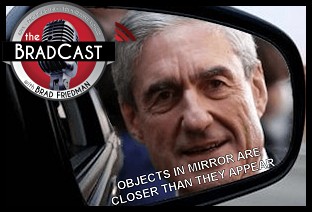
 On today’s BradCast: Donald Trump tries to walk back Helsinki, and Robert Mueller has more shoes to drop, according to a former federal prosecutor’s analysis of recent indictments. [Audio link to show follows below.]
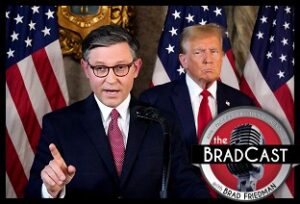
The fallout from President Trump’s stunning comments in Helsinki on Monday continued on Tuesday, in response to the President of the United States taking sides against his own intelligence agencies and in favor of Russian President Vladimir Putin, who stood beside him at a joint press conference following their one-on-one summit. After more than 24 hours of unrelenting backlash from media, Democrats, former intelligence officials — and even a number of largely gentle public critiques from some Republicans — Trump attempted to clean up his overseas comments.
Working from written remarks at the White House today, he now claims he “accepts” the U.S. Intelligence Community assessments of various alleged Russian cyber-attacks on the 2016 election, and that he simply misspoke — just one word — when claiming during Monday’s joint presser with Putin that he saw “no reason why it would be Russia” behind the 2016 attacks. He meant to say “wouldn’t”, rather than “would”, he now says. Trump is hoping to dig out from under his denial just days after Special Counsel Robert Mueller filed new felony charges against 11 Russian military intelligence officials said to have been working on behalf of Putin, according to the indictment, when they infiltrated DNC and Hillary Clinton campaign computers to steal emails, release them to the public before the election, plant malware on state and local election official computers and steal voter registration data in 2016.
Mueller’s Friday indictment preceded yet another one announced on Monday by the Dept. of Justice, concerning the Sunday arrest of a Russian national who allegedly infiltrated the National Rifle Association along with a Putin-connected oligarch.
We’re joined today by former federal prosecutor MICHAEL J. STERN who explains how Mueller’s Friday indictment of Russian military operatives was filed and written in a way that suggests there are more such indictments to come, particularly of Americans. Stern describes, from a prosecutorial perspective, how and why investigators working on sprawling conspiracy cases tend to work their way up from lower-level aspects of the case, toward their main targets, while trying not to prematurely tip their hand or reveal evidence they hope to keep under wraps before the later indictments.
He details how Mueller’s Friday charges of the Russian military officials (and a number of Russian social-media scam artists earlier this year), serve to buy time for the Special Counsel probe, while establishing an understanding among the public for the larger crimes being investigated — before other “shoes” are ultimately dropped.
“He was essentially allowed to have his cake and eat it, too. He was able to set forth the indictment and charge the Russian members of the conspiracy. But, because they’re not in the United States and the likelihood of them being extradited at all is slim, he’s able to continue his investigation without the pressure of having to deal with those defendants making appearances in court, etc,” Stern tells me. “It’s my sense of things that there was a calculation, a strategy on his part in doing that.”
“There’s a process, I think, that Mueller is going through to get, not only members of Congress, but more importantly, the public, to understand that what has been alleged — the Russian interference with the 2016 presidential election — has actually occurred,” he argues. “Mueller knows exactly where he is going, and that what he’s doing is dropping bread crumbs until he gets to the loaf of bread, which, I believe, will include Americans.”
Finally today, Desi Doyen joins us for the latest Green News Report, as summer heat, exacerbated by global warming, continues to take its toll in several different ways that folks don’t often consider. That, at the same time as many who have been longtime science deniers now seem to be coming around in several different interesting ways as well…
CLICK TO LISTEN OR DOWNLOAD SHOW!…
[audio:http://bradblog.com/audio/BradCast_BradFriedman_TrumpWalksBackHelsinki_MichaelJStern_MuellerRussiaIndictments_071718.mp3]
(Snail mail support to “Brad Friedman, 7095 Hollywood Blvd., #594 Los Angeles, CA 90028” always welcome too!)
|
















On July 16, 2018, Democracy Now! featured a debate between award-winning journalist Glenn Greenwald and president of the Ploughshares Fund, Joe Cirincione. Greenwald favored talks between the United States and Russia for lessening the likelihood of war; Cirincione disagreed, feeling that talks legitimated Russia authoritarianism, giving cover for its alleged actions in the US elections (while not denying, but in fact asserting, that us did that and worse elsewhere in affecting other nations’ internal politics) and that Trump’s ignorance of international relations leaves him open to being bested by a wily Putin and obtaining no kind of anti-nuclear weapon peace deal.
For all its good qualities (It is Democracy Now!, of course) the debate, I would argue, misses the point. The talks were not in pursuit of some species of mutual coexistence between two rival nations, an opening act toward nuclear disarmament. After the Soviet break-up Russia is no longer a communist country. It now has a capitalist economy, one that sustains a wide gap between the rich and everyone else (just like the USA). As a model it more resembles the authoritarian Latin American nations that the US supported in the 1980s. It is quite clear that Russian President Vladimir Putin’s power is based on what we can call a parliamentary-oligarchic autocracy.
Russia’s efforts to destabilize the western democracies is not due to a hostility to democracy per se in other nations, as is claimed in the American corporate media. Rather, it is that those nations’ membership in NATO makes them a threat to Russia and its interests. Indeed, Russia’s current support for reactionary forces in the western nations is based on a calculation that reaction in those nations will lessen the threat those nations pose as an anti-Russian alliance. This is because reaction would be act as a shared value between them and Russia and serve as the acid to dissolve any alliance borne of any interest to either protect or promote liberal democracy or act as a check on nationalism and its handmaiden, military belligerence. Since the end of the Cold War the United States has pursued the expansion of NATO membership, pushing its boundaries practically up to the Russians’ front door, if you will, in the face of Russian objections. This is after many “assurances” by the U.S. not to seek NATO expansion.
See this from the Los Angeles Times: http://www.latimes.com/opinion/op-ed/la-oe-shifrinson-russia-us-nato-deal–20160530-snap-story.html
This is the transcript of a congressional hearing debating the merits on NATO expansion (it is very long, but not hard to follow; you can just skip to very end for the “Resolution”): https://www.gpo.gov/fdsys/pkg/CHRG-105shrg46832/html/CHRG-105shrg46832.htm
But one could ask: The US has buddied up with bad regimes abroad before so what’s the big whoop now? What’s one more bad regime bff given US history? And I pose the question in the spirit of willfully leaving aside recent US treatment of its allies (who have also supported bad regimes during the post WWII era, and often in collaboration with the US.)
Answer: the project for both US and Russia is not mutual coexistence between two rivalrous but powerful nations. No. The project is the formation of a new rightist axis alliance. Putin and Trump are not interested in peaceful relations. Rather, they are interested in forming a new alliance based upon a shared vision of reactionary politics. In Russia we have an oligarchic-parliamentary-autocracy while in the US we have an alt-right-friendly executive branch with nostalgic dreams of a pre-Lochner, pre-Civil Rights, pre-women’s liberation movement America, sustained by a legislature whose majority is openly hostile to domestic democracy and shows it by supporting efforts that make electoral democracy ever more out of reach with voter-suppression schemes, etc. Don’t even get me started on the US Supreme Court.
Does anyone really believe that the character of any “negotiations” between Trump and Putin is in the pursuit of lessening tensions for the long-term goal of keeping and extending whatever peace there is between their nations? Or can one see that the real goal in such talks is the mutual project of right wing politics, with each nation in pursuit of its specific domestic bigotries, weaponized against their own respective populations?
The real historic tension that the US has always had with Russia is that Russia can, if it wished, act as a rival interest in its own immediate neighborhood (like, say, Iran can), and it can even act as a restraint on American imperial designs in the parts of the world where Russia may still have influence or interests. This capacity was present during the Cold War and although Russia is now a weaker nation, it still has that capacity to check American designs.
And that is the REAL reason you see so much bipartisan finger-waving-at-Trump-rage in the corporate press. What mainstream TV liberals (with the notable exception of Chris Hayes) and TV conservatives share is a deep-seated misconception of American power in the world as fundamentally benign, and that its overall project is the protection and promotion of democracy abroad and at home. Needless to say, the historical record shows otherwise.
Neo-Cold-War-ism in the establishment liberal community, joining hands with embarrassed conservatives who haven’t forgiven Russia for having been communist – which it had ended ‘way back in 1989 – is a spectacle that is only possible if we ignore the rightist domestic agendas of BOTH nations. If the US had a true small-d democrat in the White House, one that was truly committed to peace, then talks with Russia would clearly make sense within the context of lessening international tensions. But we have Trump – a man who does not have a peaceful bone in his body and had lied about his opposition to Bush II’s war in Iraq. Peace is not his agenda – he moved the US embassy in Israel from Tel Aviv to Jerusalem for f*ck’s sake! How much peace did we get out of that? So, what could his agenda possibly be with Russia, if we were to at least humor the notion that peace may indeed not be it, his claims to the contrary notwithstanding?
Also, a true small-d democrat would need to rethink NATO which, quite frankly, has always been part of the American imperial infrastructure disguised as an alliance to preserve democracy by military means. Remember, the US has bases in many (if not all) NATO member nations and around the world. Trump is an imperialist, like all other US presidents, but he is clueless as to what NATO is. He thinks it is a protection racket for which the US collects dues. We don’t need to rehash a correction here. As well, remember that when the US was attacked on 9/11, NATO’s famous Article 5’s mutual defense provision had seen its invocation ONLY for that one time. This is because the US, as a matter of international law, could not get UN support for invading Afghanistan and Iraq. Check out this carefully argued essay in its review of that important matter: http://www.e-ir.info/2013/11/06/was-the-nato-invasion-of-afghanistan-legal/
Let us repeat from earlier: the US has encouraged new members into NATO, causing its frontiers to close in on Russia. That is pretty imperialist, if you ask me.
So, all of this upset and handwringing and finger-waving and what-all over Trump’s “performance” in Helsinki is just a show of who’s more patriotic (read: imperialist) than who. It was a display of a fundamental pathology, described above, that afflicts the American political class. Taking offense at Trump’s evident – and let us face it, very real – bowing and scraping before the leader of a rival power is just too rich for words (mine notwithstanding). Oh, boo-hoo, he did not demonstrate “strength”, he did not demand whatever from Russia’s meddler-in-chief. He looked “weak”, he made America look “weak”. *Groan!*
If America being the foremost model of domestic democracy and the benign nature of American hegemony abroad were not both held as foundational beliefs by the American political class, beliefs that are sustained and promoted by the American corporate media’s news and entertainment outlets, the American people would have an opportunity to expand the questioning of Trump’s actions beyond the prospect of either his being “bought” or his fearing the release of a pee-pee tape.
[Dammit, first paragraph grammar correction]
On July 16, 2018, Democracy Now! featured a debate between award-winning journalist Glenn Greenwald and president of the Ploughshares Fund, Joe Cirincione. Greenwald favored talks between the United States and Russia for lessening the likelihood of war; Cirincione disagreed, feeling that talks legitimated Russia authoritarianism, giving cover for its alleged actions in the US elections (while not denying, but in fact asserting, that the US did that and worse elsewhere in affecting other nations’ internal politics) and that Trump’s ignorance of international relations leaves him open to being bested by a wily Putin and obtaining no kind of anti-nuclear weapon peace deal.
[OK, that’s better…]
NO. Mueller has thrown every major investigation he has ever been on. Mueller is a special special counsel. He is containing and covering up the truth. Look at his entire career, especially with Tom Thurman at the FBI crime lab.