
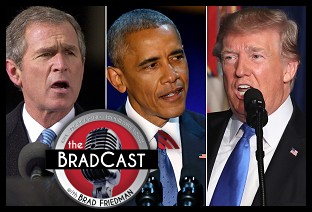
 On today’s BradCast: Now that he’s President, after years of decrying “our very stupid leaders” for “wasting” blood and treasure to stay in Afghanistan, Donald Trump announced on Monday night that the U.S. will be spending more blood and treasure to stay in Afghanistan — for an indefinite period of time. [Audio link to show follows below.]
But, he claimed, justifying his flip-flop, he has a “new” strategy for “victory” in the war torn nation, more than 16 and a half years since the U.S. first invaded following the 9/11 attacks. What exactly is that “new” strategy? Based on his prime-time televised address from Fort Myer in Arlington, VA, it’s not entirely clear. Then again, neither is whatever the hell is going on in Afghanistan. “It’s complicated,” my guest explains today.
Joining me to try and help us understand America’s longest war and where it goes from here under the ownership of Donald Trump is blogger, historian and longtime Middle East/South Asia expert JUAN COLE, of the University of Michigan. Professor Cole, who has been writing about this “invisible war” at his “Informed Comment” blog since 2002, describes the difficulties faced by the last three U.S. Presidents in Afghanistan — not to mention previous colonial powers from other nations — and how Trump’s plans appear to be both different and the same as his two predecessors’.
If President Obama was unable to succeed with his counter-insurgency strategy with 100,000 U.S. troops, it seems unlikely that Trump, with some 12,000 soon to be there, will do much better with his “not nation building — killing terrorists” strategy.
“There’s no real danger the Taliban are going to take over the [Afghan] government and kick us out,” Cole tells me, in trying to explain why we are still there. “However, if the U.S. got out, I don’t imagine that the government in Kabul would last more than a year.”
So, is it possible to ever get out, at this point? What good has 16+ years of bombing, 1 trillion in tax-payer dollars and the lives of some 3,500 U.S. troops — not to mention untold millions of Afghans — actually accomplished? We discuss the roots and the reasons for the ongoing quagmire and much more with the good professor.
“Whatever resources and capacity Afghanistan had to be an independent country were destroyed from 1978 forward, once the [Soviet] Communists took over, and then Reagan conducted what I call the ‘Reagan Jihad’,” Cole explains. “He got all the Muslim fundamentalists all together — including what became al-Qaeda — to kill the Communists. Since that time, since 1978 forward, Afghanistan has been roiled and in turmoil. I figure a couple million people have been killed. The country has no real resources. It’s one of the poorest countries in the world. So this is just not a place, especially given what was done to it in the last 30 years, that is very likely to stand up a government. This is one of the reasons the U.S. is stuck there.”
“The thing that puzzles me — I can’t entirely understand it — is that no one in the United States cares about Afghanistan. No one cares if we’re there or we’re not there. If troops are killed over there, it hurts me in my gut. I’m an Army brat. But they put it on page 17 of the Washington Post. And it never comes on cable news,” says Cole, adding: “It’s an invisible war.”
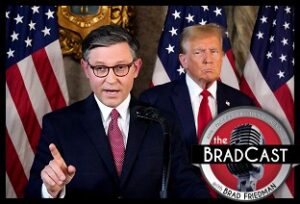
After that conversation today, a quick look at Trump’s domestic war with the leadership of his own party and others, before we finally turn to Desi Doyen with the latest Green News Report, on how corporate lobbyists from Monsanto, Exxon and other major corporations continue to game the system for their own profits, while playing the rest of us for suckers…
CLICK TO LISTEN OR DOWNLOAD SHOW!…
[audio:http://bradblog.com/audio/BradCast_BradFriedman_TrumpWarAfghanistan_JuanCole_082217.mp3]
(Snail mail support to “Brad Friedman, 7095 Hollywood Blvd., #594 Los Angeles, CA 90028” always welcome too!)
|
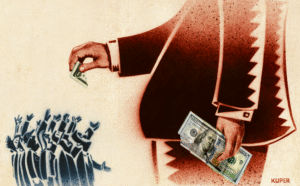










They want to keep skimming the profits on Afghanistan’s famous cash crop. The Taliban made the mistake in early 2001 of declaring it un-Islamic to grow opium any more. A few months later the US invaded and production resumed.
The Politics of Heroin by Alfred McCoy is a good read.
The deity and religion of Oil-Qaeda is not Islam, Judaism, or Christianity:
(Doing The Alt-Right Thing – Mithraism – 5, quoting 1944 Book).
It is a state secret.
Brad: Love your podcast, I’m a frequent listener. I appreciate your interview with Juan Cole, but I feel the need to point out that he did not at all answer your question “why are we there?” Very telling that the words “pipeline,” “opium,” and “heroin” were absent. When the invasion began in 2001 it was presented as a response to 9/11, but in reality it (as all of our recent military escapades) was about where the pipelines were going to be laid (cf. the US offering the Taliban earlier in 2001 “a carpet of gold or a carpet of bombs”; known fact that before 9/11, the US told its allies that it was going to invade Afghanistan before the snows fell), and of course, the heroin industry, one of the most profitable in the world, and about which the least truth is told in our media. I recommend you interview Peter Dale Scott about that.
Thanks, Gents!
Good points, and I’ve forwarded them to Juan Cole to get his thoughts in kind. Hope to get those back, and will share his responses on an upcoming show. Hopefully this week!
This post contains some of many links to gov documents showing the rich mineral and fossil fuel reserves there (Secret Afghanistan Underground – 3).
Afghanistan is the source of up to 90% of the worlds poppy and we have an opiate problem now. Maybe the Afghan war like the opium war in China in the 19th century is about more than terrorism or colonialism.
Responding to Juan Cole’s response, which Brad read on the air on Aug 24 BradCast (I don’t know where to read it again, please publish in these comments): I acknowledge that he is more of an expert than I am on the subject. I think his response about opium/heroin is disingenuous; there is copious evidence that the CIA has a decades-long involvement with the movement of illegal drugs. Again, Peter Dale Scott and Alfred McCoy are authoritative sources on that. Regarding pipelines, it’s not realistic to claim that control of oil and gas output is not one of if not the main reason(s) for our military involvement in the region. Regarding that subject in regard to Afghanistan, the Complete 9/11 Timeline has original sources:
“History Commons link
Sorry for my HTML incompetence. HistoryCommons.org is home of the 9/11 Timeline. I did a search for “Taliban” + “carpet”: http://www.historycommons.org/searchResults.jsp?searchtext=taliban+%2B+%22carpet%22&events=on&entities=on&articles=on&topics=on&timelines=on&projects=on&titles=on&descriptions=on&dosearch=on&search=Go
Will R.,
Yes, Juan is wanting in his knowledge, or excessive in his denial.
Here is a link to an extensive discussion of CIA opium involvement going back several decades and several wars:
(Alfred W. McCoy).
Brad,
Did Juan Cole respond to the hundreds of .gov documents concerning the minerals and oil in Afghanistan?
I supplied links to official .gov documentation.
BTW,
In my link @10 above, I quote Alfred W. McCoy.
For those who don’t know, he wrote The Politics of Heroin, CIA Complicity in the Global Drug Trade.
Will R. @ 7:
As you requested, here’s Juan Cole’s reply to your and others questions above (as well as one of my own), as I shared on air, on yesterday’s show:
The US did substantial poppy crop eradication in 2005-06 but it backfired because it hurt farmers and they turned to the Taliban. There is a glut of opioids in the world and the US is not in Afghanistan for the drug trade or apparently to stop it either.
Economic reasons for imperialism are always attractive in principle but great power politics has other dynamics as well. Neither Afghanistan nor Syria have any economic value, but both have become important to great Powers, one to the US and the other to Russia, because Powers like spheres of influence, blocking other powers, bases, and they also like a low intensity war because it allows them to show off their arms industry and keep their armies battle ready. These are not however reasons for invading, only perceived benefits of remaining.
Fear of terrorism by Muslim extremists drives both Washington and Moscow.
The big question about fear of terrorism driving remaining in Afghanistan is whether those fears are overblown. If you had an isolationist administration (a real one, not a phony one like Trump) that decided the terrorist threat from abroad is overblown and that Russia or Iran or Pakistan or India could handle Afghanistan, the US would come home.
Obama, who would have liked to get out, even tried to involve China. The mothers of the Communist Party of China’s politburo members did not, however, raise any dummies.
cheers Juan
Dredd @ 10, 11 and 12:
Juan was responding to the specific comments above by Mark and Will R. and Alex on opium and pipelines in Afghanistan, as well as an addition question of my own.
He was not speaking, at least specifically, to whether or not there was past (or current) involvement by the CIA in the drug trade in various places. I had also asked him for a “brief” response, so that I could share it on air with listeners.
He is usually responsible to readers at his website, if you’d like to press him on additional issues. Given the decades he’s worked on these issues, and his longtime excellent record as a progressive blogger on them, I don’t know that it’s fair to say he is “wanting in his knowledge, or excessive in his denial.” But that’s just my .02.
Brad @ 14,
Juan wrote “Neither Afghanistan nor Syria have any economic value” which shows he is wanting in his knowledge or excessive in his denial according to official government admissions:
(USGS Report, PDF).
Reuters has reported in the past that oil in commercial quantities has been available since 1959 (USGS website archive) but the war impedes development (Afghanistan to start oil-licensing round).
And there’s this:
(Afghanistan: The Route to Riches, archive).
As it turns out, the American taxpayer’s military is the free security entitlement being provided to various corps for development.
Brad @14,
You wrote “Juan was responding to the specific comments above by Mark and Will R. and Alex on opium … in Afghanistan … He was not speaking, at least specifically, to whether or not there was past (or current) involvement by the CIA in the drug trade in various places.”
There is a statement by the CIA that (suspected opium dealers in Afghanistan) a Karzai brother was on their payroll for years:
The link to the above quote is in this piece:
(The Daily Beast).
Wikipedia has this:
(Allegations of CIA drug trafficking).
Some say CIA involvement is controversial, but IMO no one can say with a straight face that CIA involvement has been conclusively disproved.