
 I missed this Washington Post article when it first came out late last year. But thanks to too-occasional BRAD BLOG and Washington Monthly contributor D.R. Tucker, I was glad to catch it over the weekend.
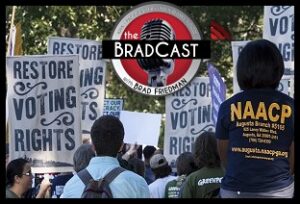
It’s based on a study by University of Massachusetts at Boston sociologist Keith Bentele and political scientist Erin O’Brien. They looked at restrictive voting statutes enacted over the past several years in all 50 states and the “dominant explanations (and accusations) advanced by both the right and left” in regard to legislation such as polling place Photo ID rules, stricter registration requirements, and other such restrictions on the basic right to vote.
What they found will absolutely NOT stun you in the least…
More specifically, restrictive proposals were more likely to be introduced in states with larger African-American and non-citizen populations and with higher minority turnout in the previous presidential election. These proposals were also more likely to be introduced in states where both minority and low-income turnout had increased in recent elections. A similar picture emerged for the actual passage of these proposals. States in which minority turnout had increased since the previous presidential election were more likely to pass restrictive legislation.
…
Restrictive laws were especially likely to pass when states both had larger Republican legislative majorities and had become increasingly competitive in the previous presidential election. Meanwhile, states that had become increasingly competitive but had larger Democratic majorities were less likely to pass restrictive laws.
Bentele and O’Brien went on to note that the findings cited above are particularly relevant to last year’s (horrible) 5 to 4 U.S. Supreme Court ruling which gutted the section of the Voting Rights Act requiring federal preclearance of voting related laws in those jurisdictions around the country (largely in the South) with a historic record of racial discrimination at the polls…
Ultimately, recently enacted restrictions on voter access have not only a predictable partisan pattern but also an uncomfortable relationship to the political activism of blacks and the poor.
Yes. Imagine that.
(Snail mail support to “Brad Friedman, 7095 Hollywood Blvd., #594 Los Angeles, CA 90028” always welcome too!)
|










Hello Brad Friedman,
I’m gobsmacked that the XTreme Kourt would be partisan and ignore facts as well as reality. I suspect that bringing a lawsuit to put the restrictions back in place and all that occurred from that point onward that restricted the peoples right to vote be removed as if it never happened would never get even 5 votes to do so. The 5 should be removed but even that is a fantasy at present and they are so evil that they might live for another three of four decades while residing on the Kourt.
While it is always useful for a university to present findings that support a central thesis — in this case that states with the highest percentages of African Americans also have the most restrictive voter suppression laws — I can’t say that I am surprised.
Recall that, for the better part of a century, all-white right wing regimes in apartheid South Africa excluded black South Africans from the polls altogether.
As we discussed when covering the Texas GOP’s photo ID law — perhaps the most restrictive in the nation in that it requires impoverished citizens who neither own a vehicle nor possess a driver’s license to travel as much as 200 miles round trip to obtain one — right wing Republicans are faced with demographic changes revealing that whites, and with them the Republican Party, are soon to be relegated to minority status when measured against the rapidly expanding Latino and African American populations.
The greater the threat to white majority status, the more desperate the effort to tilt the electoral outcome by way of voter suppression.