
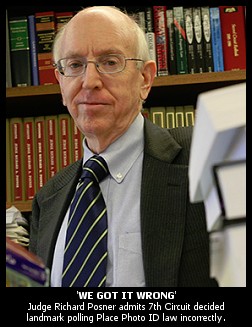
 This is nothing less than remarkable. The 7th circuit court judge who wrote the majority opinion in the landmark Crawford v. Marion County Election Board case, has now admitted he got it wrong!
“I think we did not have enough information,” Judge Richard Posner said in remarks at HuffPo Live today. “If the lawyers had provided us with a lot of information about the abuse of voter identification laws, this case would have been decided differently.”
Crawford is the Indiana polling place Photo ID restriction case that went to the U.S. Supreme Court where it was upheld in 2008. It is the case cited, usually inaccurately, by Republican advocates of such restrictions, who argue that such disenfranchising laws are not in violation of the U.S. Constitution. For example, it is the case cited (inaccurately) by TX Attorney General Greg Abbott, in his argument against the U.S. Dept. of Justice’s current lawsuit attempting to block the Lone Star State’s most recent attempt to institute that voting restriction at their polling places. “The U.S. Supreme Court has already ruled that voter ID laws do not suppress legal votes,” Abbott said misleadingly in response to the DoJ’s suit, as explained in detail last month by BRAD BLOG legal analyst Ernest Canning.
But, setting aside the misuse of SCOTUS’ very limited ruling on Crawford, the remarkable news today comes via UC Irvine election law professor Rick Hasen, who transcribes remarks made today by Judge Richard Posner, author of the original 7th circuit majority opinion in Crawford, now completely recanting his original opinion on the case!
Read this from Hasen. It’s amazing…
“Yes. Absolutely. And the problem is that there hadn’t been that much activity with voter identification. And … maybe we should have been more imaginative… we…. weren’t really given strong indications that requiring additional voter identification would actually disfranchise people entitled to vote. There was a dissenting judge, Judge Evans, since deceased, and I think he is right. But at the time I thought what we were doing was right. It is interesting that the majority opinion was written by Justice Stevens, who is very liberal, more liberal than I was or am…. But I think we did not have enough information. And of course it illustrates the basic problem that I emphasize in book. We judges and lawyers, we don’t know enough about the subject matters that we regulate, right? And that if the lawyers had provided us with a lot of information about the abuse of voter identification laws, this case would have been decided differently.â€
Here’s the quote from Posner’s book, which Mike Sacks flashed on the screen: “I plead guilty to having written the majority opinion (affirmed by the Supreme Court) upholding Indiana’s requirement that prospective voters prove their identity with a photo id—a law now widely regarded as a means of voter suppression rather than fraud prevention.”
We have written at enormous length and breadth over many years here at The BRAD BLOG about how polling place Photo ID restrictions disproportionately disenfranchise minority, student and elderly voters. (Again, see Canning’s most recent coverage of the DoJ’s latest case against Texas to get a small idea.) We’ve also reported, for years, on how Republicans attempting to institute these laws know that they will disenfranchise voters who tend to lean towards Democrats.
 By way of one example, in TX, according to the DoJ’s analysis of the state’s own data supplied to them, “Hispanic registered voters are more than twice as likely as non-Hispanic registered voters to lack such identification.” In South Carolina, where the DoJ blocked a similar law there last year under Section 5 of the Voting Rights Act, they found [PDF] that — again, according to the state’s own data — “minority registered voters were nearly 20% more likely to lack DMV-issued ID than white registered voters, and thus to be effectively disenfranchised” by the state’s new Photo ID restriction law.
For the most part, the only thing that GOP proponents of these laws have had to hang their hats on for all of these years, in regard to legal findings on this type of voter suppression law, has been the 2008 SCOTUS ruling upholding Crawford, though even that ruling never made a determination that Photo ID laws “do not suppress legal votes” as Abbott dishonestly argued recently in TX.
In its 2008 decision, the U.S. Supremes found only that Indiana’s version of the law did not disenfranchise voters “on its face”, as Canning reported, because the plaintiff attorneys “failed to offer evidence establishing that any voter would either be disenfranchised or unduly burdened by the state’s Photo ID restrictions. As a facial challenge, there was simply no evidence presented in the case to dispute the District Court’s finding that the Indiana statute did not impose an undue burden” on voters.
But the Court also left the door open for a case in the future that might include specific evidence of whether or not such laws, when instituted in places such as Texas — where it is very difficult for many voters (disproportionately minority voters, specifically) to obtain the requisite ID needed to vote under this type of restriction — actually disenfranchised voters. A future SCOTUS case, examining the actual effect of such laws, is almost certain.
Following the Supreme Court’s gutting of the Voting Rights Act over the summer Republican-controlled states have raced to implement polling place Photo ID restrictions in jurisdictions, such as TX and North Carolina, where it had been previously blocked by provisions of the VRA. States such as Pennsylvania and Wisconsin have long been attempting to enact such polling place restrictions as well, often citing the Crawford case as the precedent to allow them to do so.
Now, the very judge who wrote the ruling in the original case later approved by the U.S. Supreme Court is abandoning ship, and directly admitting he got it completely wrong. That the only case of note used by supporters of this kind of voting restriction has now been pretty much disowned by the judge who wrote its majority decision is simply a remarkable development in this years-long battle.
UPDATE 10/14/13: In comments below, Bill Groth, lead counsel for the Indiana Democratic Party in the Crawford case, takes some exception to our characterization of the evidence offered during the actual trial and, seemingly, to Posner’s characterization of it as well. See comments below for his response…
UPDATE 10/16/13: Posner says he is surprised by the response to his disavowal of his own Photo ID ruling, adding that he wasn’t “alert” to the extent of “trickery” used in elections these days. Details here…
UPDATE 10/28/2013: Rightwing smears Posner; Others say ‘we told ya so!’; Justice John Paul Stevens, who wrote controlling opinion in SCOTUS affirmation of Crawford, says he agrees with him that they all go it wrong. Details here…
UPDATE 10/29/2013: Seriously? Yes, seriously. Posner now attempts to recant his recantation!…










Crawford provides a classic example of how appellate courts can produce bad law when attorneys at the trial level fail to develop an adequate factual record.
Justice Stevens, in his Supreme Court opinion, noted that the Crawford plaintiffs failed to offer any evidence either that otherwise lawful voters would be disenfranchised or that the Act imposed an undue burden.
While cases we’ve covered in WI, PA, TX and SC contain ample evidence that warrant a different result, Judge Posner is suggesting that evidence exists suggesting that even Indiana’s Photo ID law should be regarded as unconstitutional.
That’s a rather remarkable statement by a sitting appellate judge, and, quite frankly, one that he perhaps should not have publicly discussed in this manner given that the issue could come back before him if someone were to file an as applied challenge to the Indiana Photo ID law.
Remember our friends in Alabama, held hostage by the GOP…
http://legalschnauzer.blogspot.com.br/
Another blog for yer perusal…Good stuff
http://www.youaredumb.net/
Huge news.
The so-and-sos in Wisconsin often point to Crawford, saying right after their ‘photo-voter-is-a-common-sense-reform’ BS that Crawford has already definitively spoken on the constitutionality of photo voter ID.
No mention that Crawford was a facial challenge; and I would bet there will be no mention of Justice Posner’s comments you cite in the coming days.
The two cases challenging Wisconsin’s voter ID law in fed court begin on November 4.
See http://moritzlaw.osu.edu/electionlaw/litigation/Frank.v.Walker.php
I served as lead counsel for the Indiana Democratic Party in Crawford and write to respond to Mr. Canning’s apparently uninformed comments suggesting that the record in Crawford contained no evidence that any voter had been or would be harmed by Indiana’s new ID requirements. Though my client brought this suit as a pre-enforcement facial challenge, it is untrue to state or imply that the record contained no evidence from or about voters who’d be disenfranchised or unnecessarily burdened by the law’s requirements. If anyone would take the time to review the voluminous record of affidavits, deposition transcripts, and declarations submitted in support of our summary judgment motion, as well as by the ACLU which represented several individuals and associations, it will be obvious that the problem with Posner’s ruling was not the lack of evidence but that, as he now concedes, he applied the wrong legal standards, including a too strict burden on the Plaintiffs and no burden whatsoever on the State to prove that the “problem” the State sought to ameliorate (imposter voting) existed. He also made no effort to inquire whether the new law would unnecessarily burden or even disenfranchise more voters than the number of imposters it would deter or detect. Not only did the record before the district court, which is accessible at no cost here, include a large number of affidavits from voters who did not have and would be unable to obtain a photo ID, it included expert testimony including from a renowned political scientist at Indiana University who opined, without contradiction, that this law would increase the costs associated with voting and thus have an adverse impact on turnout.
Judge Posner’s admission of errer is indeed a stunning one. Had he switched his vote, the Indiana law would have been declared unconstitutional, and the odds that SCOTUS would have granted cert. would have declined exponentially, given Posner’s prodigious reputation. In short, there would have been no Crawford decision handed down by SCOTUS in 2008 and many other voter suppression laws subsequently enacted would not have enjoyed the broad license many now (though wrongly) claim Crawford provides.
Re Bill Groth @4.
I haven’t actually reviewed the lengthy trial record. To the extent that the record reflects otherwise, I would agree that my comment was under-informed, and you have my apologies for that, sir.
My comments as to the inadequacy of the record were based on those offered by Justice Stevens in his lead opinion in the SCOTUS decision in Crawford, to wit:
…
Further, the deposition evidence presented in the District Court does not provide any concrete evidence of the burden imposed on voters who currently lack photo identification.
In sum, on the basis of the record that has been made in this litigation, we cannot conclude that the statute imposes “excessively burdensome requirements” on any class of voters. The record includes depositions of two case managers at a day shelter for homeless persons and the depositions of members of the plaintiff organizations, none of whom expressed a personal inability to vote under SEA 483. A deposition from a named plaintiff describes the difficulty the elderly woman had in obtaining an identification card, although her testimony indicated that she intended to return to the BMV since she had recently obtained her birth certificate and that she was able to pay the birth certificate fee.
Judge Barker’s opinion makes reference to six other elderly named plaintiffs who do not have photo identifications, but several of these individuals have birth certificates or were born in Indiana and have not indicated how difficult it would be for them to obtain a birth certificate…One elderly named plaintiff stated that she had attempted to obtain a birth certificate from Tennessee, but had not been successful, and another testified that he did not know how to obtain a birth certificate from North Carolina. The elderly in Indiana, however, may have an easier time obtaining a photo identification card than the nonelderly…and although it may not be a completely acceptable alternative, the elderly in Indiana are able to vote absentee without presenting photo identification.
The record says virtually nothing about the difficulties faced by either indigent voters or voters with religious objections to being photographed…
In sum, on the basis of the record that has been made in this litigation, we cannot conclude that the statute imposes “excessively burdensome requirements” on any class of voters.
While the actual trial record may, as you suggest, Mr. Groth, substantiate that “the problem with Posner’s ruling was not the lack of evidence,” that conclusion is inconsistent with the reasons given for Judge Posner’s newly announced confession of error in Crawford.
In recanting his earlier decision, Posner said: “we…weren’t really given strong indications that requiring additional voter identification would actually disfranchise people entitled to vote.”
In short, where you are suggesting that Posner is simply admitting a legal error, Posner claims that the error was based upon an inadequate record.
This is a story about someone who did something and now he regrets it. It’s bogus for him to blame the legalities.
There is no way for an educated and experienced judge to misunderstand the point of these voter ID laws, and who wants them, and what they are supposed to do.
He did the wrong thing, he probably know it at the time, and now that the politics around this stuff is really starting to metastasize, he doesn’t want his name attached to it.
Not a profile in courage here folks.
Robert LaFollette of Wisconsin must be ashamed of those Wisconians that support voter ID laws, a state that has been at the front of fairness, honor and dignity. He is probably wondering how so few could do away with the ideas this country, and his state in particular, have led the nation in fairness, honor and dignity
Posner is un-repentant because he still refuses to tell the truth. A person who can do what he did and has to at least tell the truth in order to repent, right judge?
Gosh, I’m so sorry now that I let the dogs out last week, and they’ve been running around the neighborhood biting people ever since, and nobody can do anything anymore.
Golly-Gee, I’m so regretful, and I would make a different decision now, but it’s too late.
I’m so sorry I let the dogs out.
They were rabid and aggressive, and I thought it would be good for their health.
Who thought anything bad could happen?
Please forgive me.
Thank you all very much for your kindness.
I would agree with Bill Groth @4 that I had erred in suggesting that he presented “no” evidence of voter disenfranchisement and undue burden. That said, I would note that former Supreme Court Justice John Paul Stevens, who authored the lead opinion in Crawford agrees with my assessment that Groth failed to develop an adequate trial record.
Rick Hasen’s Election Law blog reports [emphasis added):
“I have always thought that David Souter got the thing correct, but my own problem with the case was that I didn’t think the record supported everything he said in his opinion,” said Justice Stevens, who retired in 2010. “He got a lot of stuff off the Internet and inferred things and so forth.†But “as a matter of actual history, he’s dead right. The impact of the statute is much more serious†on poor, minority, disabled and elderly voters than evidence in the 2008 case demonstrated, he said.
Recall, also, that we took TX Attorney General Greg Abbott (R) to task for his statement that the “Supreme Court has already ruled that voter ID laws do not suppress legal votes…”
Stevens validates our claim that “the U.S. Supreme Court never ruled Photo ID laws ‘do not suppress legal votes.’“
EAT THAT TONY! You unconstitutional mob bastard/bitch.
An fer any one who’s wonderin ,that would be the dishonorable scalia.