 Today, President Obama offered an address to mark the fifth anniversary of the Lehman Brothers bankruptcy and the beginning of the 2008 collapse of the Wall Street casino or, as the President described it, “the worst economic crisis of our lifetimes.” (He also spoke briefly, at the top of his remarks, on our latest mass shooting rampage which took place at the Washington D.C. Navy Yard this morning, reportedly resulting, in the deaths of at least 12 people at the military installation.)
“It was five years ago, this week, that the financial crisis rocked Wall Street, and sent an economy already into recession, into a tail spin,” Obama reminded us. “And it’s hard sometimes to remember everything that happened during those — those months, but in a matter of a frightening few days and weeks, some of the largest investment banks in the world failed, stock markets plunged, banks stopped lending to families and small businesses, our auto industry — the heartbeat of American manufacturing — was flat-lining.”
The President went on to tout the reforms and the recovery that have taken place since that time, arguing that “we’ve cleared away the rubble from the financial crisis and we’ve begun to lay a new foundation for economic growth and prosperity,” while conceding “we are not yet where we need to be.”
“Most of the gains have gone to the top one-tenth of 1 percent,” Obama correctly noted. “So, in many ways, the trends that have taken hold over the past few decades of a winner-take-all economy, where a few do better and better and better, while everybody else just treads water or loses ground, those trends have been made worse by the recession.”
Over the weekend, the 40-year old advocacy group, Public Citizen, marked the same occasion of the fifth anniversary of the 2008 crash with an email blast highlighting a few numbers the President did not highlight in his remarks today, including a few jarring stats that remind us how and why, despite the modest recovery and incredibly tepid reforms of the past five years, the “too big to fail” foxes still remain firmly in charge of America’s economic hen house…
- Amount the crash cost the U.S. economy: $22 trillion
- Assets of the four biggest banks in America — JPMorgan Chase, Bank of America, Citigroup and Wachovia/Wells Fargo — when they were “too big to fail†in 2008: $6.4 trillion
- Assets of those four banks today: $7.8 trillion
- Of the 63 former Lehman Brothers employees identified by a bankruptcy examiner as being aware of an accounting scheme Lehman used to mask its true finances, number who are employed in senior financial services positions today: 47
- Number of the 25 banks responsible for the bulk of risky subprime loans leading up to the crash that are back in the mortgage business: 25
- Chances that an American voter thinks that regulating financial products and services is “important” or “very important”: 9 in 10
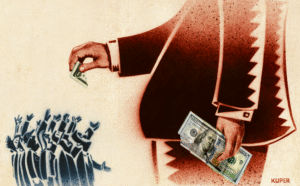
- Amount spent in 2012 by Wall Street and other finance industry behemoths on lobbying to roll back, water down and weasel out of the Dodd-Frank Wall Street Reform and Consumer Protection Act: $487 million
- Number of registered financial industry lobbyists in 2012: 2,429
- Number of lawsuits filed as of April of this year by Eugene Scalia, son of U.S. Supreme Court Justice Antonin Scalia, to hold up implementation of Dodd-Frank rules on legal technicalities: 7
- Rank of finance industry among all corporate election spending by sector in 2011 and 2012: 1







Hmmmmmmmmmmmmmm, Democracy vs corptocracy? Ill take clean and eco-financial sustainability, thank you. When the financial world has not clue one how even they will be effected by their bs, I have a problem with who is sustaining the train.
Crickets?
Well, here’s something to chew on…energy and food are being controlled by just a few when many starve. I don’t know about you, but I can’t sit still with that.
Here is sumpin you can do, don’t buy big labels. You can demand real small american companies provide you with your needs. Then, when these beasts listen, buy with best practices in mind.
GREATEST SUMMATION ON AMERICAN POLITICS
” Suppose a small group of extremely wealthy people sought to systematically
destroy the U.S. government by (1) finding and bankrolling new
candidates pledged to shrinking and dismembering it; (2) intimidating or
bribing many current senators and representatives to block all proposed
legislation, prevent the appointment of presidential nominees,
eliminate funds to implement and enforce laws, and threaten
to default on the nation’s debt; (3) taking over state governments in
order to redistrict, gerrymander, require voter IDs, purge voter rolls,
and otherwise suppress the votes of the majority in federal elections;
(4) running a vast PR campaign designed to convince the American public
of certain big lies, such as climate change is a hoax, and (5) buying up
the media so the public cannot know the truth. By Robert Reich
Would you call this treason?
If not, what would you call it? “